-
INTRODUZIONE AL PANTHEON PLATONICO
Il Pantheon è uno dei principali e più famosi monumenti antichi al mondo. Ogni anno milioni di persone fanno file, sempre più lunghe, per potere entrare velocemente a vedere il tempio circolare.
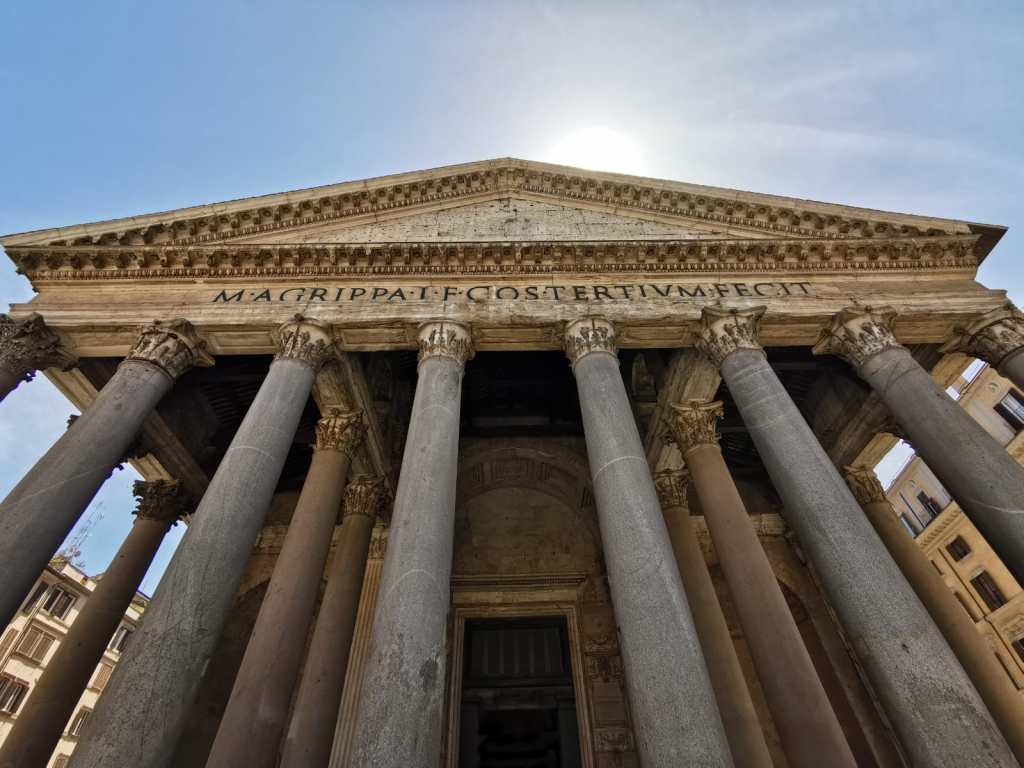
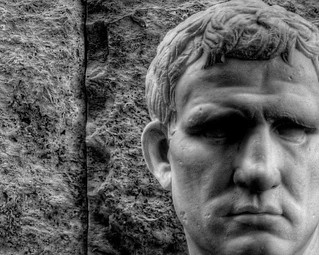
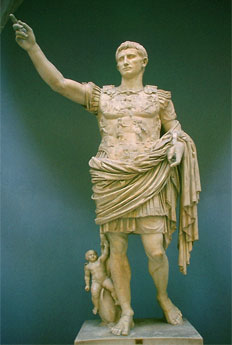
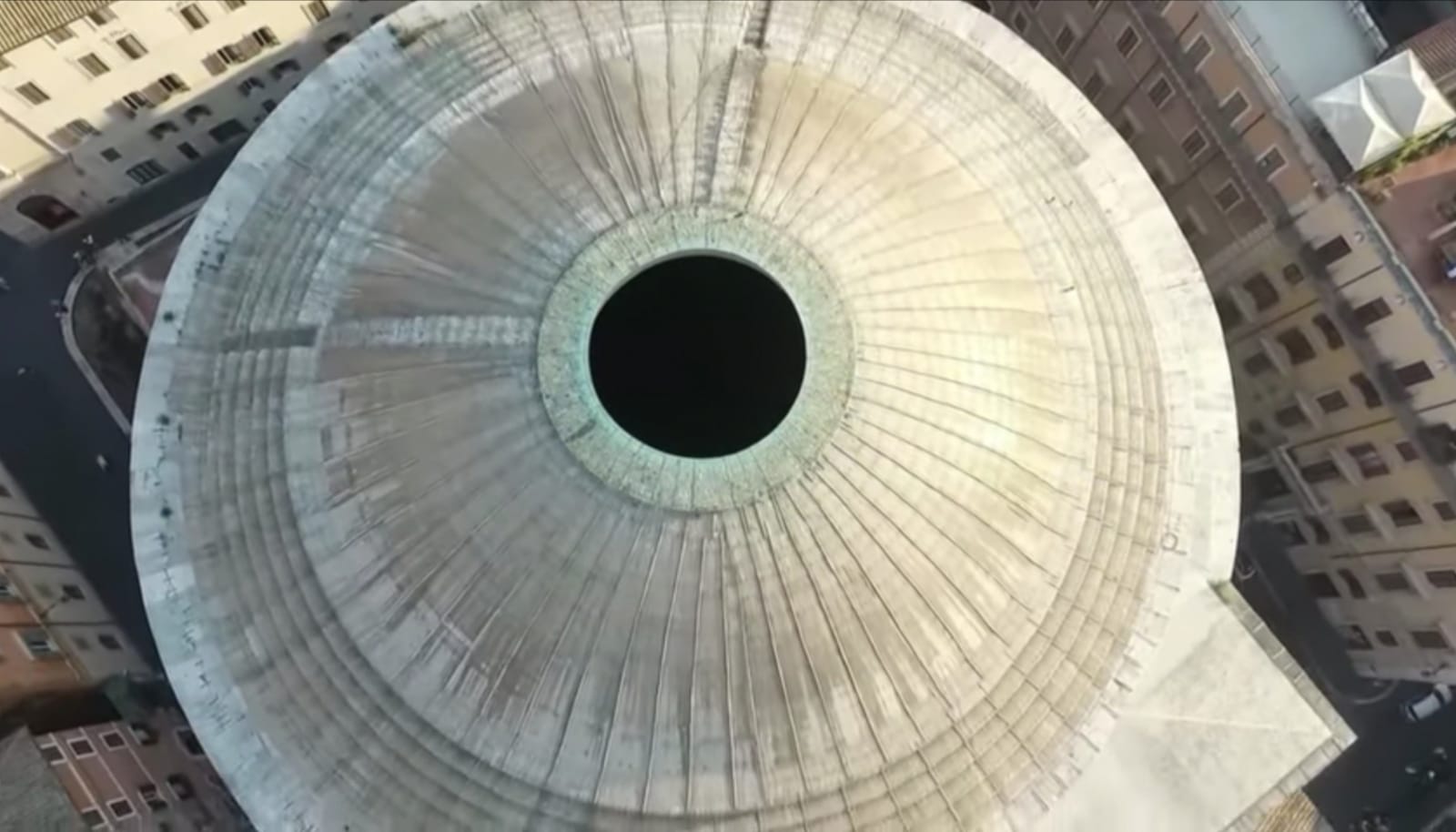
Nel frontone reca ancora l’attribuzione di esso al suo costruttore Marco Vipsanio Agrippa, amico dell’imperatore Ottaviano Augusto: da secoli è stato studiato, ma ancora nessuno è stato in grado di comprendere a che cosa servisse e perché esso avesse questa strana forma circolare. Né è stato compreso il senso della cupola con il suo buco al centro.
In questo articolo tenteremo di dare una spiegazione.
Per fare ciò ci leveremo gli occhiali moderni e tenteremo di vedere il mondo per come lo vedevano gli antichi.
Per prima cosa vediamo all’interno del tempio un simbolo stellare.
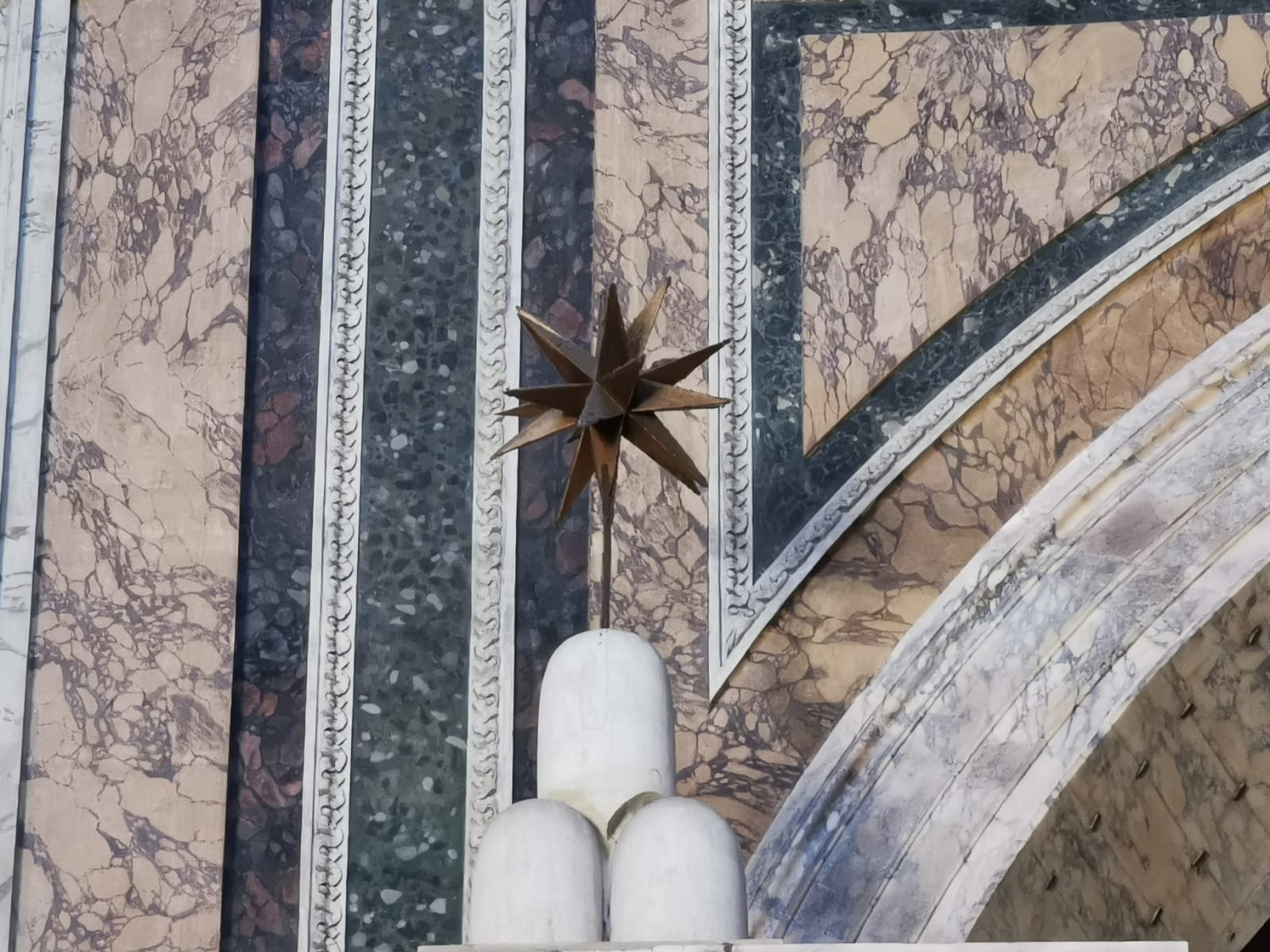
Di rassomiglianza al cielo parlavano fonti coeve come Dione Cassio e Ammiano Marcellino.
Ipotizziamo, dunque, che esso possa essere servito a finalità legate in qualche modo agli astri.
D’altronde, per come noto, l’imperatore Ottaviano venne ufficialmente dichiarato asceso agli astri con deliberazione del Senato del 17 settembre dell’anno 767 Ab Urbe Còndita (14 Dopo cristo).
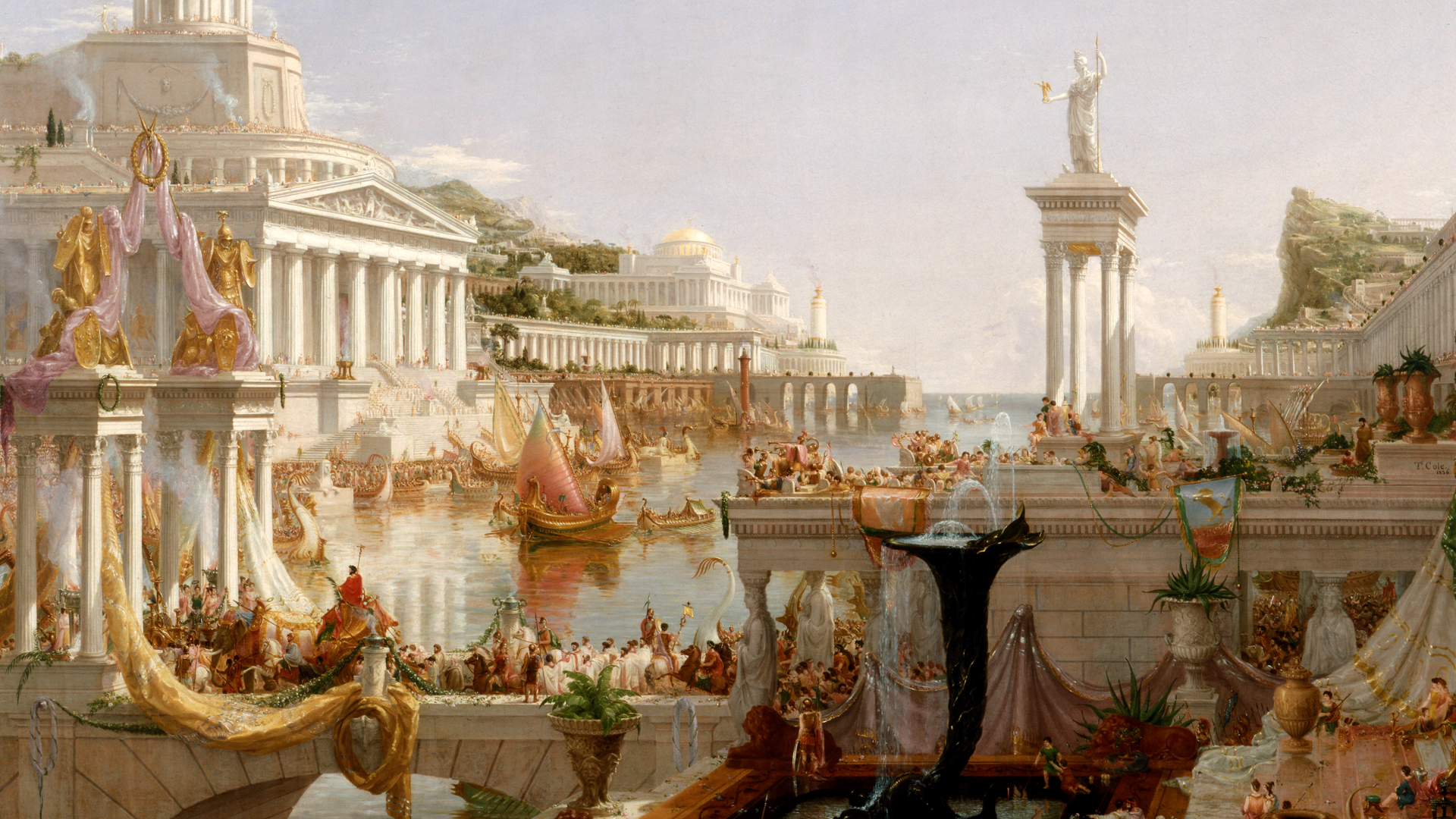
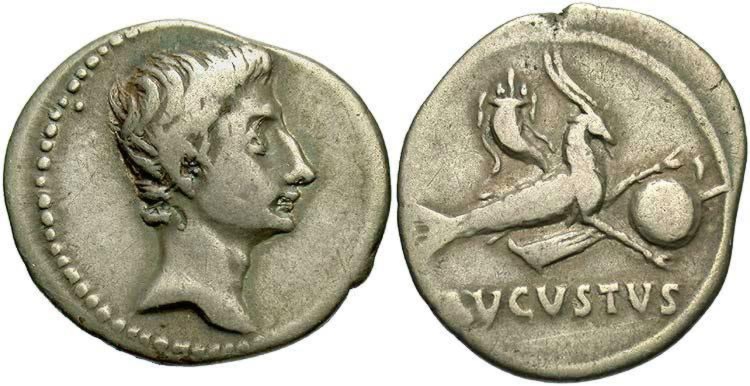
Qui la foto di una moneta augustea che ritrae la costellazione del Capricorno, quale simbolo dell’aurea aetas di Saturno, dicono gli studiosi. Secondo noi rappresentava invece la porta degli dei per l’ascesa stellare, sita nel segno del capricorno e narrata da Omèro nell’Odissea, prima, e poi da Porfirio nel “Antro delle Ninfe”. Altrettanto la gemma augustea, qui raffigurata, porta accanto all’imperatore il segno del Capricorno.
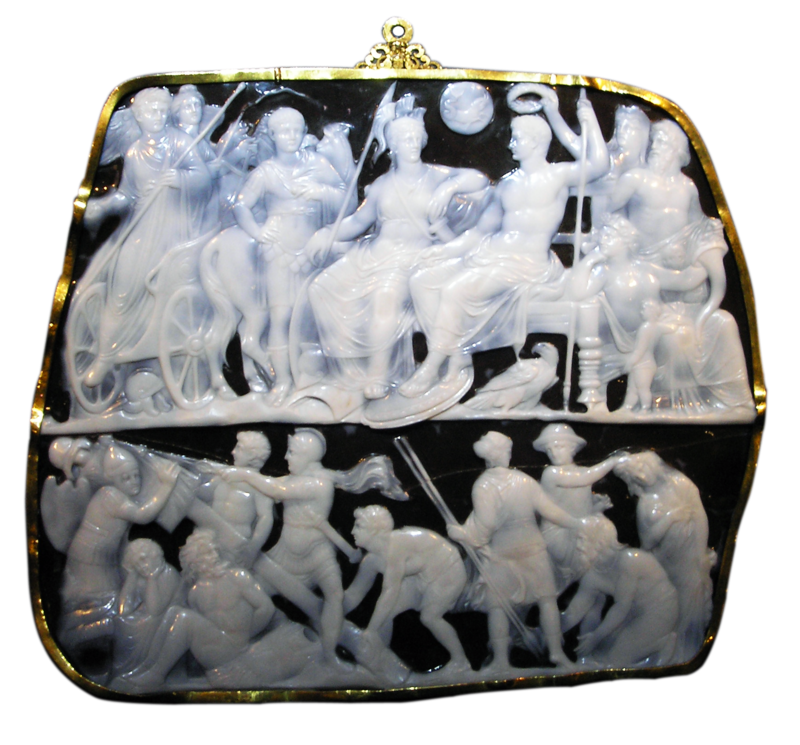
L’ascesa dell’imperatore era, dunque, solo propaganda politica? Lo scopriremo tra poco. Cominciamo con chiederci che cos’era il Mondo per gli antichi?
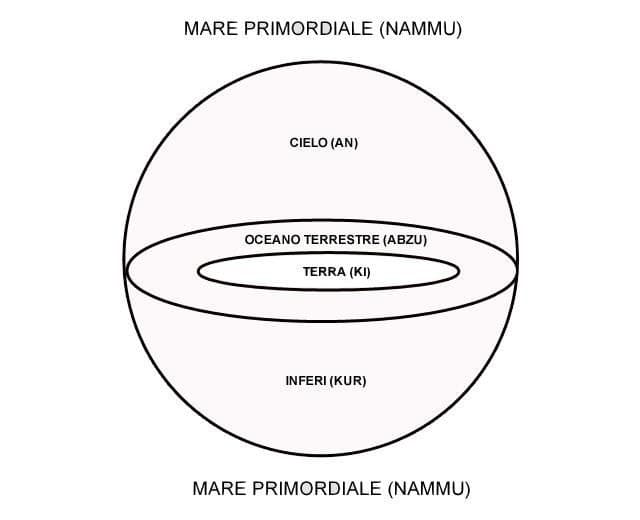
Qua vediamo la visione antica dei sumeri. Il mondo era per loro costituito da una sfera, composta dalla cupola del cielo (di an) , dalla terra (di ki) e dall’oceano terrestre (di abzu) al centro lungo l’equatore della sfera. Sotto gli inferi (di kur). La sfera era a sua volta circondata dal mare primordiale (di Nammu).
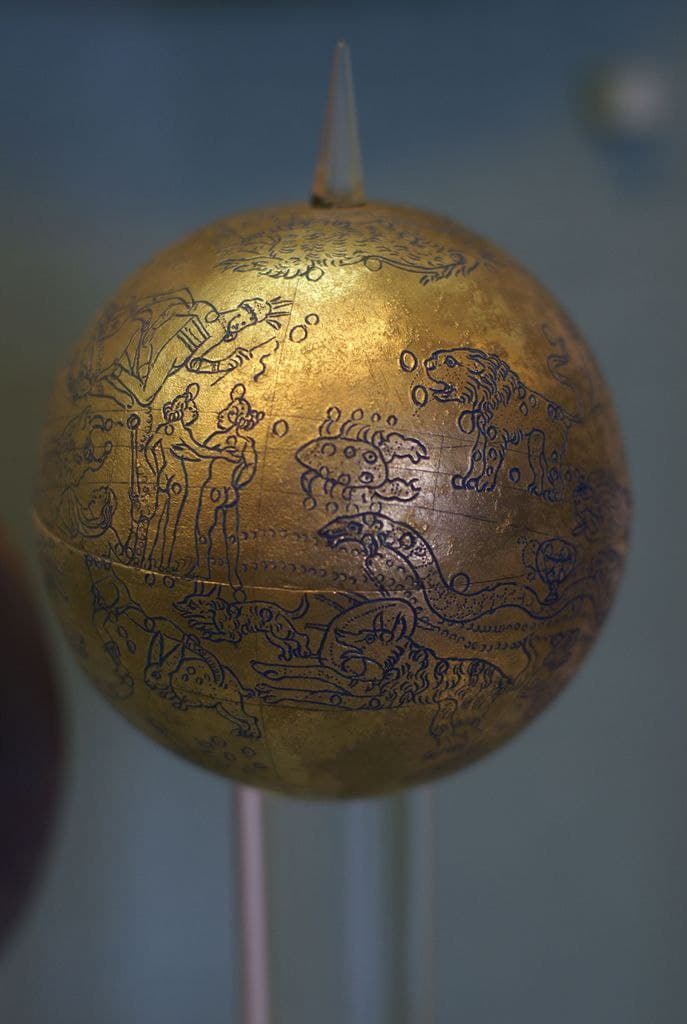
Il firmanento che circondava la sfera era adornato lungo tutta la sua circonferenza da costellazioni, per come visibile nel mappamondo di epoca Romana custodito a Mainz in Germania).
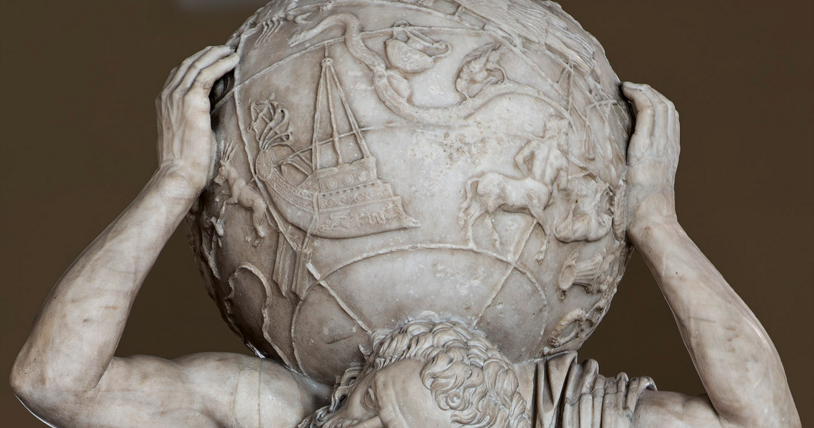
Anche la famosa statua di Atlante che sorregge la sfera del mondo mostra che sulla circonferenza di essa sono visibili le costellazioni.
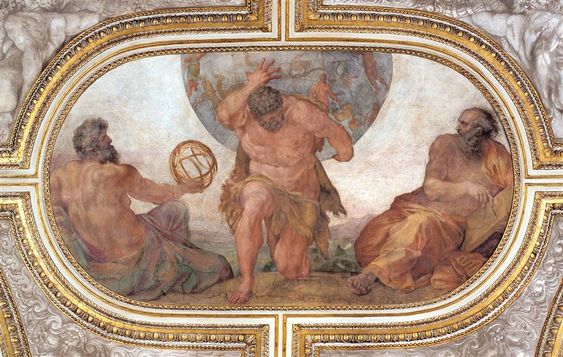
Similmente, nel dipinto di Annibale Carracci, Atlante sostiene il mondo con le costellazioni ritratte sopra di esso, nel firmamento.
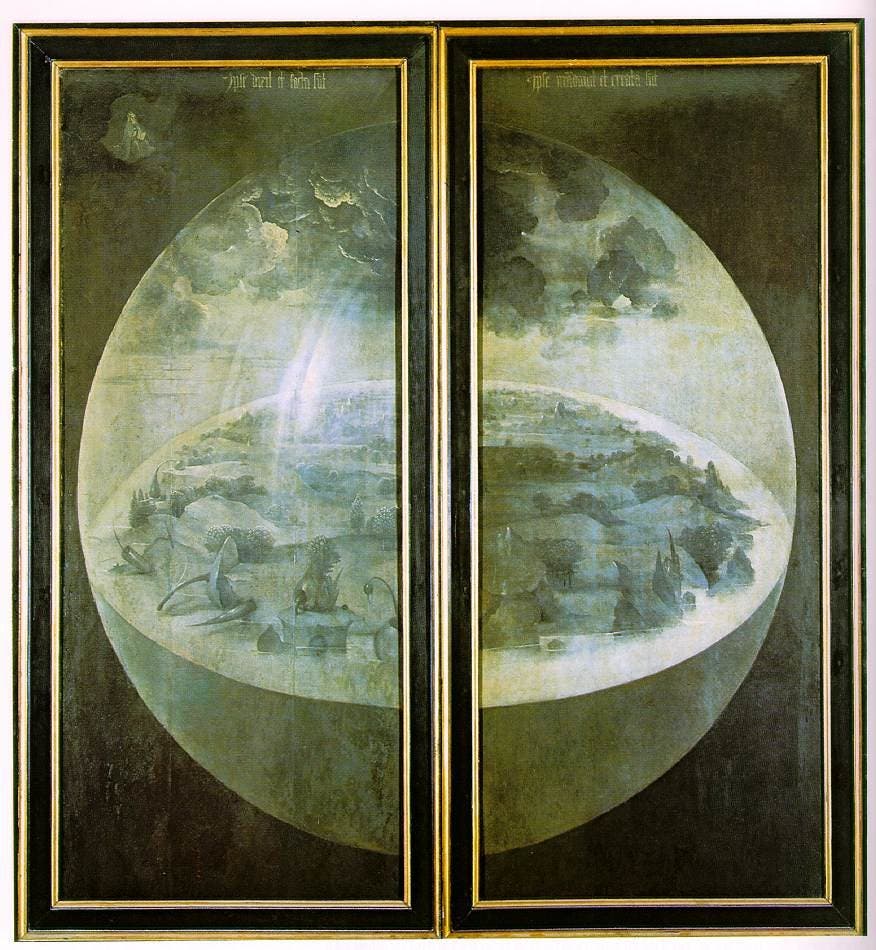
Notiamo, dunque, una differenza fondamentale: la terra non seguiva la circonferenza della sfera diventando sferica a sua volta, ma era stazionaria piana sull’equatore della sfera. il dipinto “Il giardino delle delizie terrestri” di Bosch, aiuta a capire meglio il concetto.
Il cielo, costituito da una cupola emisferica sopra e da una sotto era ripartito in 12 costellazioni che giravano attorno alla terra insieme ai sette astri, ovvero Saturno, Giove, Marte, Mercurio, Venere, Sole e Luna per come visibile in questo calendario astrologico lunare romano o in questo mosaico romano dello zodiaco.
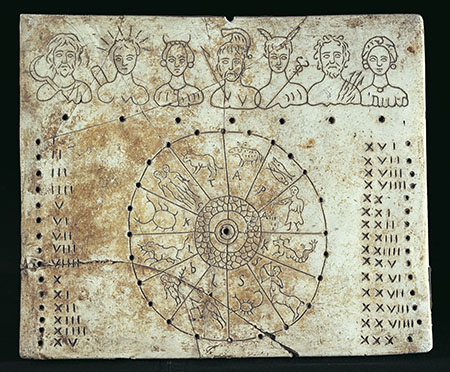
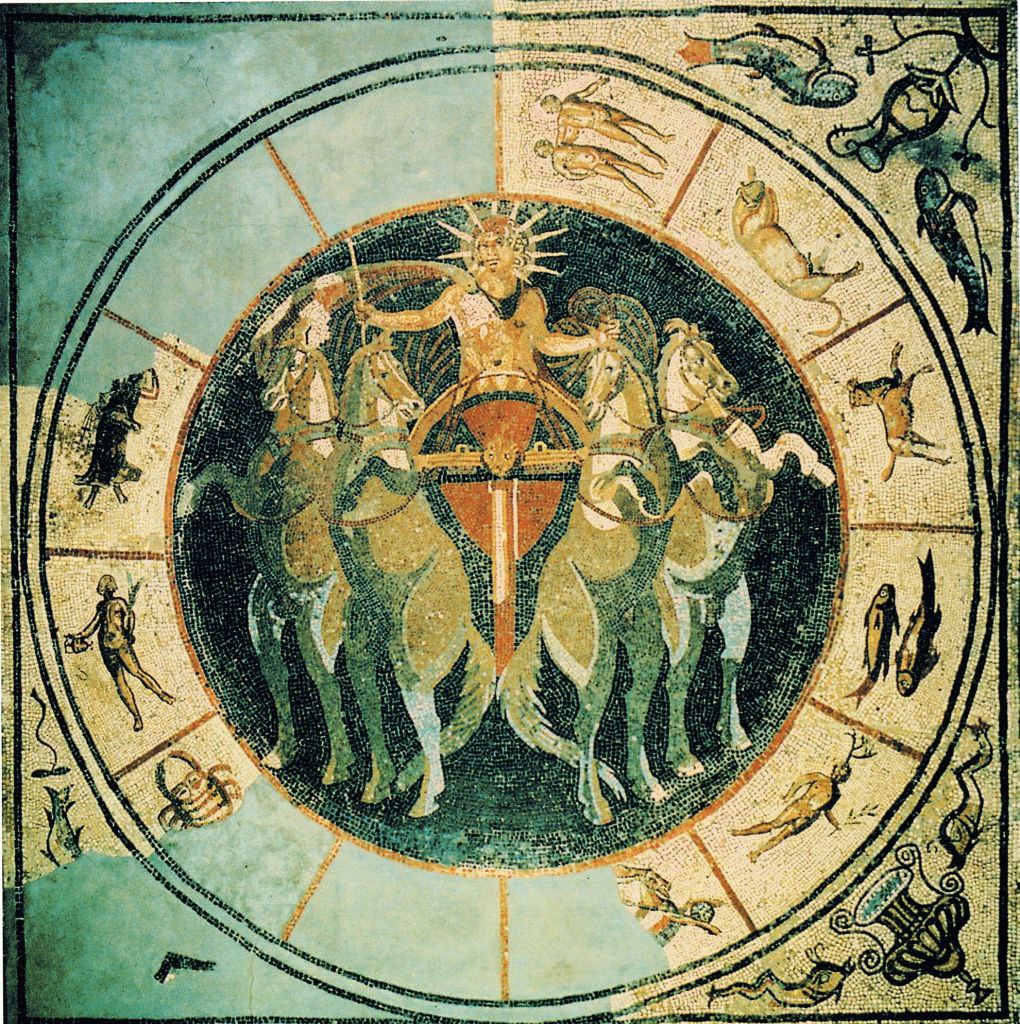
Dicevamo che nella concezione sumera la sfera era a sua volta circondata dal mare primordiale chiamato Nammu. Vediamo le acque dell’oceano sopra il firmamento e le nuvole nella raffigurazione uno sketch di Cosmas un modello dell’universo.
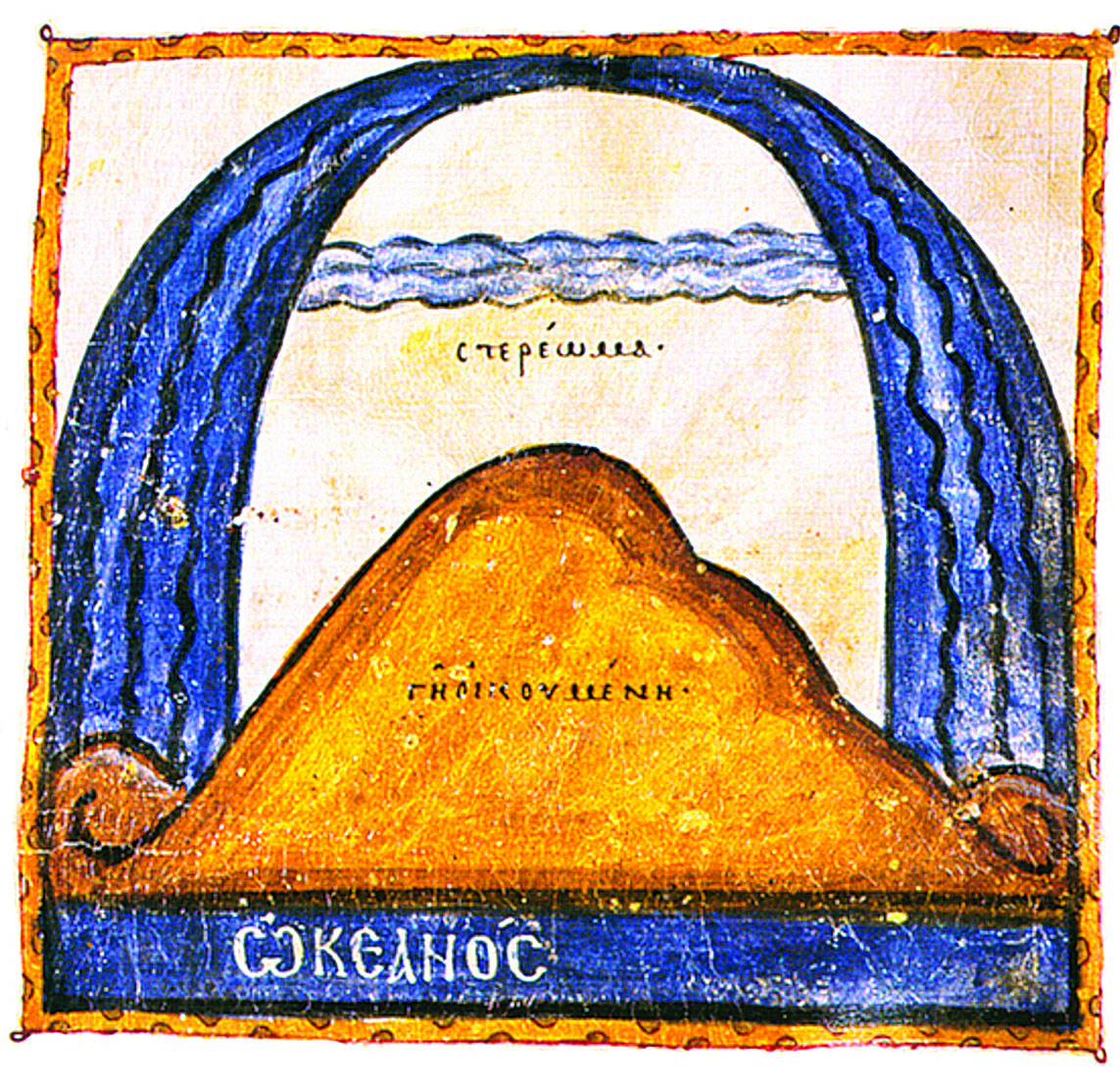
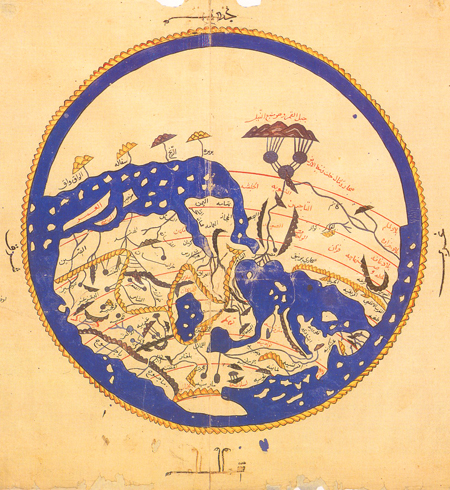
La terra stava piana all’equatore del mondo, dicevamo, per come visibile in questa mappa araba della Terra realizzata dal geografo Idrisi nel secolo undicesimo.
Essa era ripartita in varie suddivisioni climatiche per come visibile nel “Ymago mundi et tractatus alii” di Pierre d’Ailly e poi nella mappa di Sacrobosco.
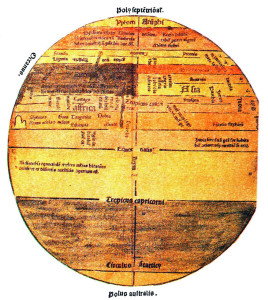
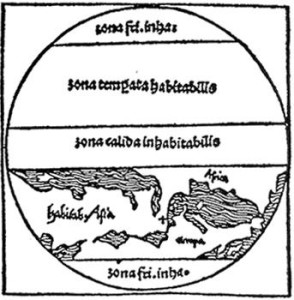
Per capire meglio la differenza tra mondo e terra e la divisione tra le aree del cielo sarà utile fare riferimento alla vasta iconografia cristiana medievale prima della cosiddetta rivoluzione copernicana, che in massima parte ha creato quegli occhiali che ci impediscono di capire il mondo antico.
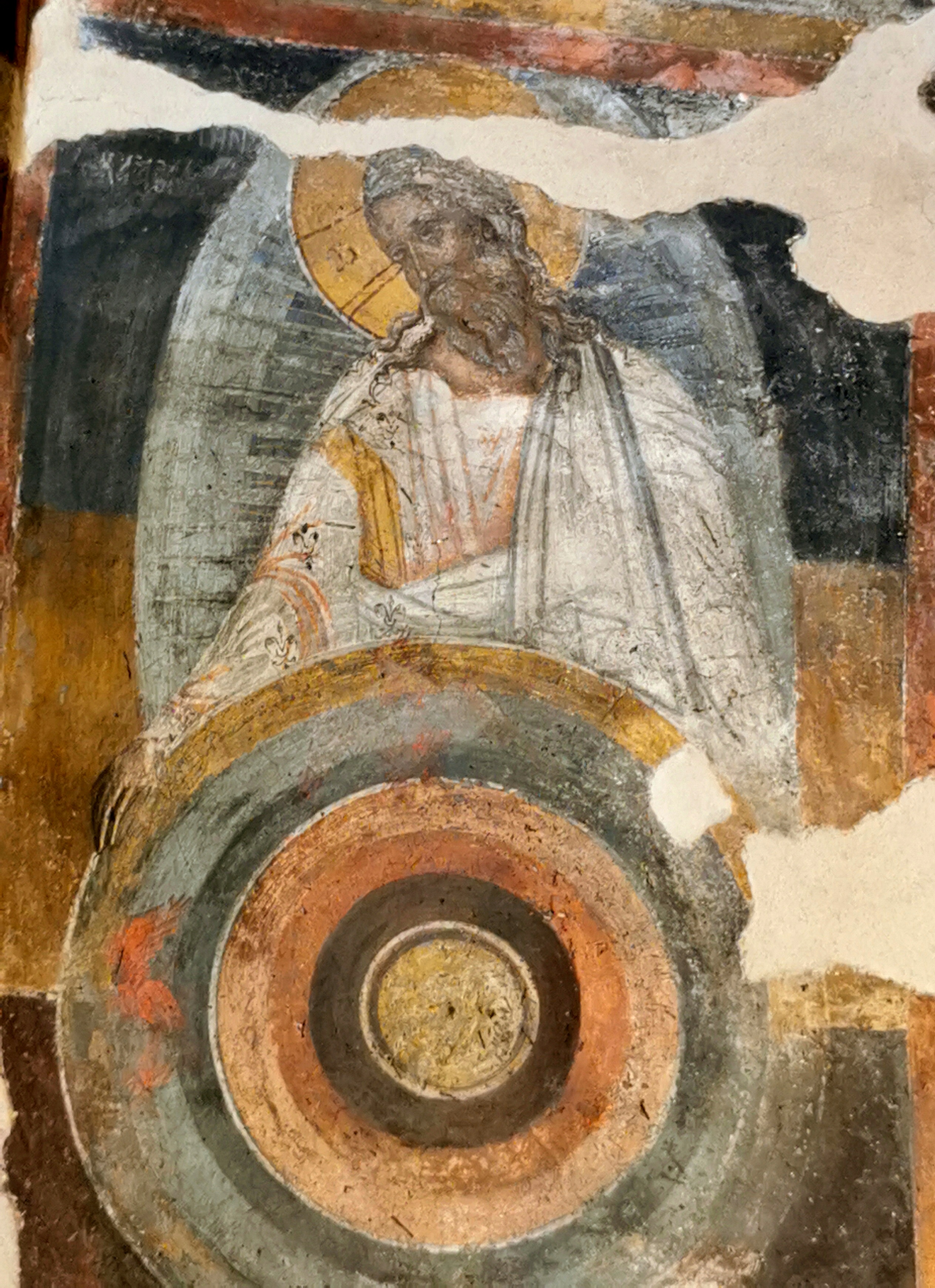
Nella Chiesa della dormizione della Theotokos di Askilipio, Rodi, Grecia troviamo degli affreschi murari del nono secolo che ci possono bene condurre:
Il primo riguarda la creazione del mondo con i sette cieli da parte del Cristo, il secondo tratta della creazione della Terra, ove la creazione della Terra e’ distinta da quella del Mondo.
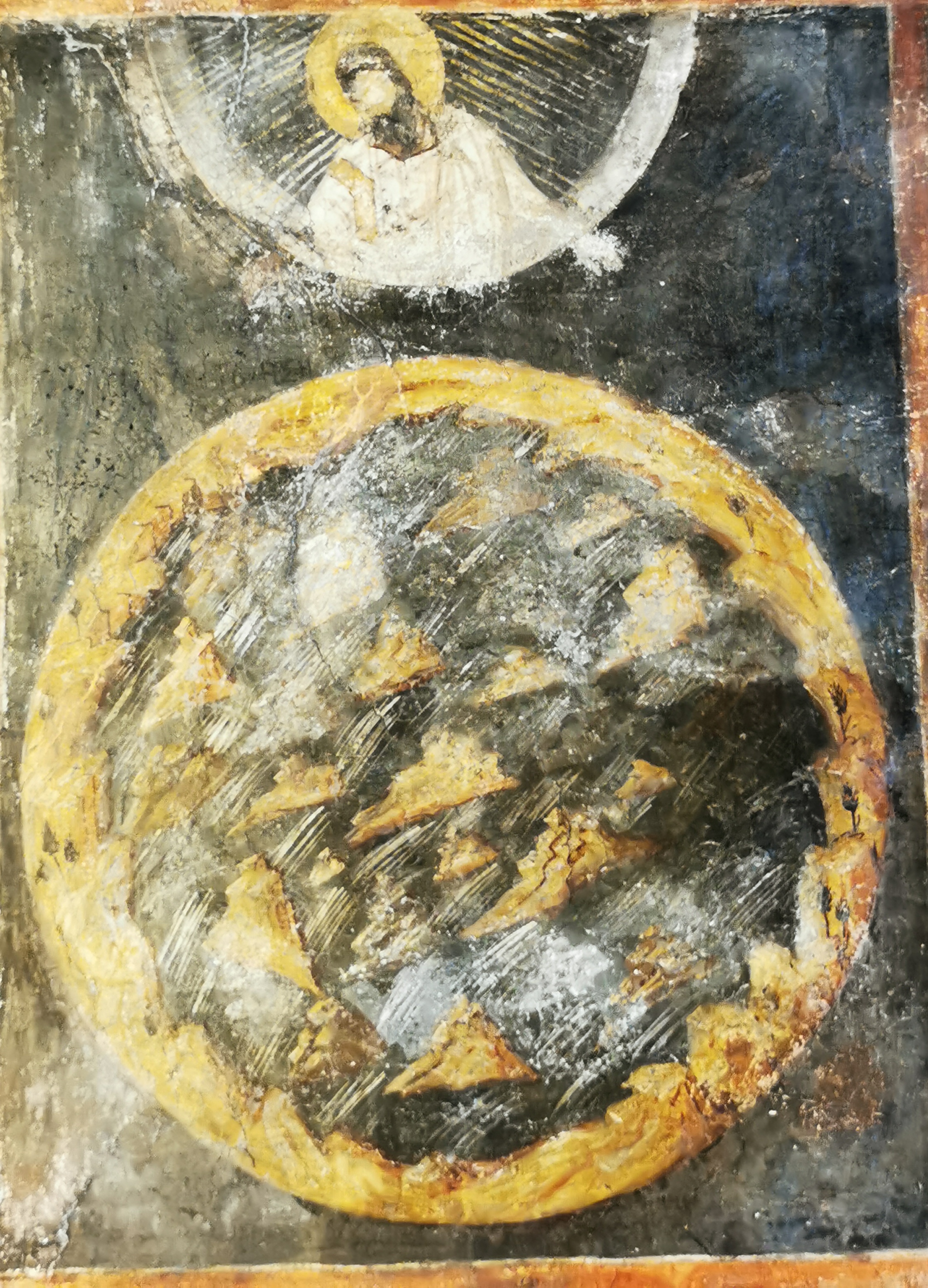
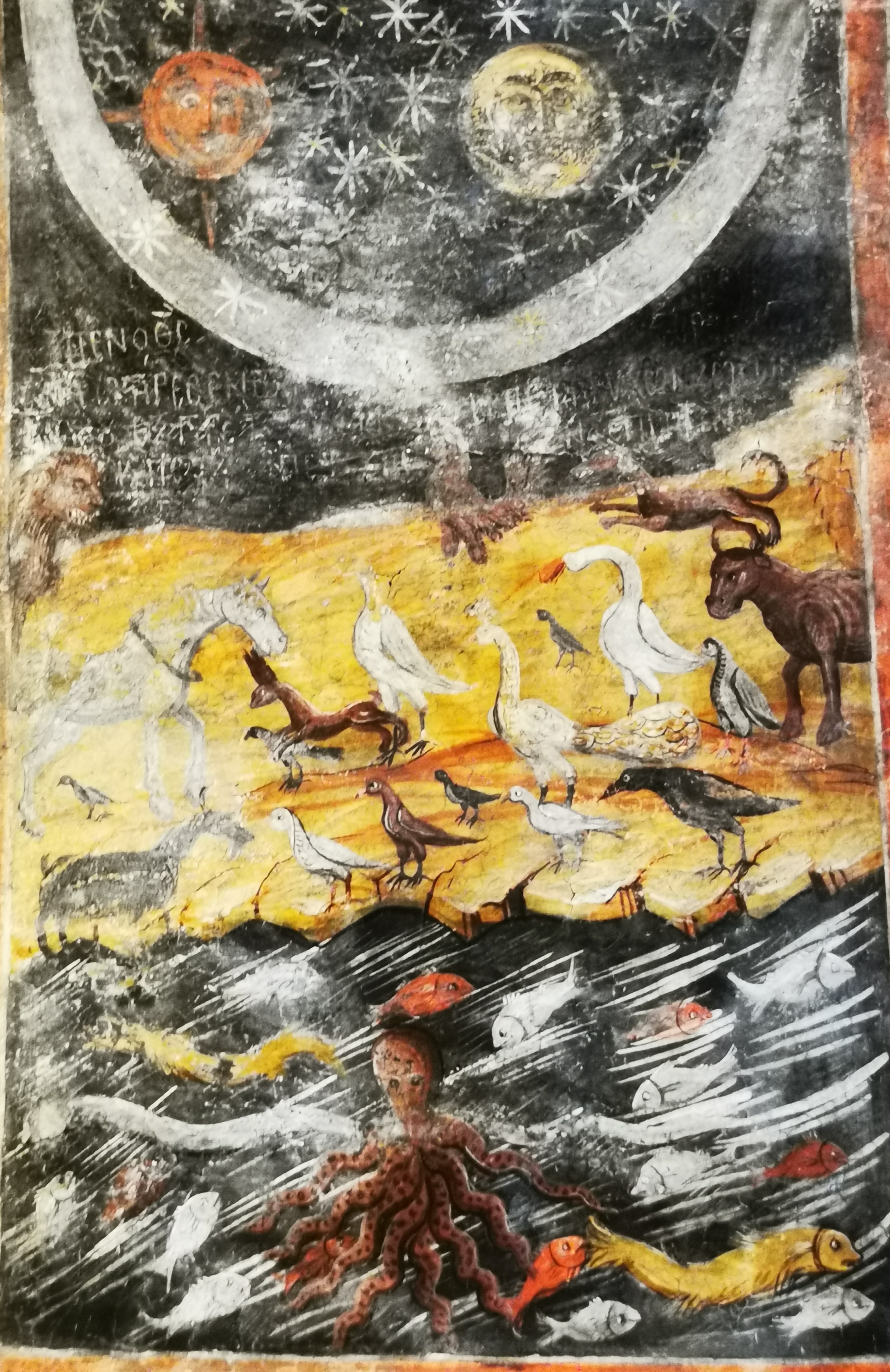
Infine, la creazione del Sole e della Luna e poi degli animali, dopo la creazione del Mondo e della Terra.
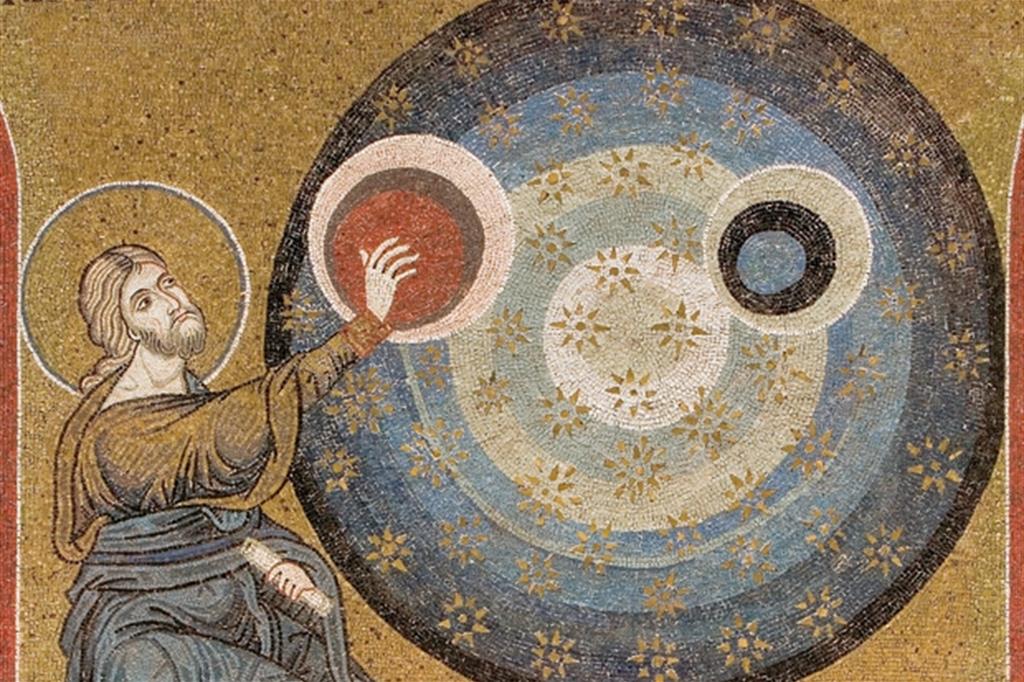
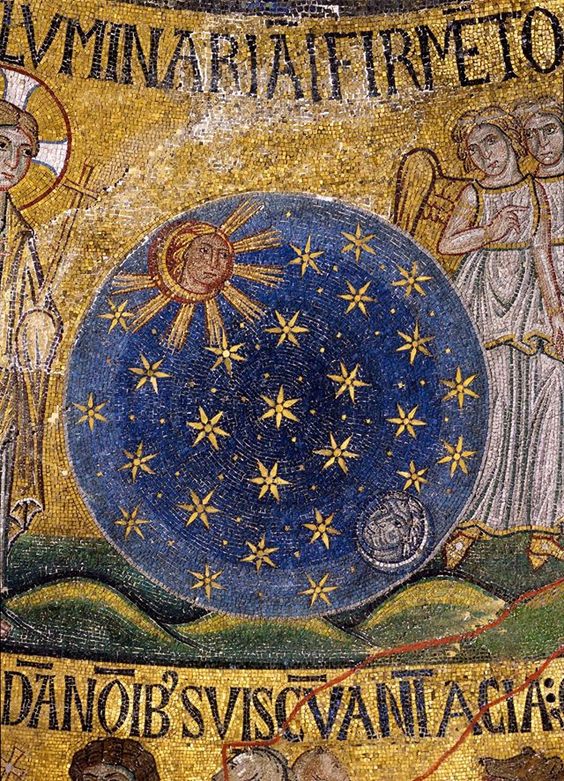
Nell’altra creazione del mondo in mosaico, del tredicesimo secolo a Venezia, basilica di San Marco, si può notare la sfera del Mondo con all’interno, Stelle, Sole e Luna.
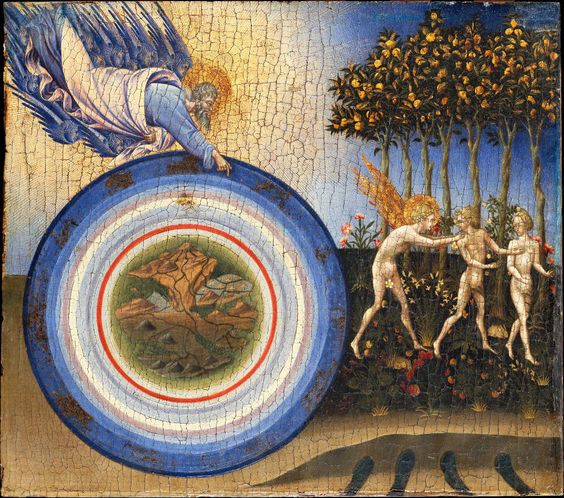
Ancora più utile il dipinto di Giovanni di Paolo, “Creazione del mondo e cacciata dal paradiso”, ove si possono vedere, attorno alla terra posta al centro, i sette cieli successivi alla sfera del fuoco e, ultima, l’ottava sfera stellata (con i simboli delle costellazioni) chiusa dal firmamento con il cerchio più scuro.
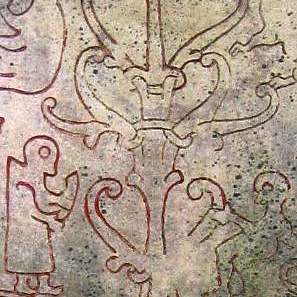
Un altro tema della grande differenza concettuale tra la concezione geografica del mondo antico e quello moderno è quello dell’axis mundi, asse del mondo, ovvero dell’asse attorno a cui girava il firmamento. Tale asse è stato denominato Yggdrasill dalle popolazioni del nord-Europa e scandinave, in particolare. Qua vediamo l’Yggdrasill in una copia di una runa in Svezia.
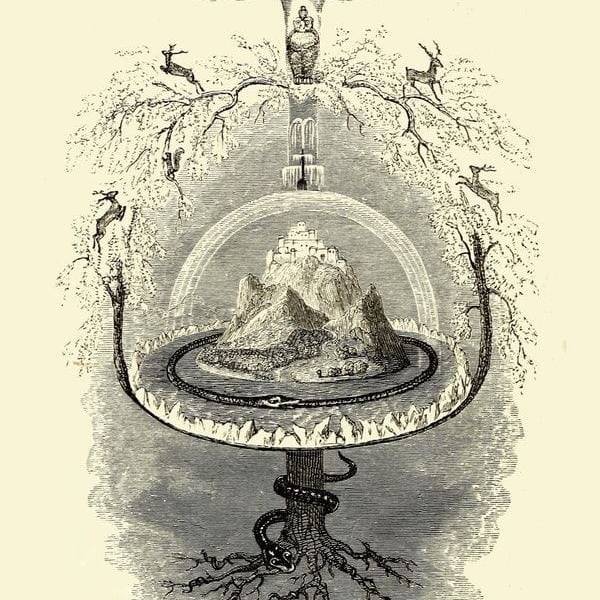
In un’altra riproduzione artistica dell’albero del Mondo Yggdrasill sono da notare le radici, tanto nel Cielo quanto nella Terra. L’apparato radicale stellare è denominato delle stelle beheniane, ovvero delle stelle radici dell’albero della vita, dall’arabo bahman, radice, dal momento che ciascuna di esse era considerata una fonte di energia astrologica per uno o più pianeti.
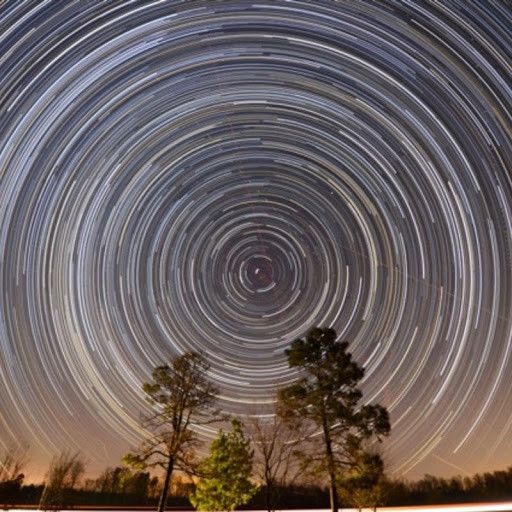
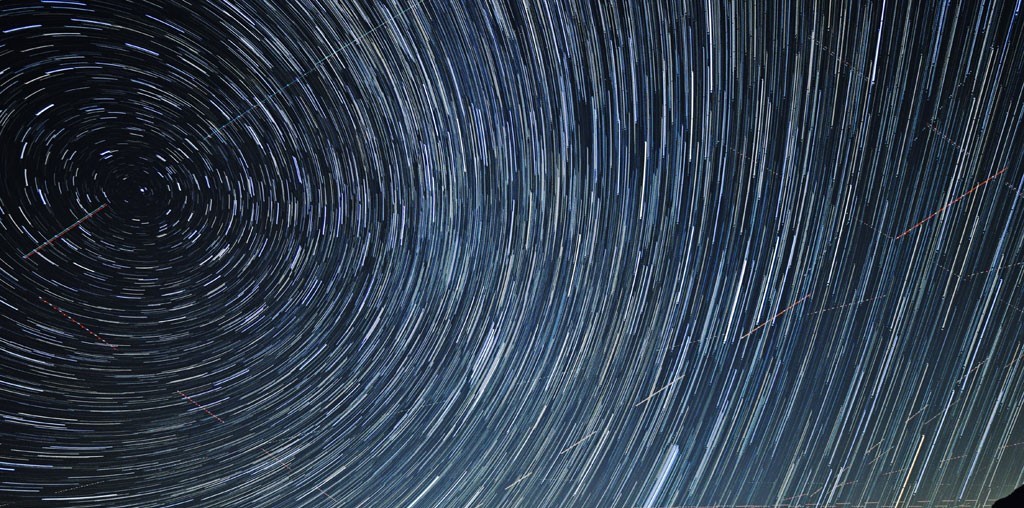
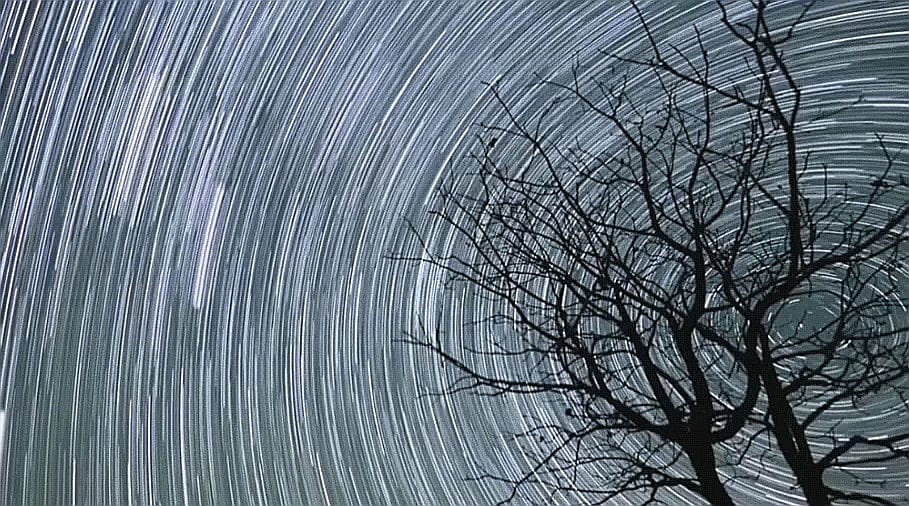
La corsa delle stelle attorno all’asse del mondo, ovvero attorno alla stella polare, qui in una foto di Ken Christison, nel mondo romano veniva paragonata alla corsa equestre.
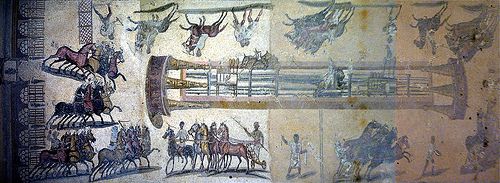
Qui vediamo nel mosaico del circo, di Villa Silin in Libia, al centro il monumento del sole, sui lati i monumenti per gli altri 6 astri.
Di seguito una rappresentazione artistica della visione antica del movimento del sole e della luna attorno all’axis mundi. E ancora una rappresentazione della visione antica del movimento della cupola celeste attorno alla stella polare, posta al centro.
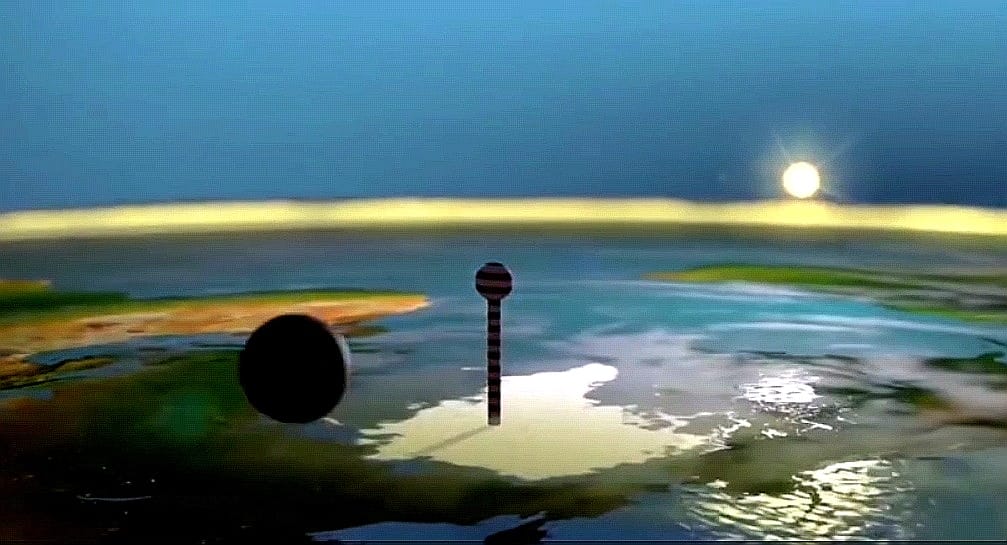
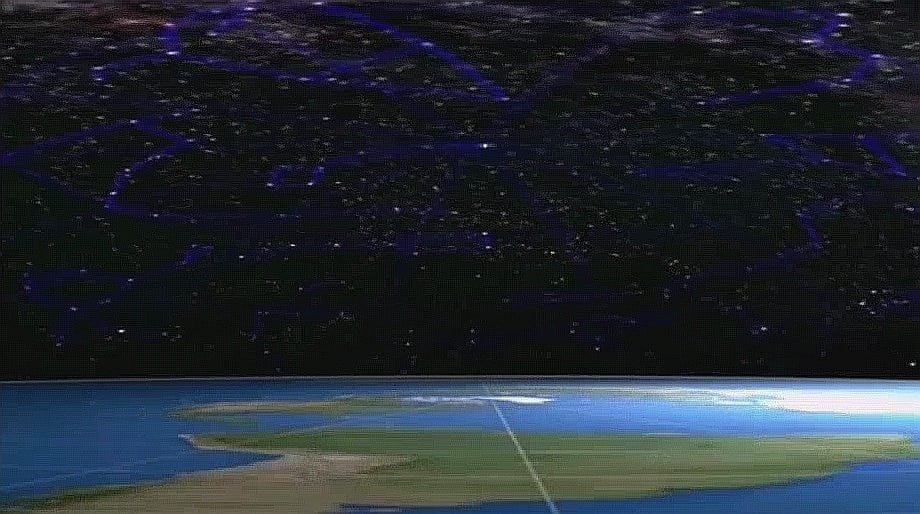
Trattiamo ancora dell’axis mundi e delle parche di cui trattava Platone nel decimo libro della Repubblica a proposito del mito di Er.
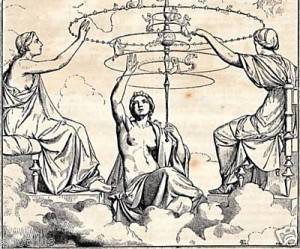
Nel disegno vediamo Ananke che regge l’asse e le parche che muovono sfere (o fusaioli come li ridefiniva Platone) attorno alla colonna di luce.
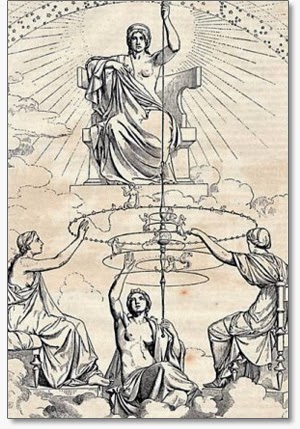
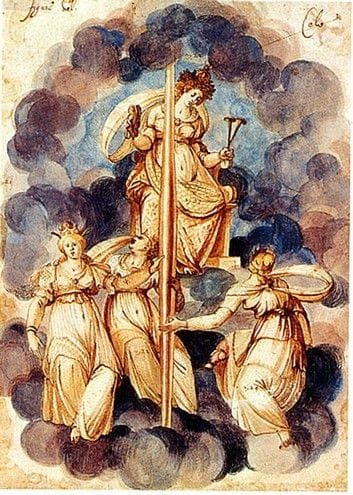
Di seguito Ananke e le parche, Lachesi, Cloto e Atropo attorno alla colonna. Una gira il fusaiolo del presente Cloto, Atropo del futuro e Lachesi del passato.
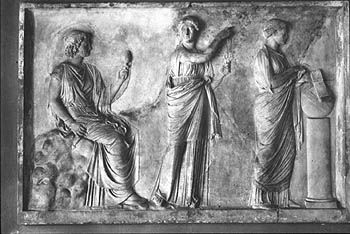
In un bassorilievo si può notare la moira Lachesi che, su un mondo, sostenuto da una colonna, tiene in mano un foglio (il destino), mentre Cloto fila e Atropo taglia il filo.
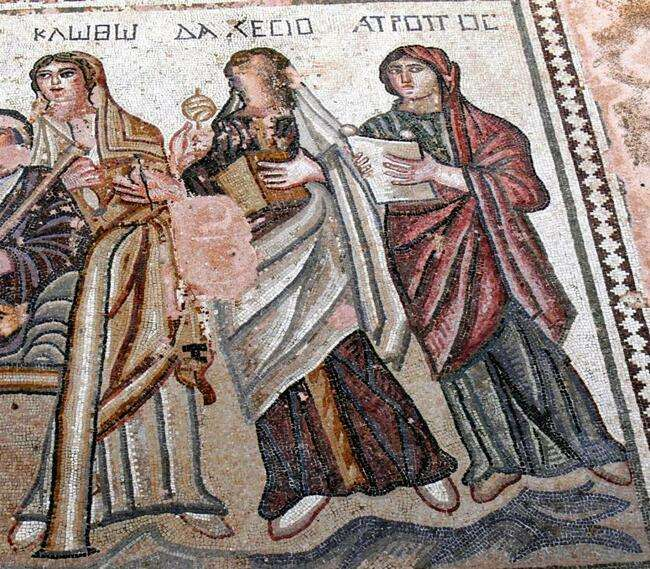
Vediamo ancora le Parche ritratte in un mosaico.
Detto dell’axis mundi e delle parche, parliamo degli otto cieli e della da noi ipotizzata similitudine col Pantheon.
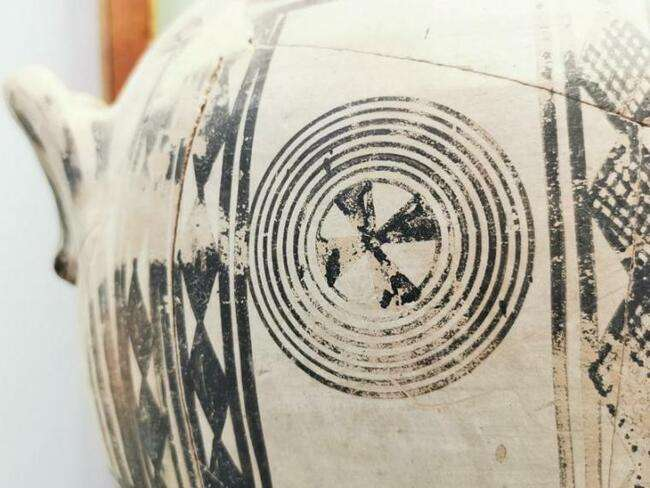
Qui vediamo un vaso riproducente i sette cieli planetari (spazi bianchi), con al centro una terra ritratta a forma di croce. Il vaso risale al nono secolo avanti Cristo.
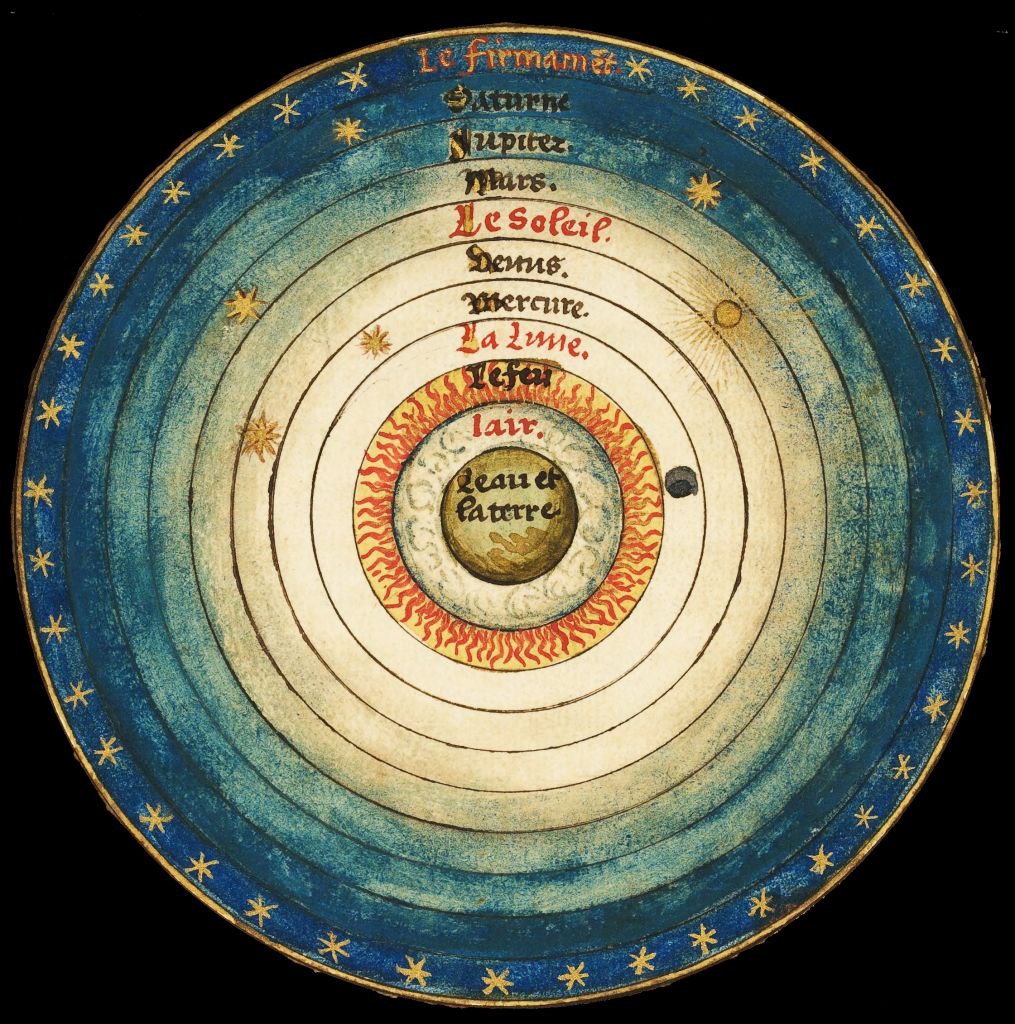
Di seguito una simile riproduzione medievale dei cieli del mondo. Dopo l’atmosfera e l’area del fuoco, si vedono i sette cieli planetari seguiti dall’ottava sfera stellare.
Per avere una visione della concezione del mondo visto lateralmente è utile la riproduzione di Fazio degli Uberti, nel Dittamondo: sopra la terra, vediamo l’acqua, l’aria, il fuoco, le otto sfere e l’empireo. La visione laterale presenta dunque una piramide o una cupola rovesciata.
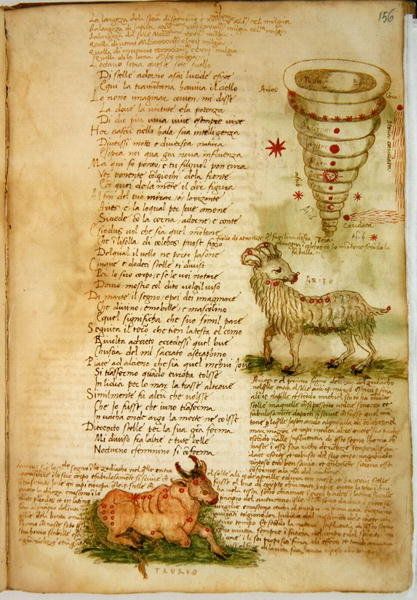
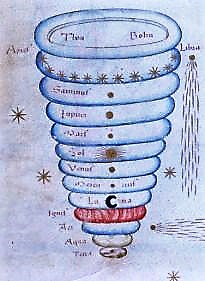
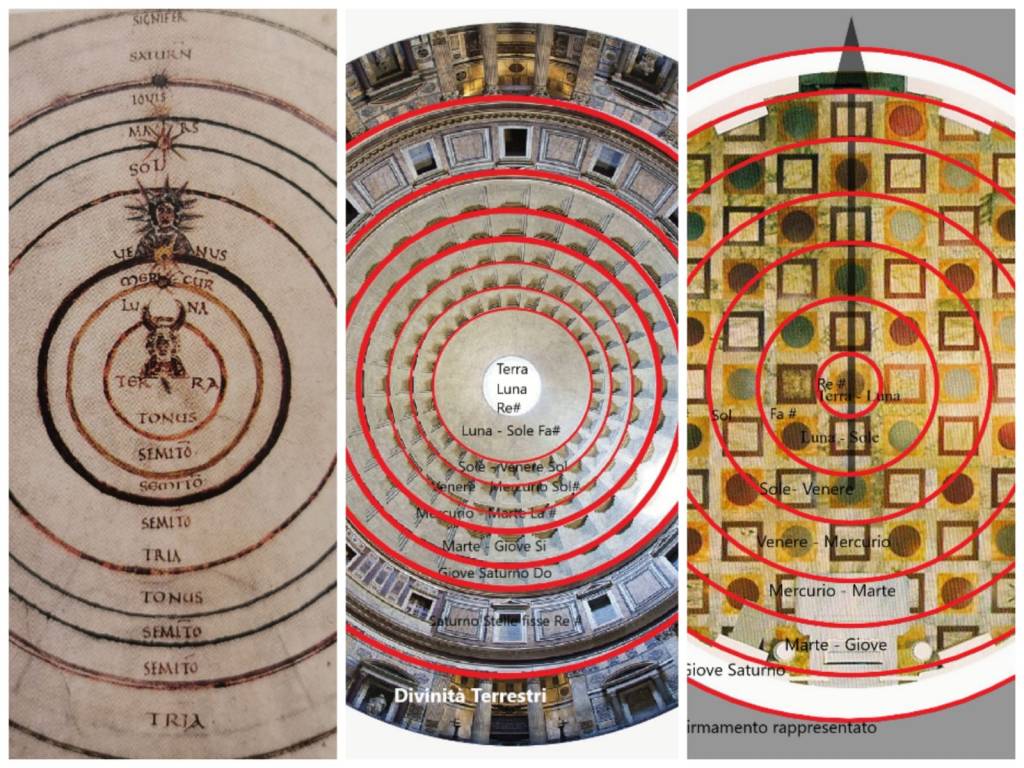
Simile rappresentazione degli otto cieli e degli otto fusaioli platonici è stata offerta da un matematico che ha provato a rappresentare i rapporti armonici e matematici tra gli astri, esposti da Platone nel mito di Er e nel Timeo. Tale studioso, Newsome, reinterpreta matematicamente gli astri di Platone e indica anche le 3 parche che girano i rispettivi fusaioli ovvero le sfere degli astri.
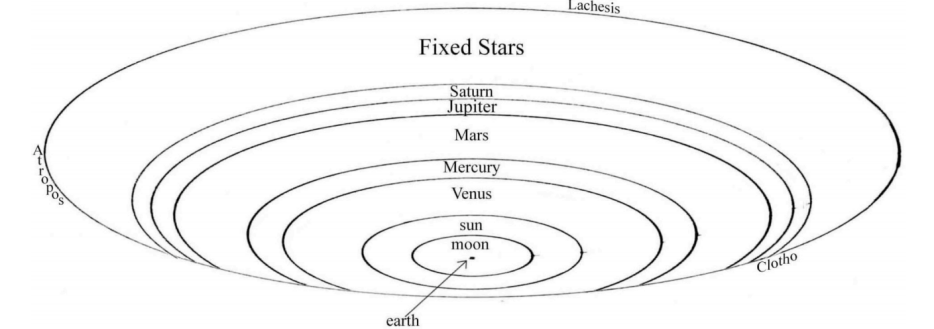
Come visibile dopo il fusaiolo della luna, in cui era conficcato l’axis mundi attorno a cui girava il cielo, stava quello del sole: tale disposizione astrae era quella antica, tipica degli egizi e di Platone. Successivamente in epoca più tarda prevalse la concezione caldea che metteva invece il sole in posizione centrale rispetto agli astri.

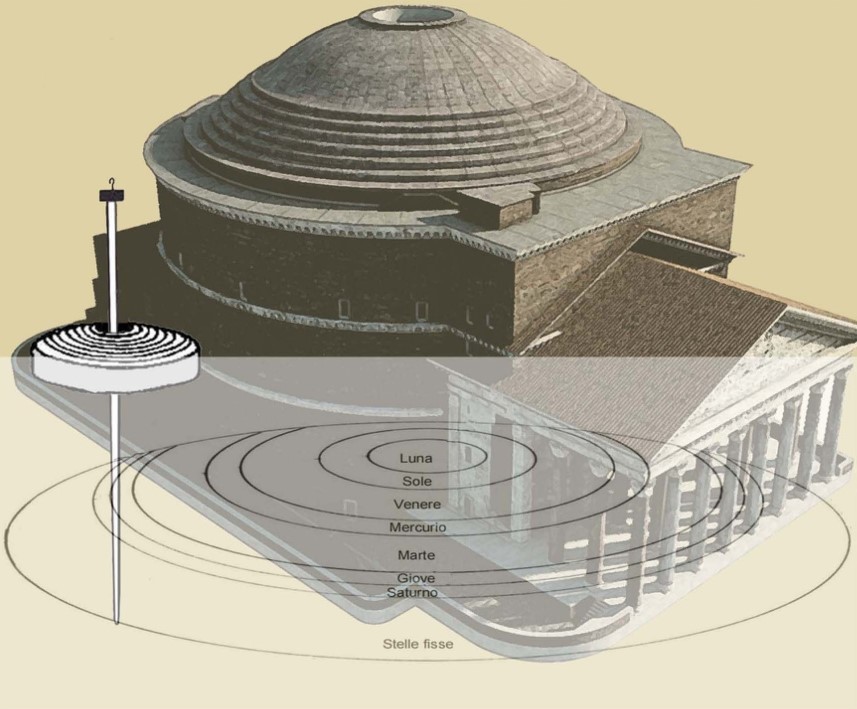
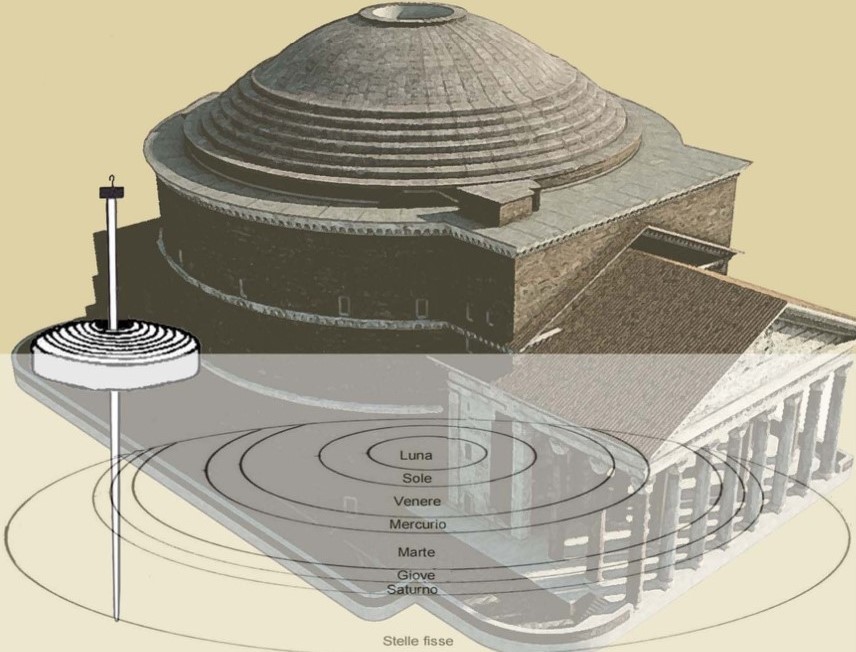
Se si capovolge la figura del Newsome, con stupore, possiamo notare che tale figura è perfettamente e incredibilmente speculare alla cupola superiore del Pantheon.
Ovviamente per ovvi motivi statici i costruttori scelsero di capovolgere i fusaioli, poiché una cupola o piramide rovesciata ben difficilmente avrebbe resistito a tempo e terremoti.
Di seguito una rappresentazione artistica dei fusaioli inseriti nella colonna di luce (axis mundi) del mito di Er platonico.
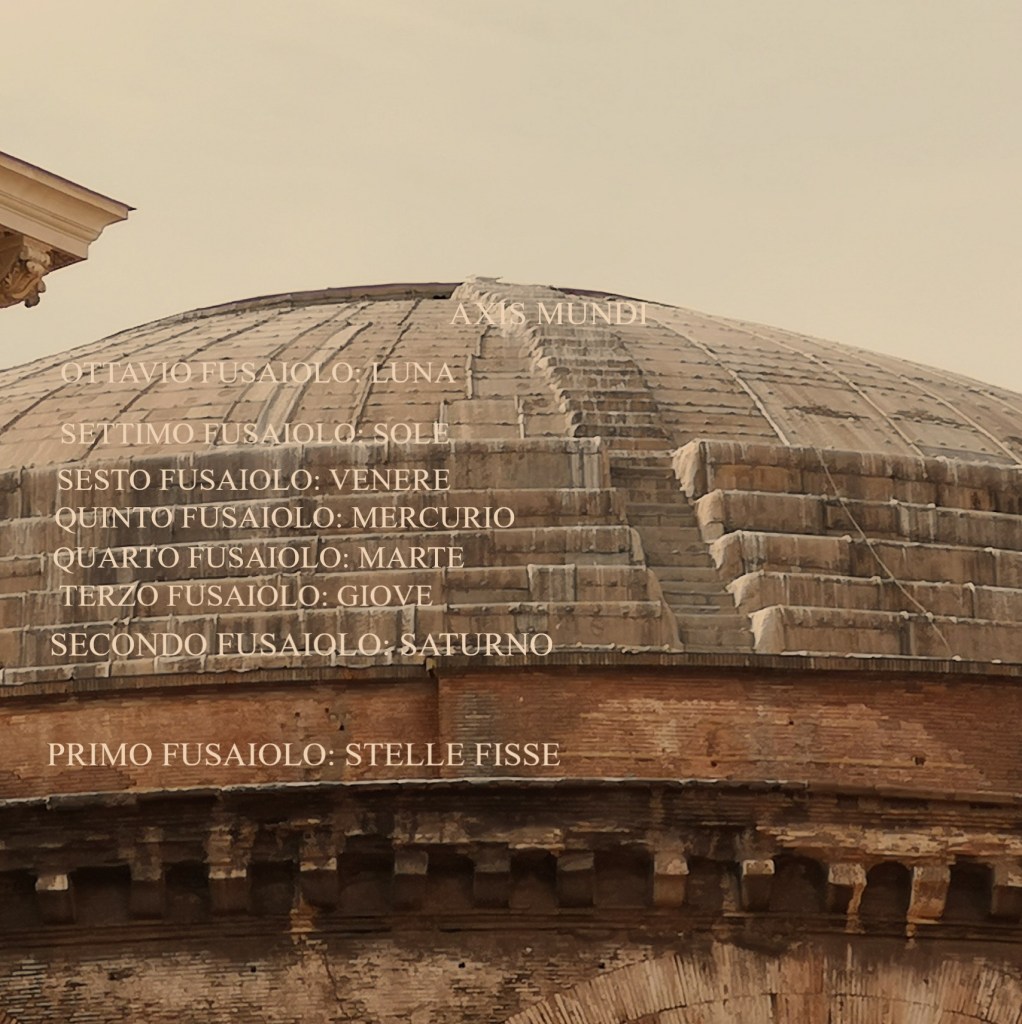
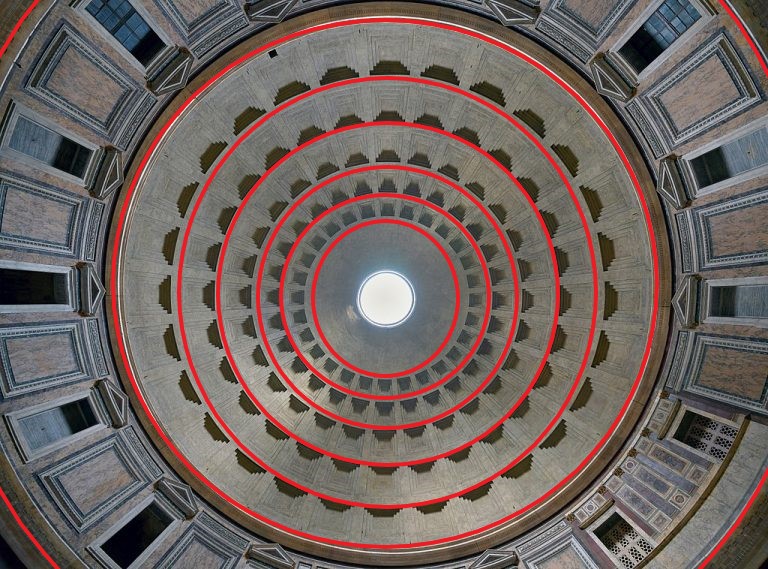
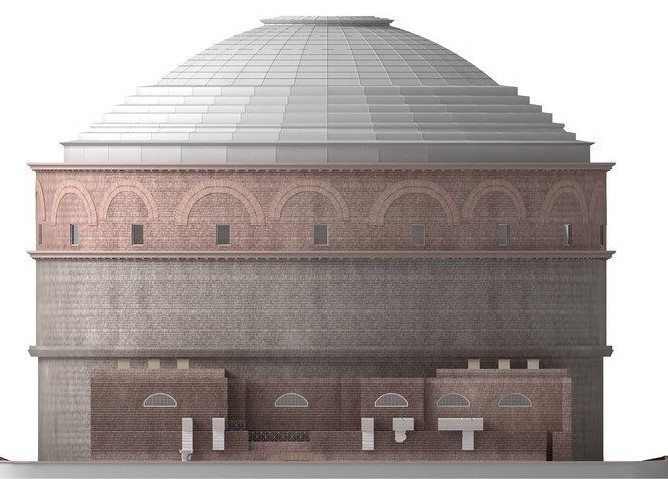
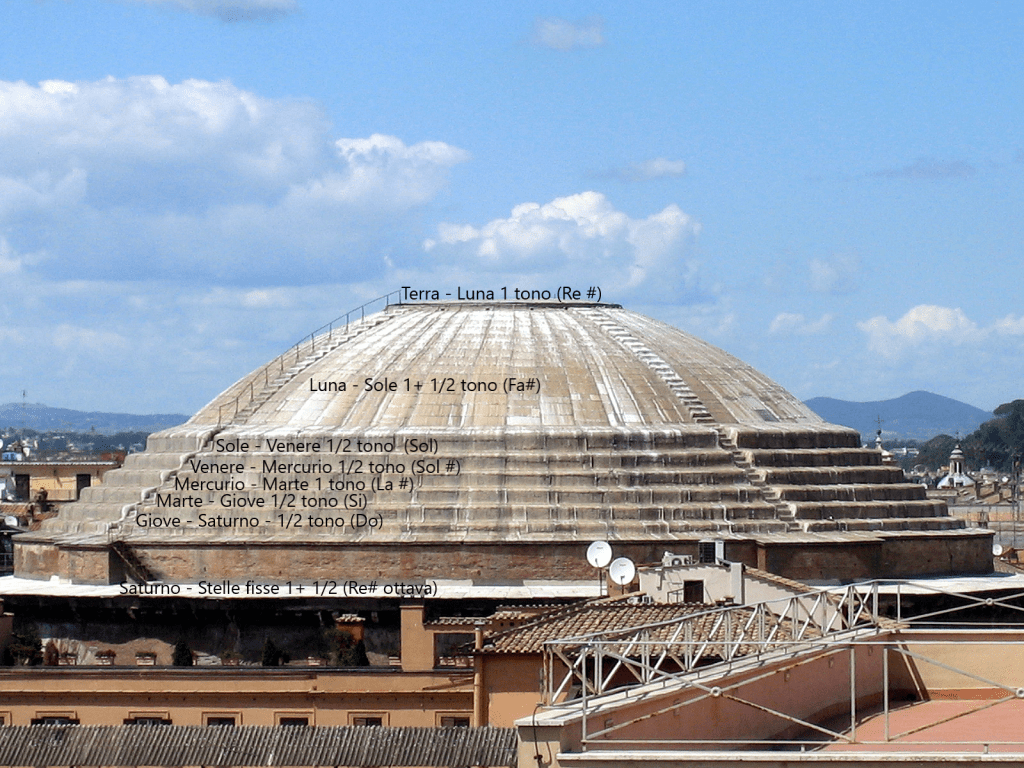
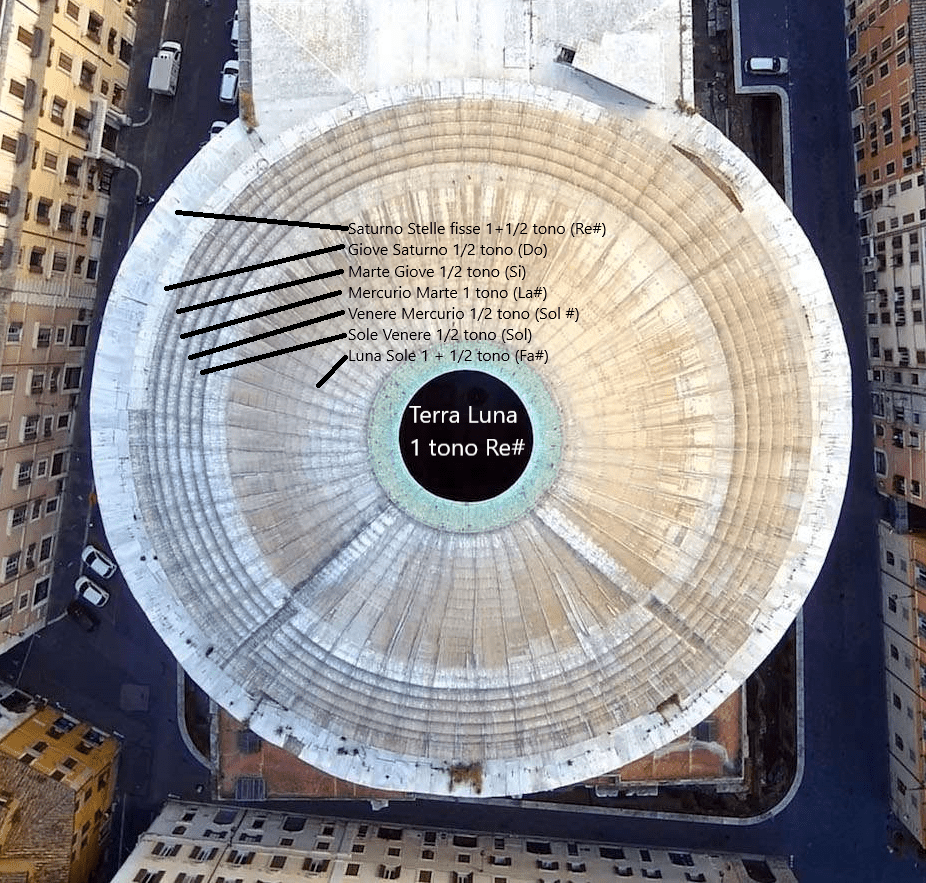
In questa foto si possono apprezzare gli otto fusaioli visti dall’esterno del pantheon e l’axis mundi in alto. L’ultimo fusaiolo, ovvero la prima fascia prima dei gradoni, è quello dell’ottava sfera ovvero delle stelle fisse, il primo fusaiolo, dopo quello di Saturno, poi Giove, Marte, Mercurio, Venere Il fusaiolo attorno all‘oculus (axis mundi) è quello della Luna.
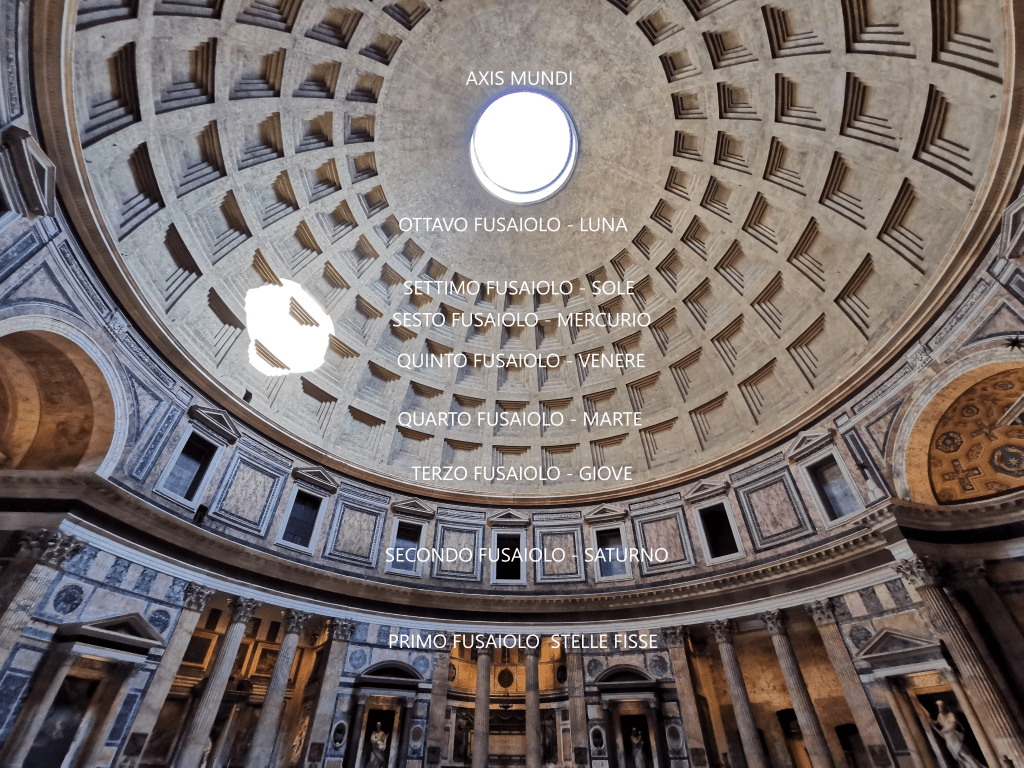
Vediamo ora come si sono resi architettonicamente i fusaioli all’interno.
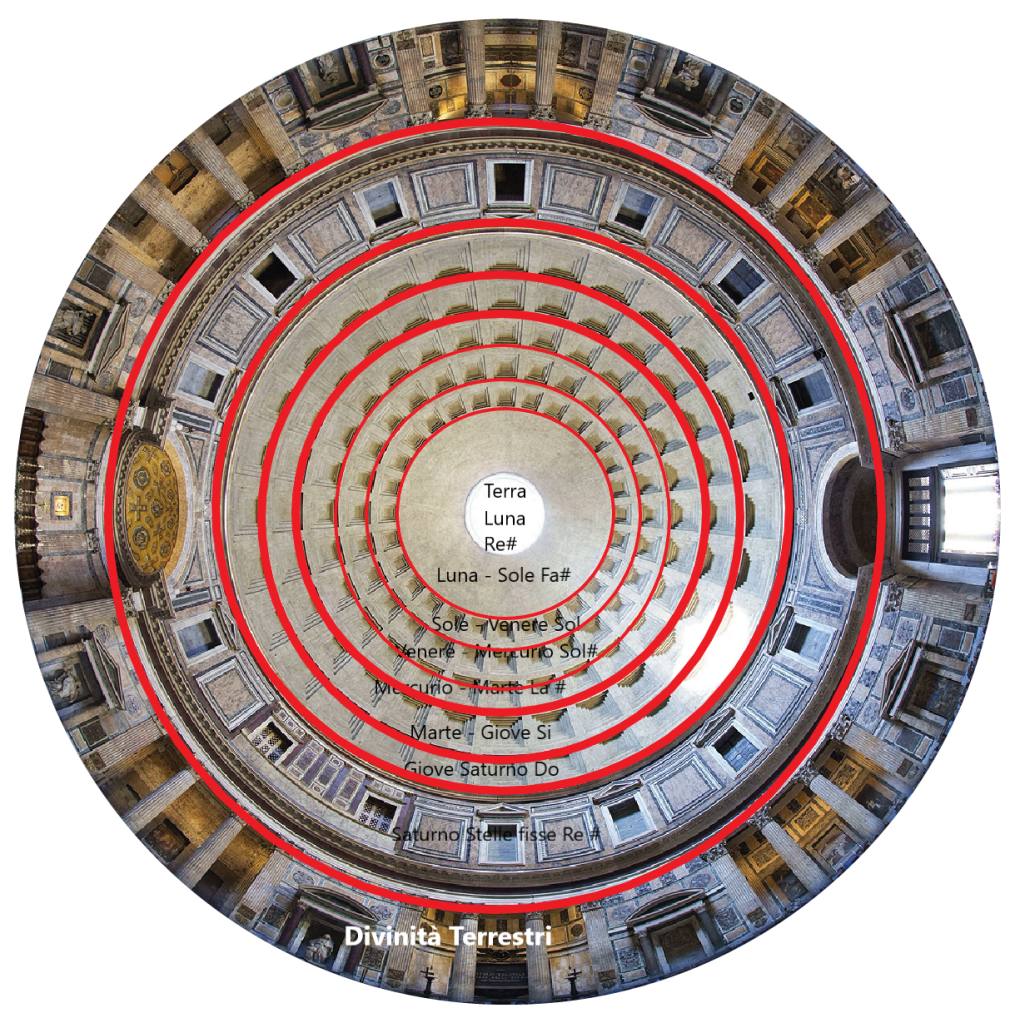
L’ottavo fusaiolo, stelle fisse, era a pianterreno ed era limitato sotto dal pavimento e sopra dalla cornice dell’imposta. Il secondo fusaiolo di Saturno era all’imposta. Con il fusaiolo di Giove cominciavano le fasce di 28 cassettoni per fascia (28 sono le case lunari), seguito da Marte, Mercurio, Venere, Sole e Luna, quest’ultima, per ovvi motivi, senza case lunari, al cui interno, come detto, stava l’asse del mondo.
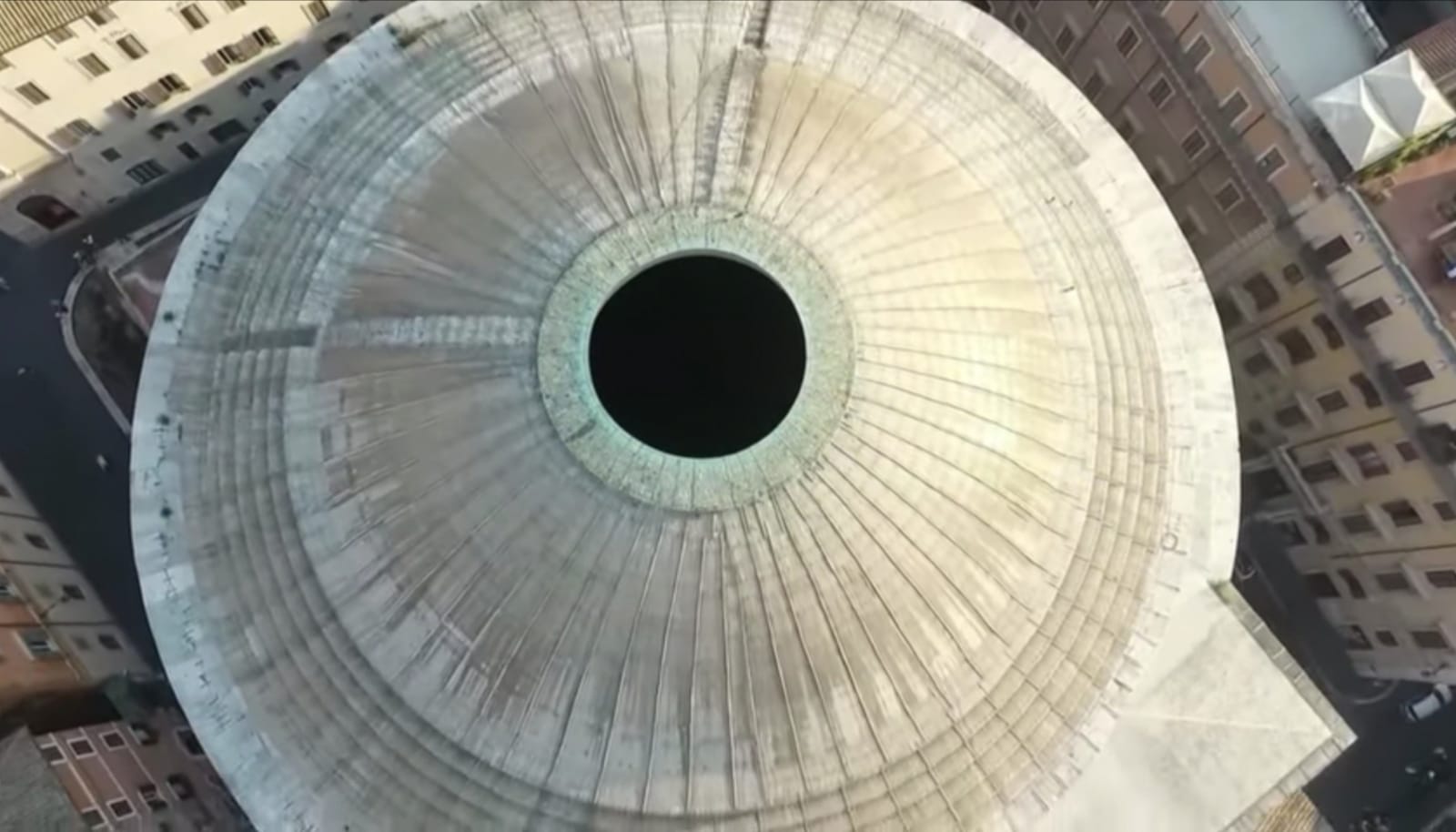
Nella visione dall’alto della cupola del Pantheon si nota l’ottavo fusaiolo (stelle) sulla circonferenza e il primo fusaiolo attorno all’oculus (axis mundi) quello della Luna.

Trattiamo ora della religione del Mondo e il Pantheon.
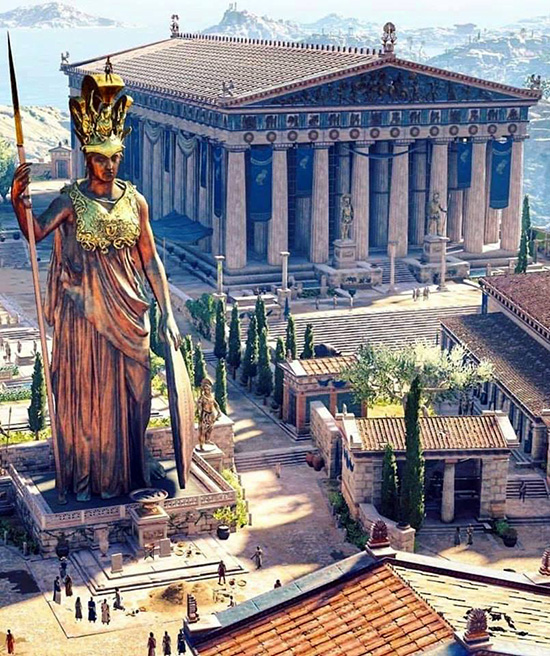
La religione cosmica di Platone (dal greco cosmos ornamento ovvero mundus in latino) ipotizziamo sia stata riprodotta nel Pantheon.
Cosa determina tale intuizione? Il fatto che come detto il Pantheon raffigurasse, per le citate notizie di Ammiano Marcellino e di Dione Cassio, il cielo, la succitata riproduzione architettonica della concezione platonica dei fusaioli celesti e, infine, una notizia che riportiamo da un autore settecentesco, il Vasi: Questo maraviglioso tempio, secondo il sentimento comune, […] si disse Panteon, perché era dedicato a tutti li Dei immaginati da’ Gentili. Nella parte superiore […] erano collocate le statue delli Dei celesti, e nel basso i terrestri, stando in mezzo quella di Cibele; è nella parte di sotto, che ora è coperta dal pavimento, erano distribuite le statue delli dei Penati.
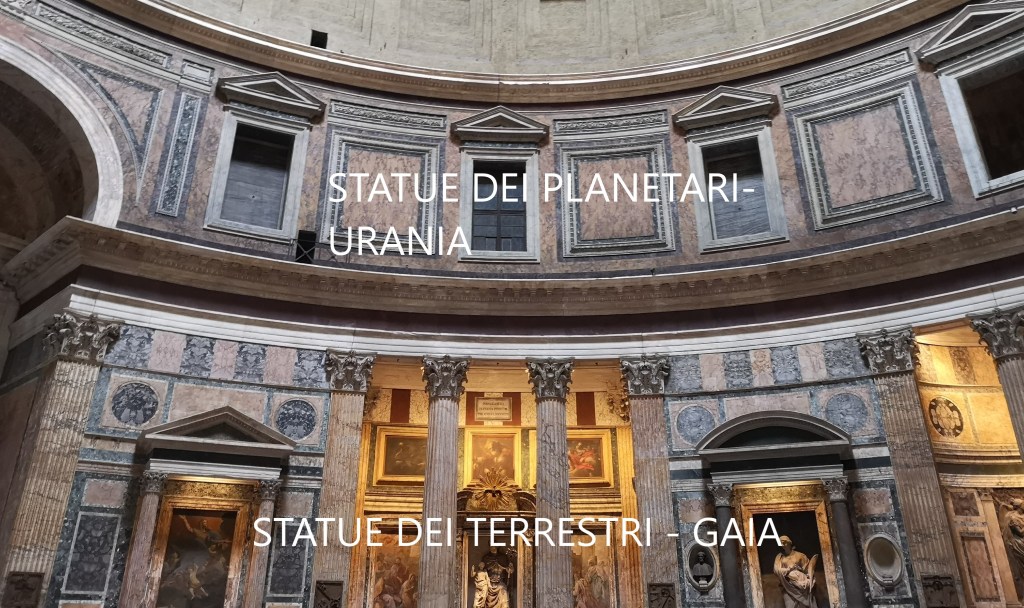
Dunque vi erano statue sotto il pavimento a rappresentare Ctonia.
Nella foto le nicchie per gli dei planetari di Urania nell’imposta e il pianterreno con le nicchie per gli Dei terrestri di Gaia.

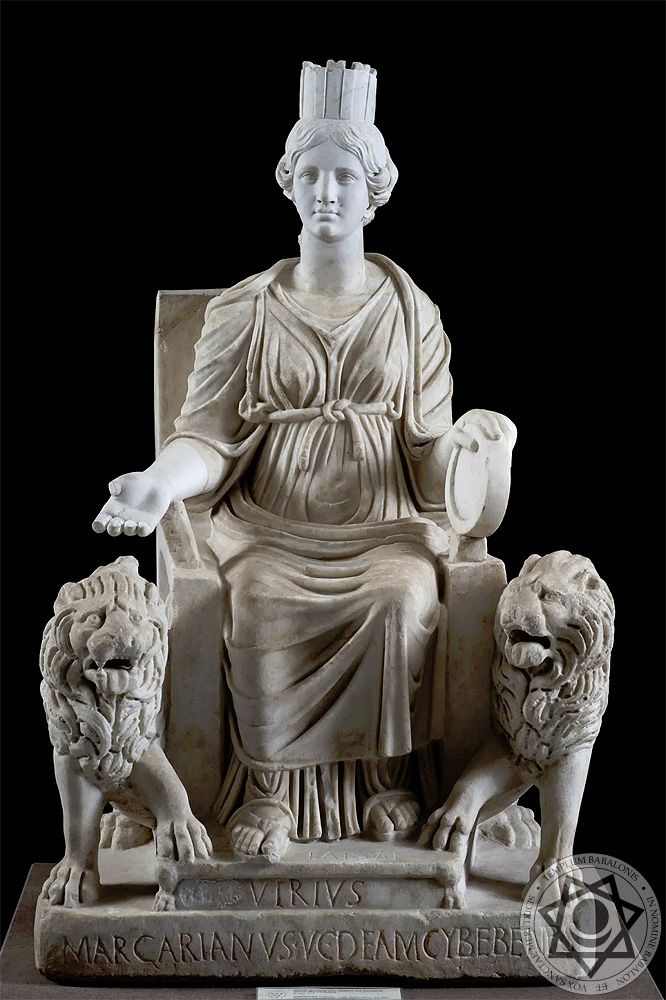
Sull’imposta erano collocate, invece, statue delle sette divinità planetarie di Urania. Gaia (la Terra) era invece rappresentata dalle statue degli Dei terrestri al pianterreno del Pantheon, con in mezzo Cibele.
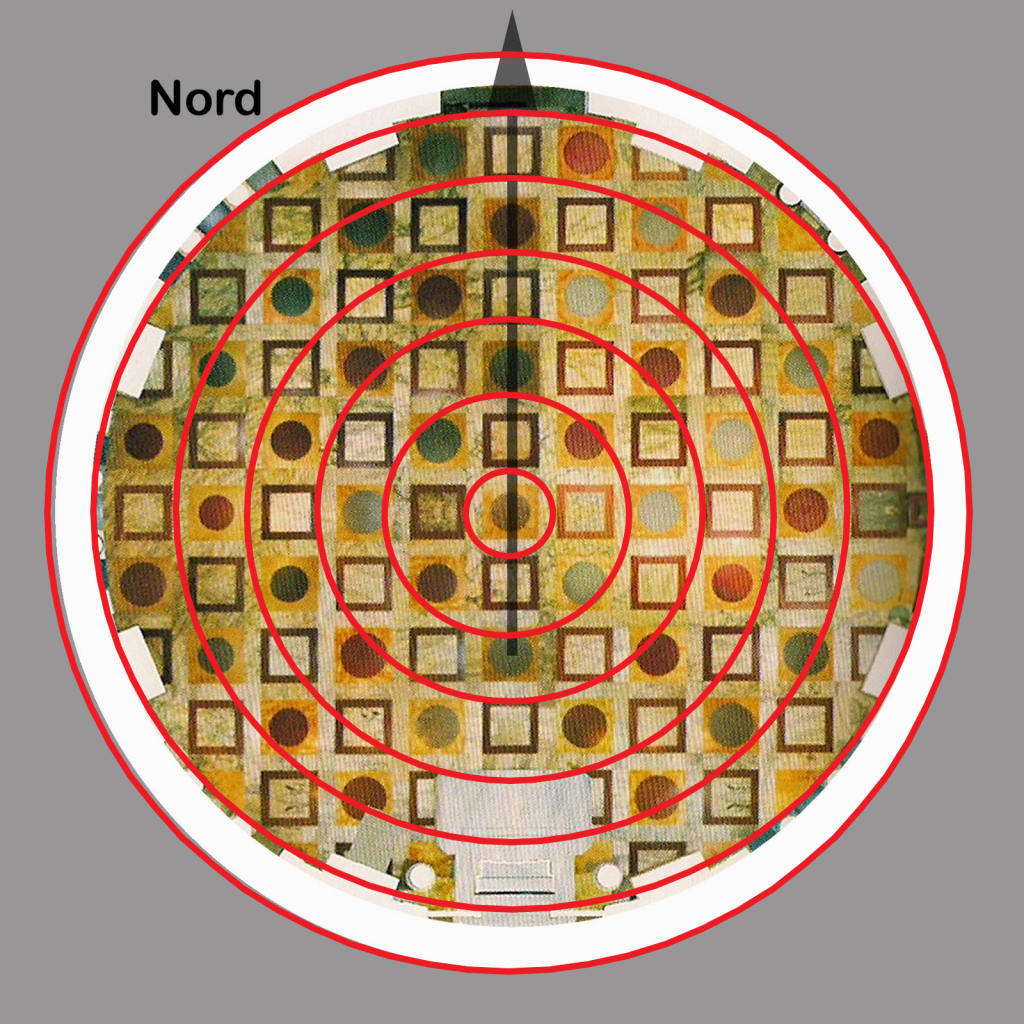
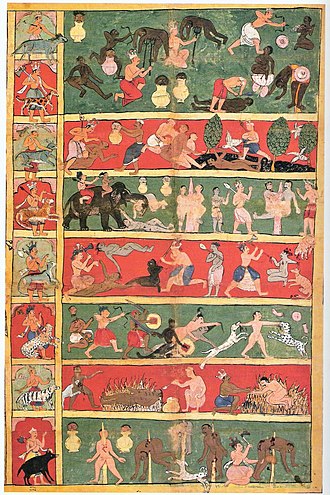
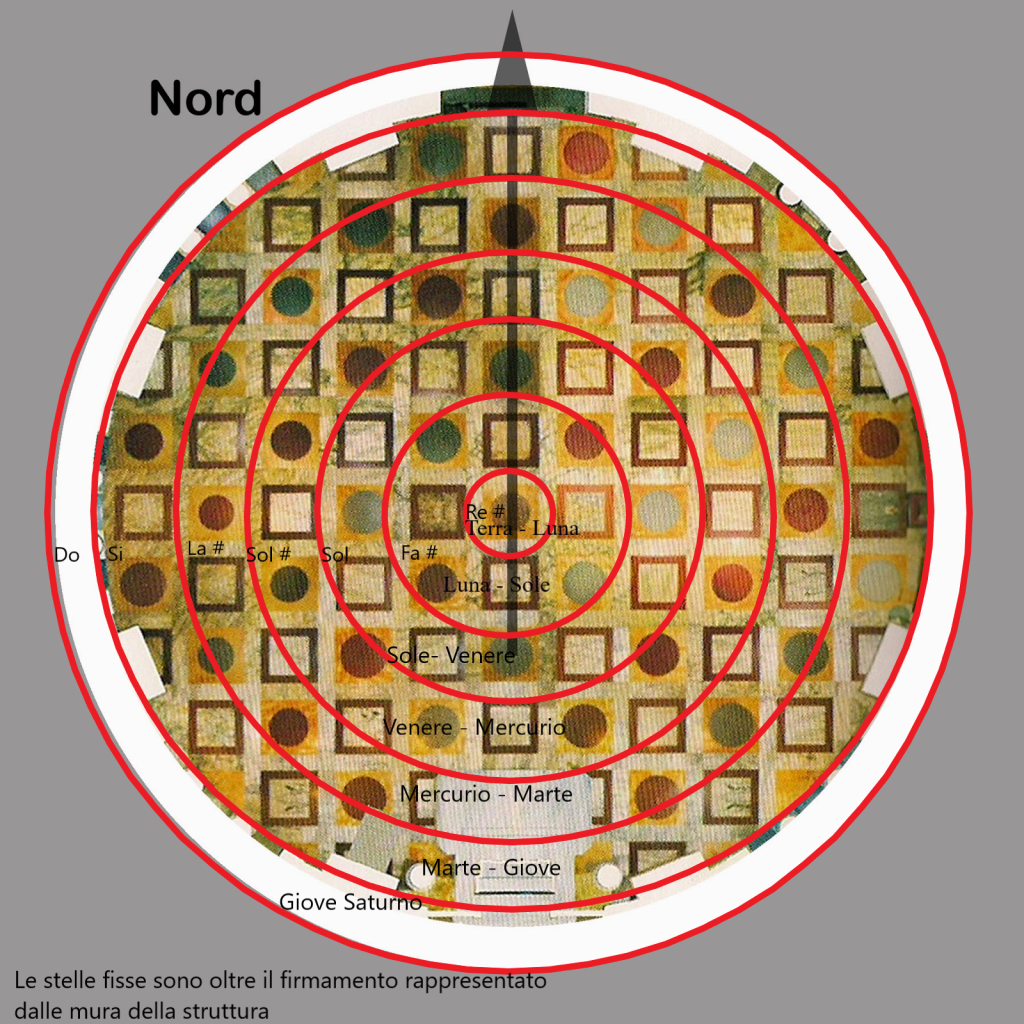
Qui vediamo il pavimento del Pantheon. Per ogni figura geometrica sono inscritte le sette fasce circolari dei sette piani ctoni, qui ritratti in un dipinto indiano del diciassettesimo secolo raffigurante i sette livelli dell’inferno giainista.
In corrispondenza, sopra il pavimento, stava la cupola interna divisa in sette fasce circolari.
Dopo Urania, Gaia e Ctonia cosa mancava per completare la celebrazione del mondo di Platone? L’oceano. Dove si trova? Dietro il Pantheon, ed era il tempio di Nettuno anch’esso realizzato da Agrippa.
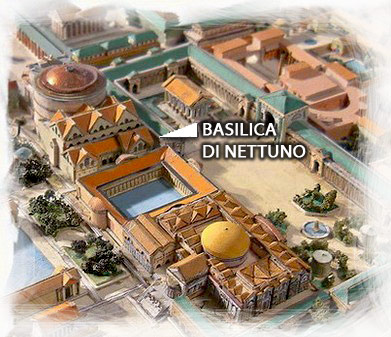
Vediamo qui una ricostruzione della basilica di Nettuno (Oceano), dietro il Pantheon. Nella immagine sulla sinistra si intravede lo Stagnum (che rappresentava l’acqua dolce di laghi e fiumi) e sulla destra il portico degli argonauti.
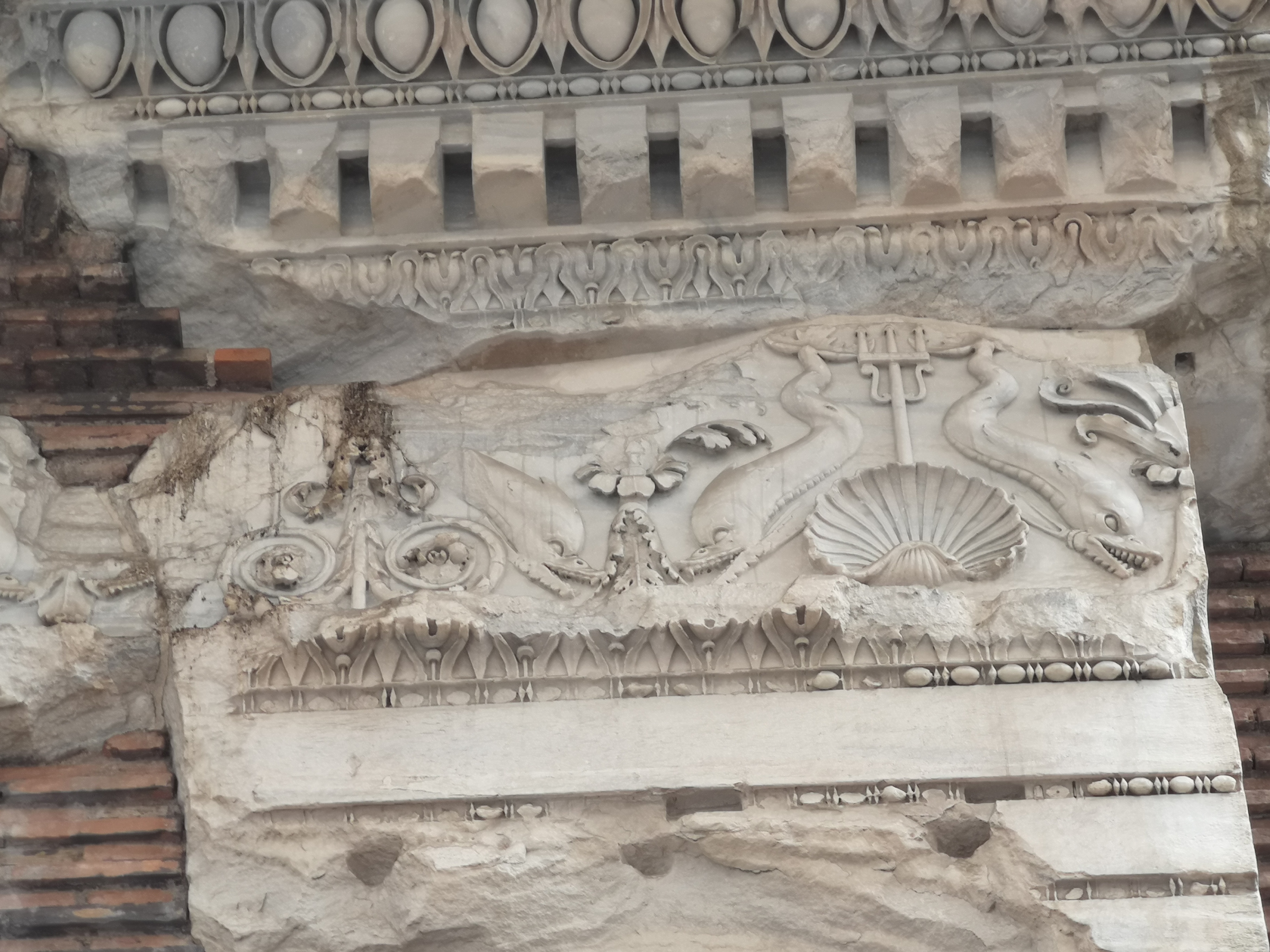
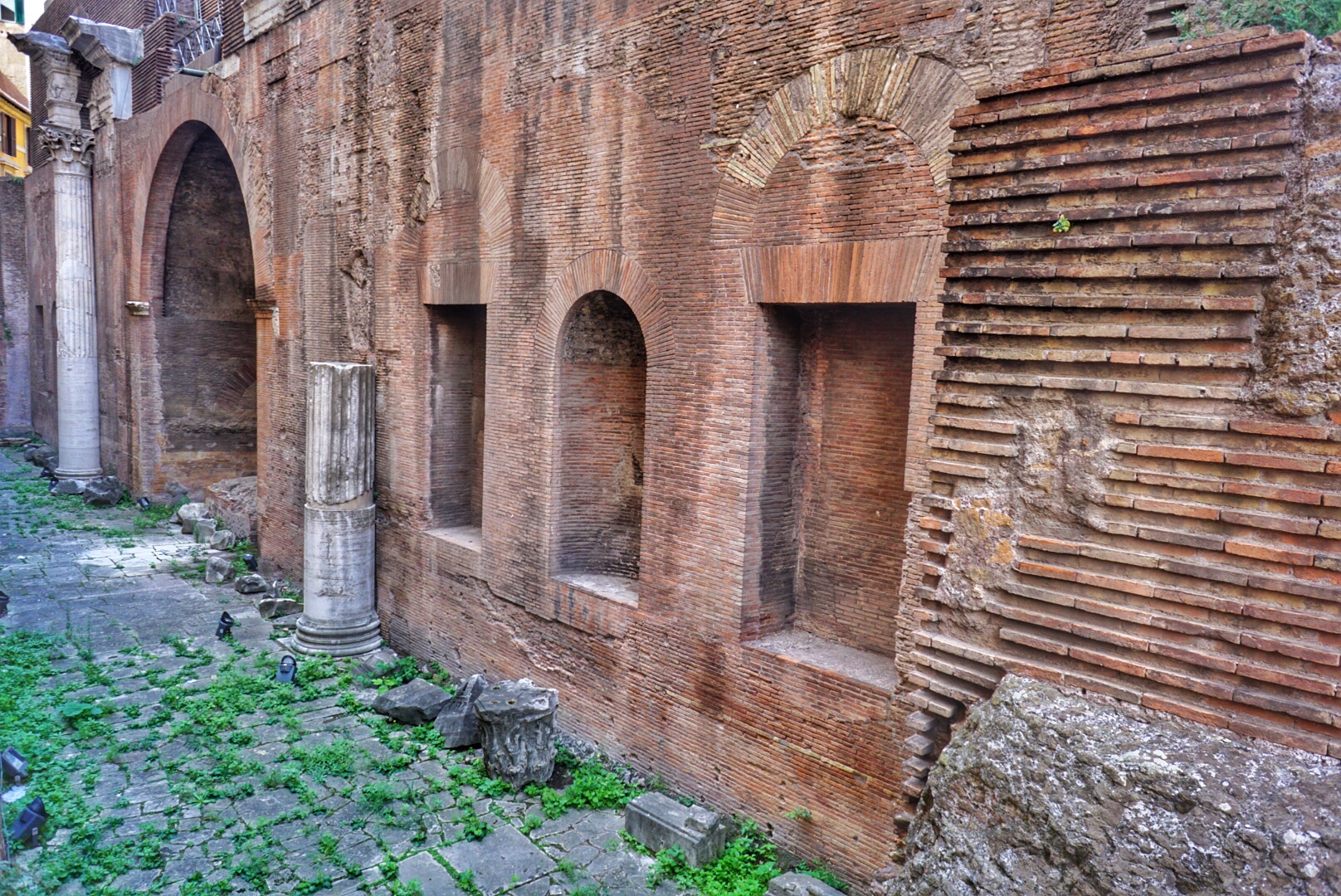
Nella foto vediamo fregi della basilica del dio Nettuno / Oceano.
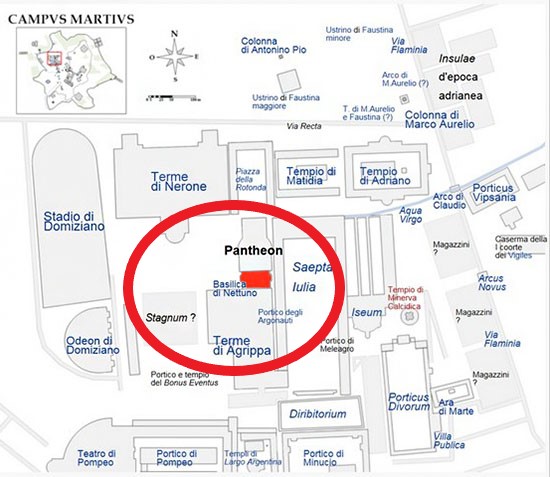
Nell’immagine accanto vediamo riassunto il piano urbanistico di Agrippa dedicato al culto del Mondo: Pantheon, Basilica di Nettuno, portico Argonauti e Stagnum. Il Pantheon comprendeva le divinità uraniche, terrestri e ctonie. La basilica di Nettuno quelle oceaniche.
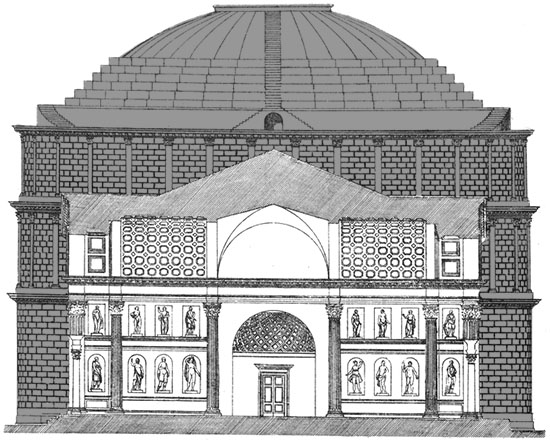
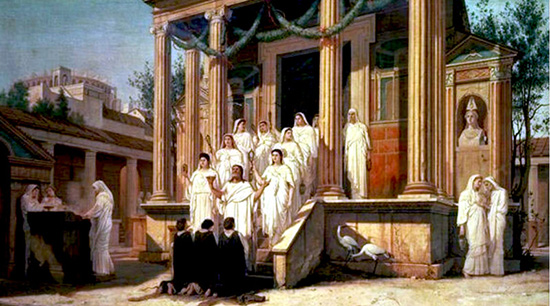
Di seguito una ricostruzione della Basilica del dio Nettuno con statue: dietro si vede il Pantheon. Si può notare la corrispondenza delle statue al pian terreno del tempio di Nettuno con quelle del Pantheon.
Accenniamo all’atmosfera.
Nella immagine gli strati dell’atmosfera terrestre secondo la scienza moderna. Come facevano gli antichi a conoscere dell’esistenza della mesosfera e della termosfera?
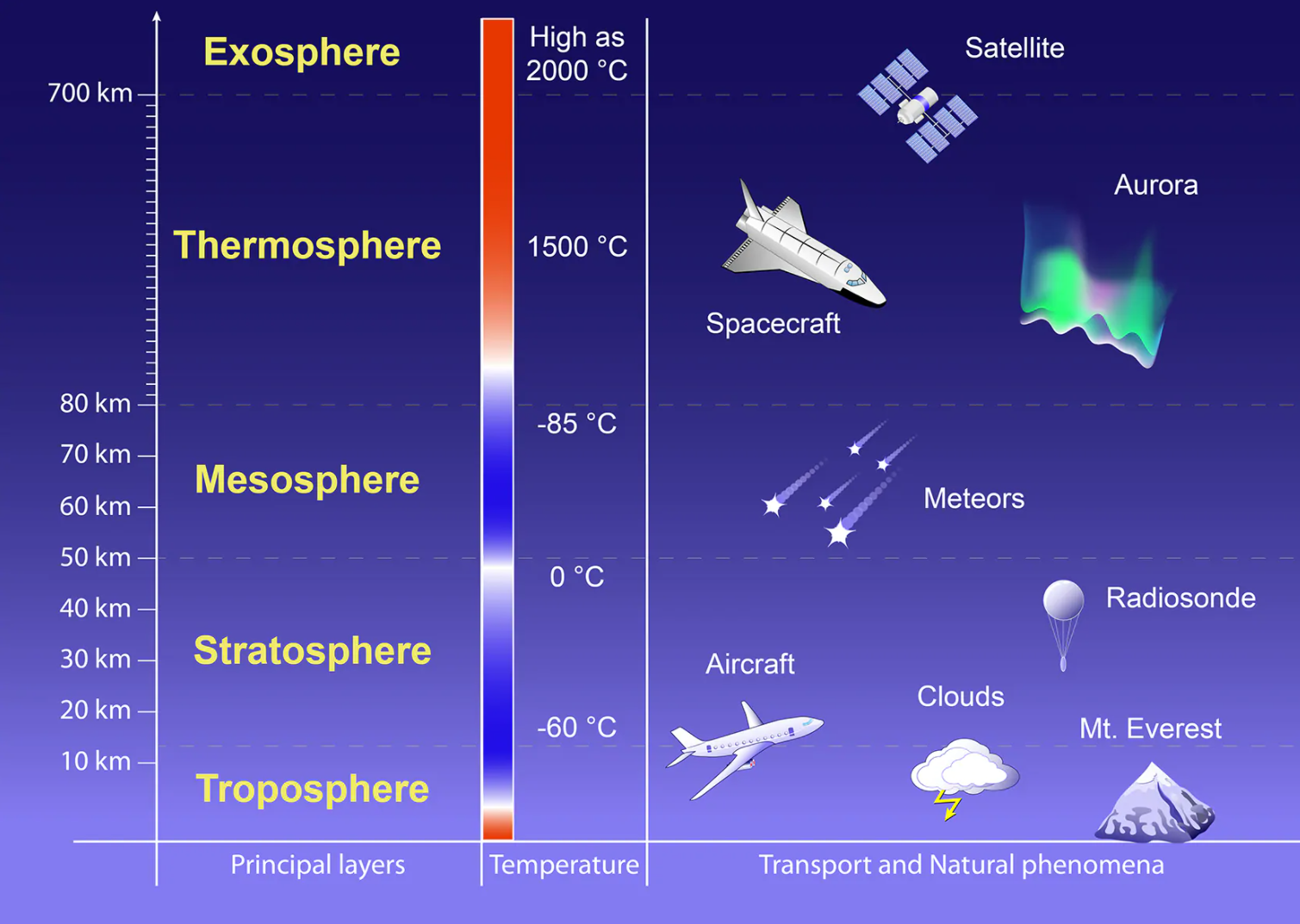
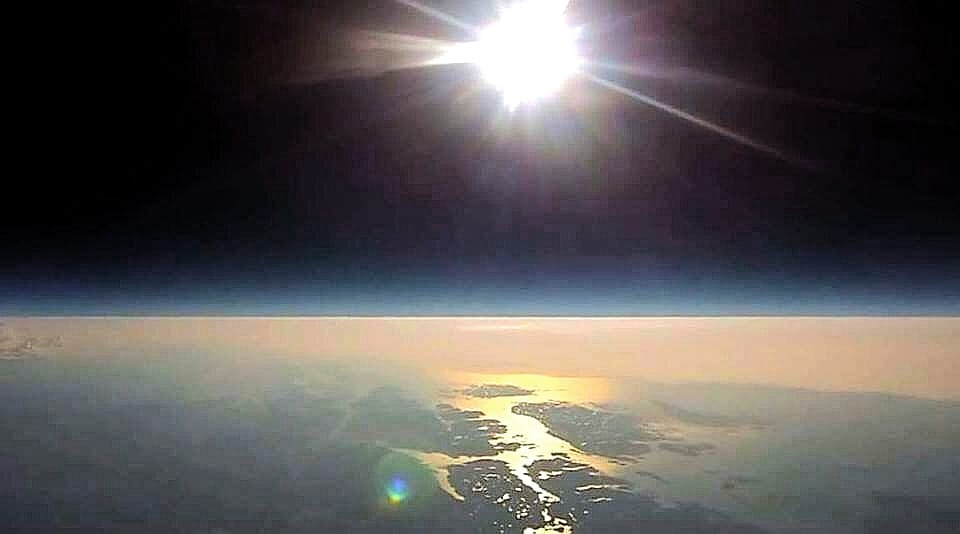
Nella foto successiva la sottile fascia atmosferica fotografata dall’altezza di 35 km da un pallone sonda.
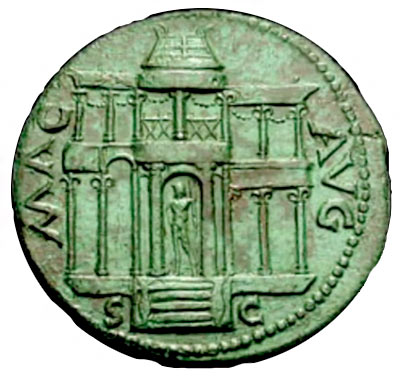
Facciamo un breve cenno alla coenatio rotunda di Nerone in cui le stelle giravano continuamente attorno a lui, per come scriveva Svetonio.
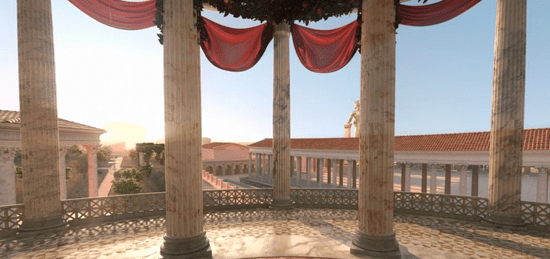
E’ evidente la similitudine con il temporalmente precedente Pantheon simile al cielo a testimonianza dell’origine augustea e non adrianea della concezione della struttura.
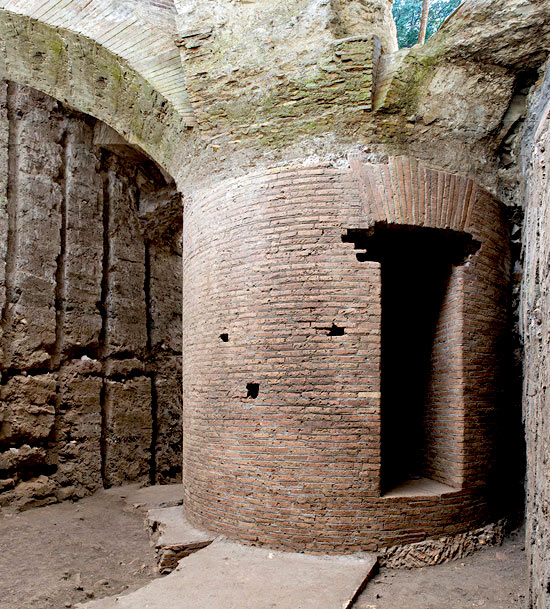
Nella foto resti della presunta coenatio rotunda di Nerone.
Di seguito una moneta che dovrebbe ritrarre la coenatio su cui è scritto: mac (machina) aug (augusta). Qualcuno sostiene che ruotasse il pavimento, ma nella visione dell’epoca la terra era stazionaria.
Ora trattiamo del punto fondamentale della nostra ricerca: la musica per l’ascesa agli astri studiata dai pitagorici è stata usata anche nel Pantheon?
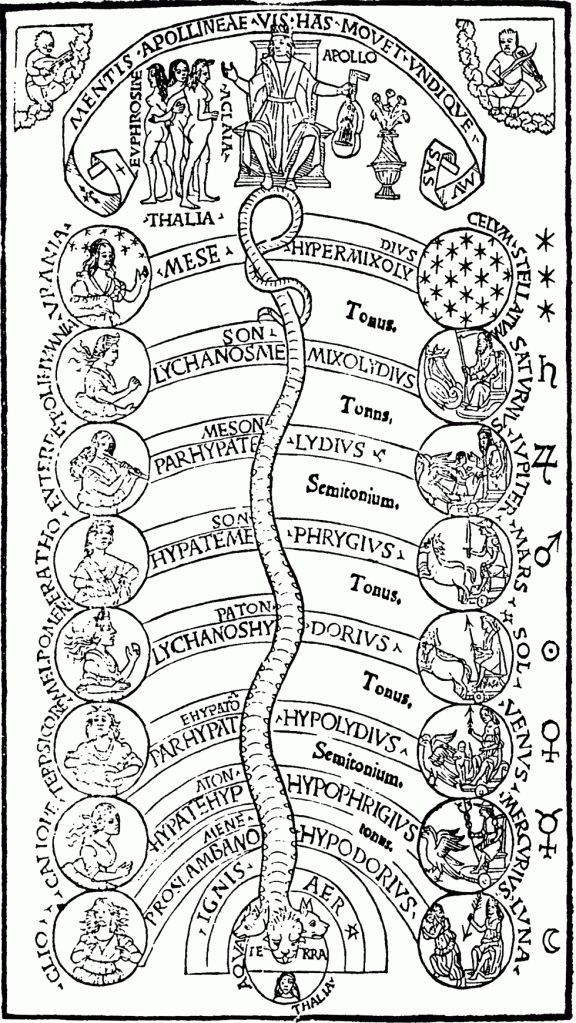
Da dottrina pitagorica, i riti per l’ascesa astrale dell’anima venivano effettuati con vocalizzazioni, toni e semitoni corrispondenti ad astri e muse.

Lo gnostico Marco così riproduceva in questo schema la corrispondenza di vocali, astri, intonazioni, note musicali e muse.
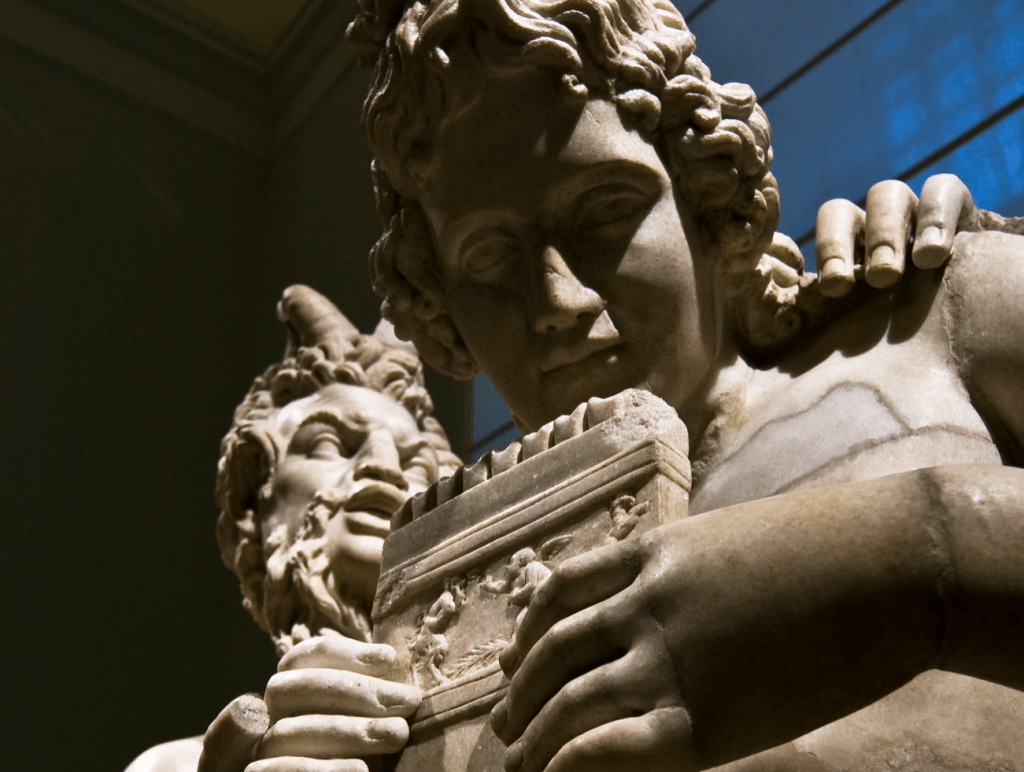
Circa l’ascesa tramite la musica: si vedano le canne della siringa di Pan che rappresentano gli astri.
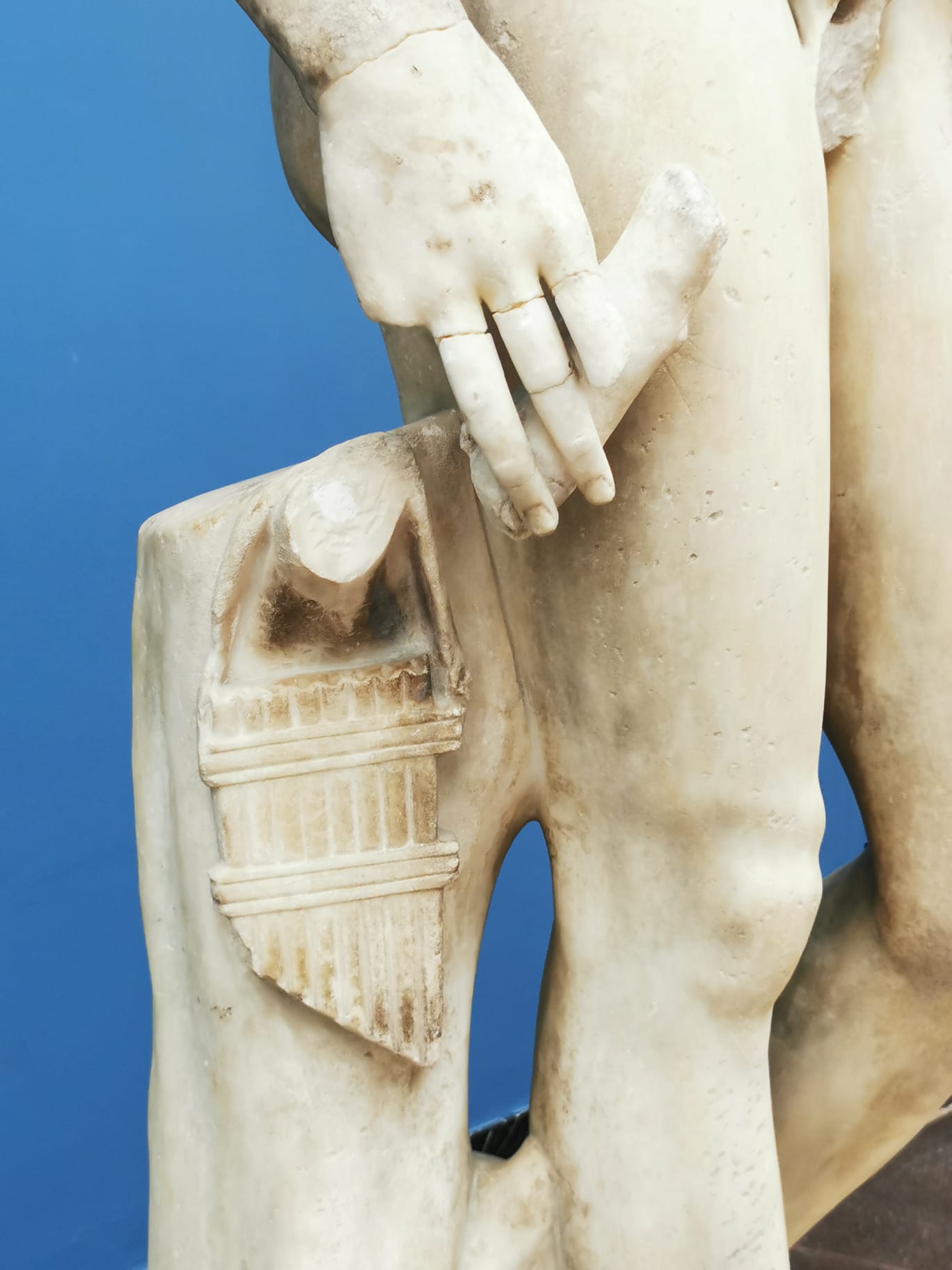
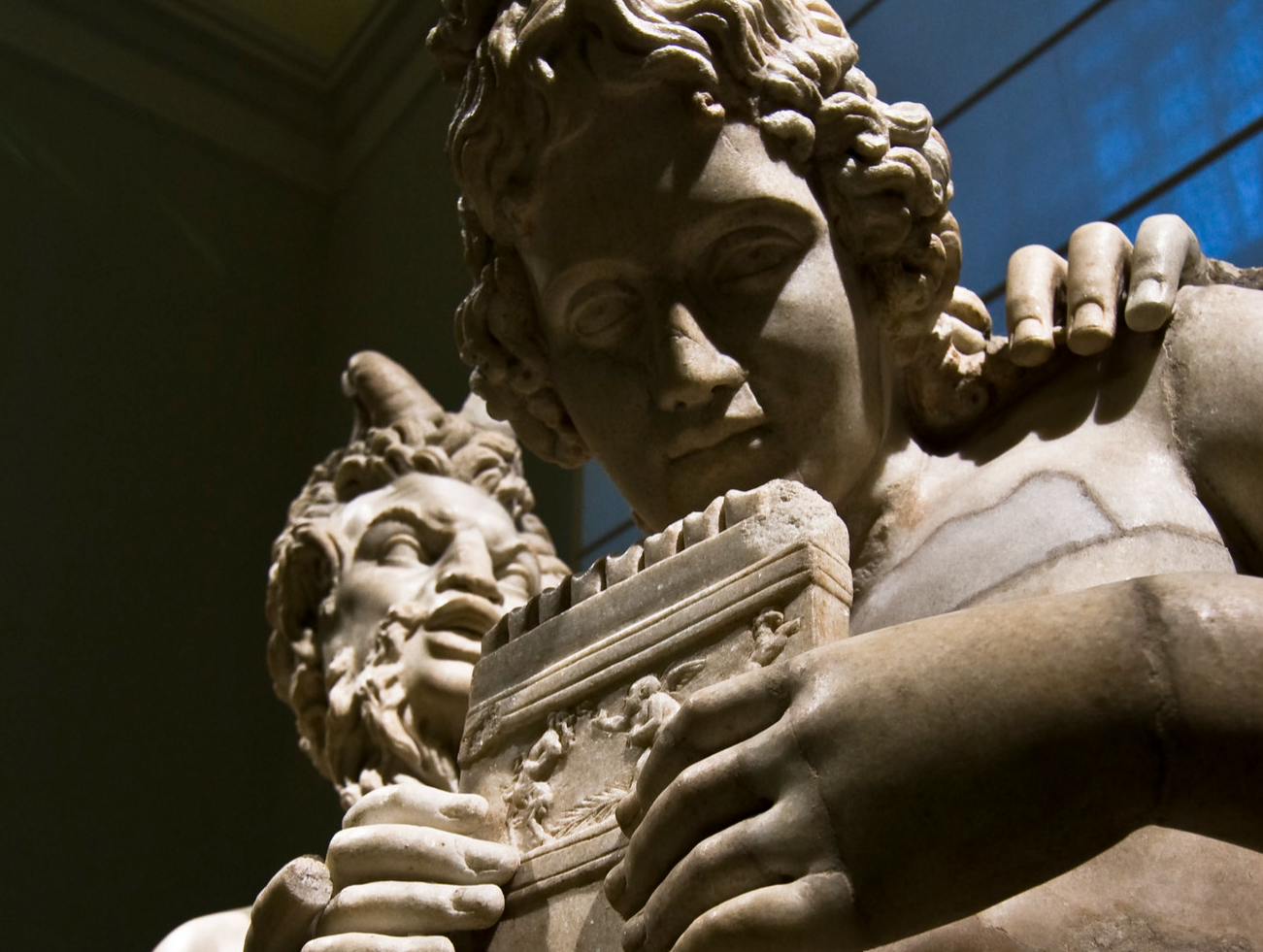
In un altra foto una statua di siringa (con le canne astrali) e Pan.
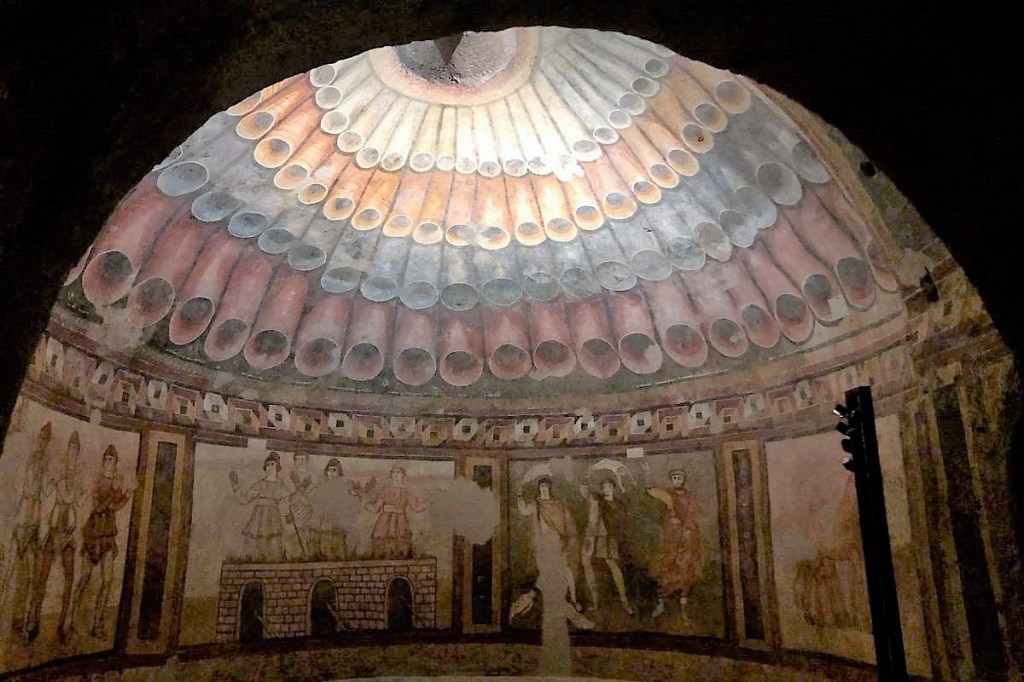
Vediamo poi l’ipogeo di Santa Maria in Stelle, presso Verona. Nessuno ha ancora capito che quei strani tubi sono in realtà le canne cosmiche della siringa di pan quale rappresentazione dell’armonia musicale delle sfere.
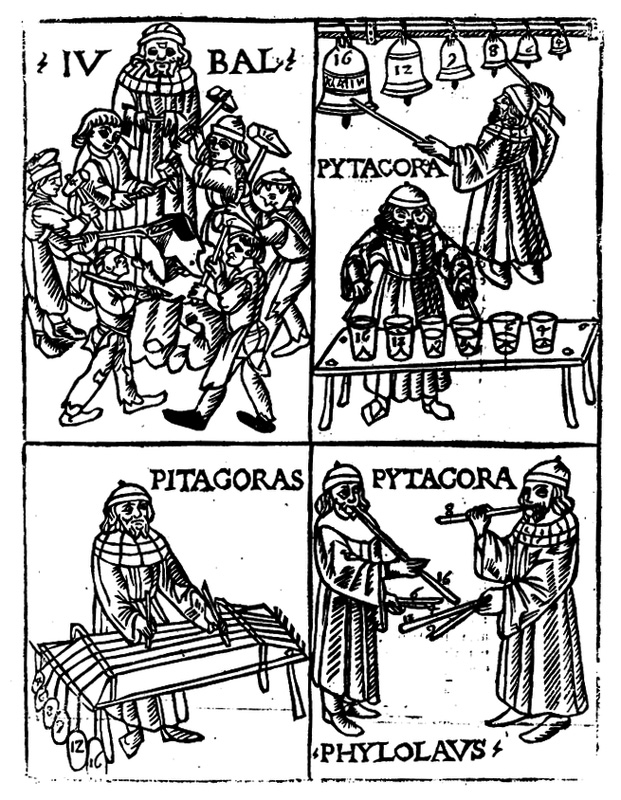
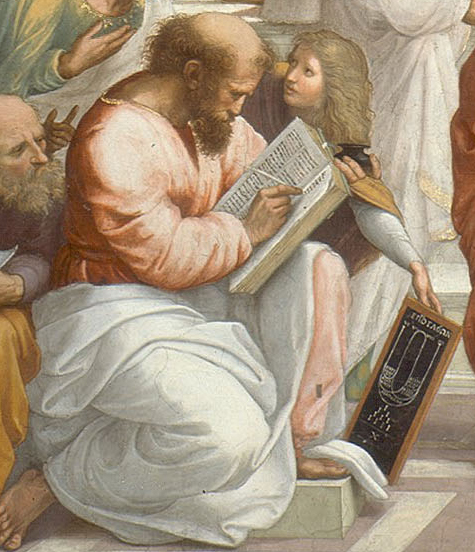
Un altra immagine ritrae Pitagora che studia l’armonia e la ratio con diversi strumenti musicali.
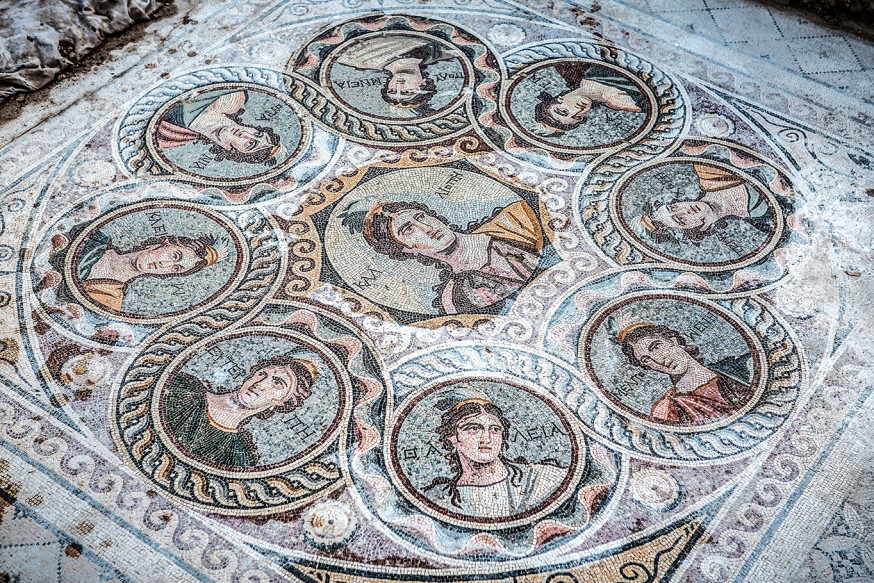
Da Zeugma (in Turchia) viene questo bel mosaico delle muse.
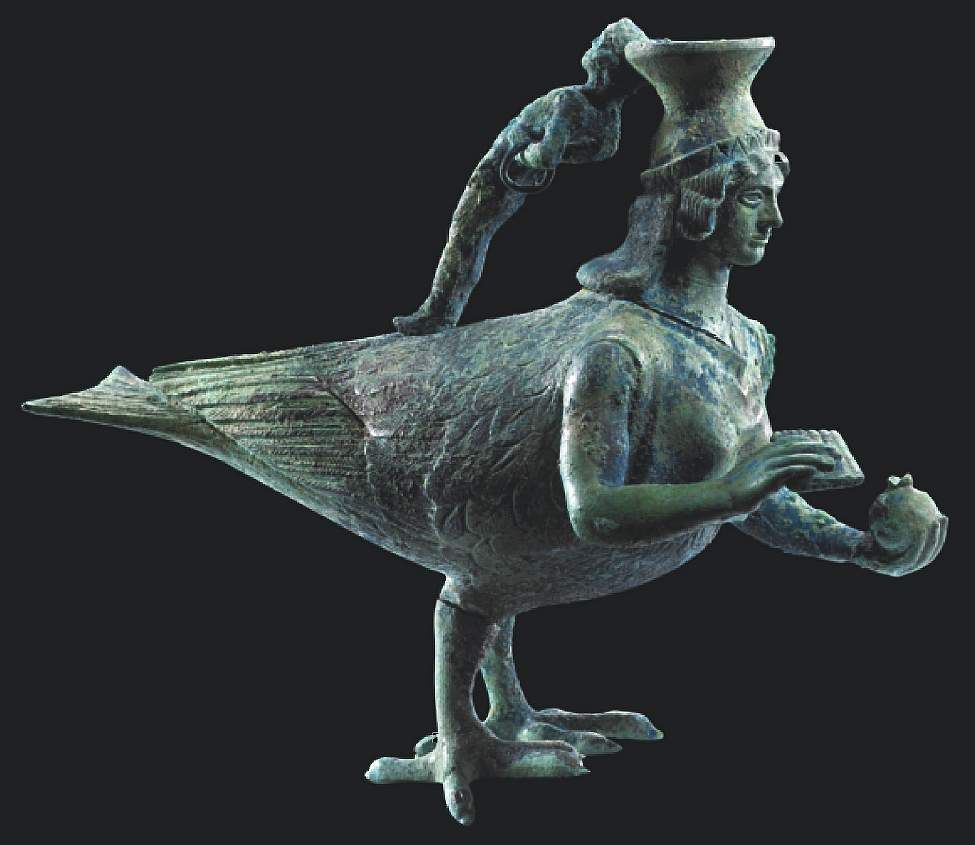
Quì abbiamo un askos pitagorico a forma di sirena. la siringa a sette canne rappresenta l’armonia dei sette astri, la melagrana il ciclo vita morte. Nel manico è raffigurata l’anima del defunto gestita dalla sirena del mito di ER con in mano la siringa.
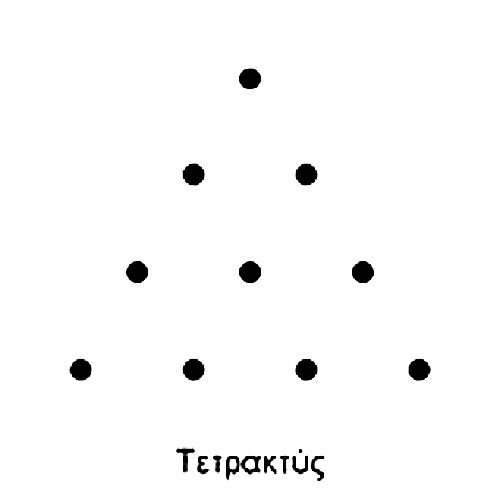
Nella successiva immagine vediamo la tetraktys, armonia delle sirene, che raffigura l’universo musicale pitagorico: l’ottava (1 in rapporto a 2), la quinta (2 in rapporto 3) e la quarta (3 in rapporto a 4).
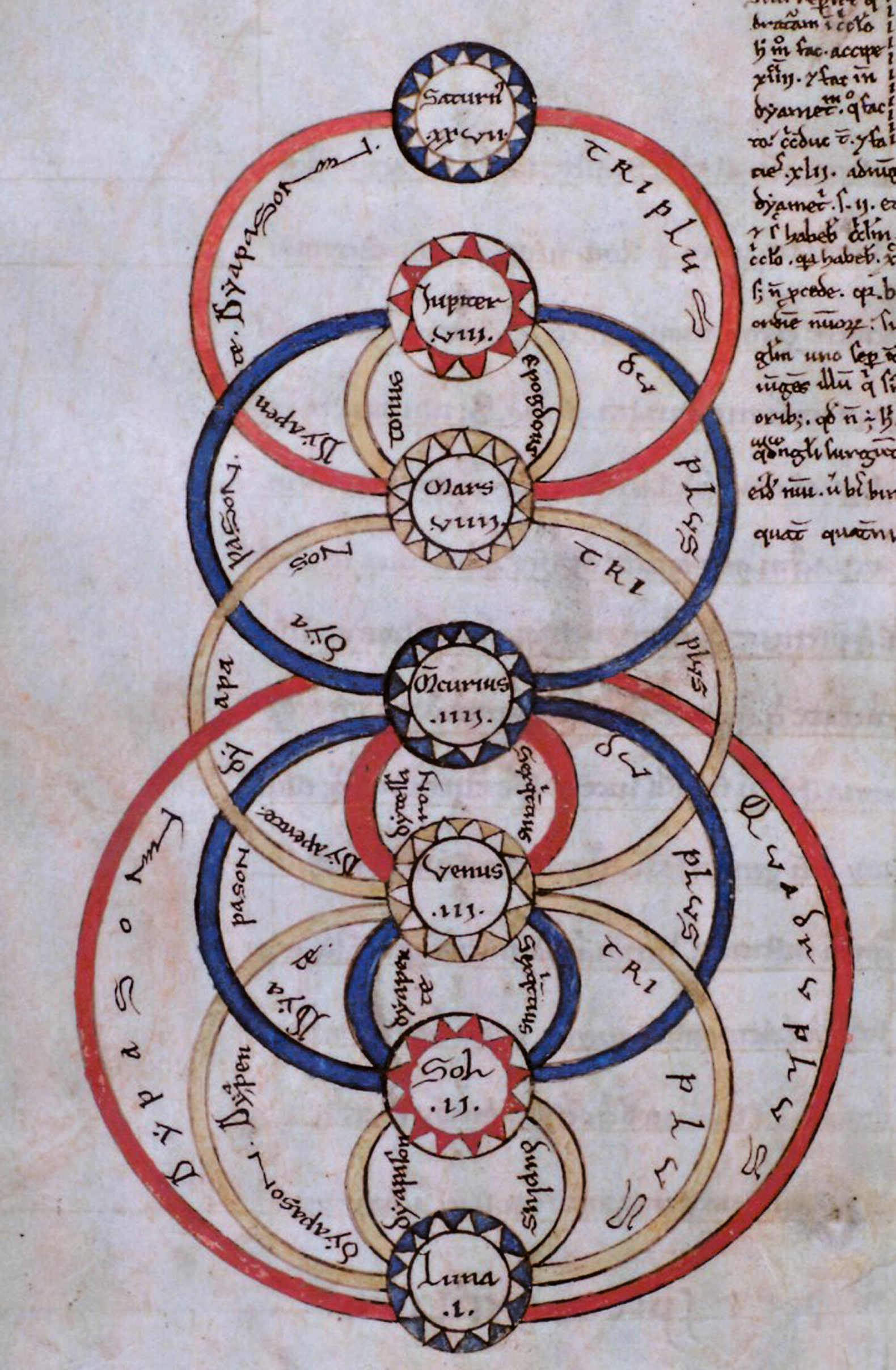
Nel sistema dei diapason pitagorici e nel Timeo di Platone, il diapason della luna risuona doppio fino al sole, triplo fino a venere e quadruplo fino a mercurio, eccetera.
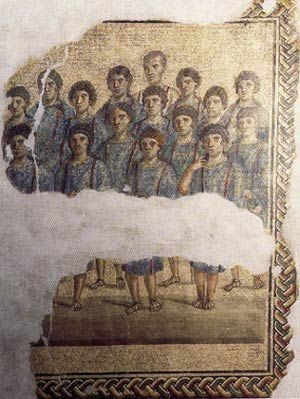
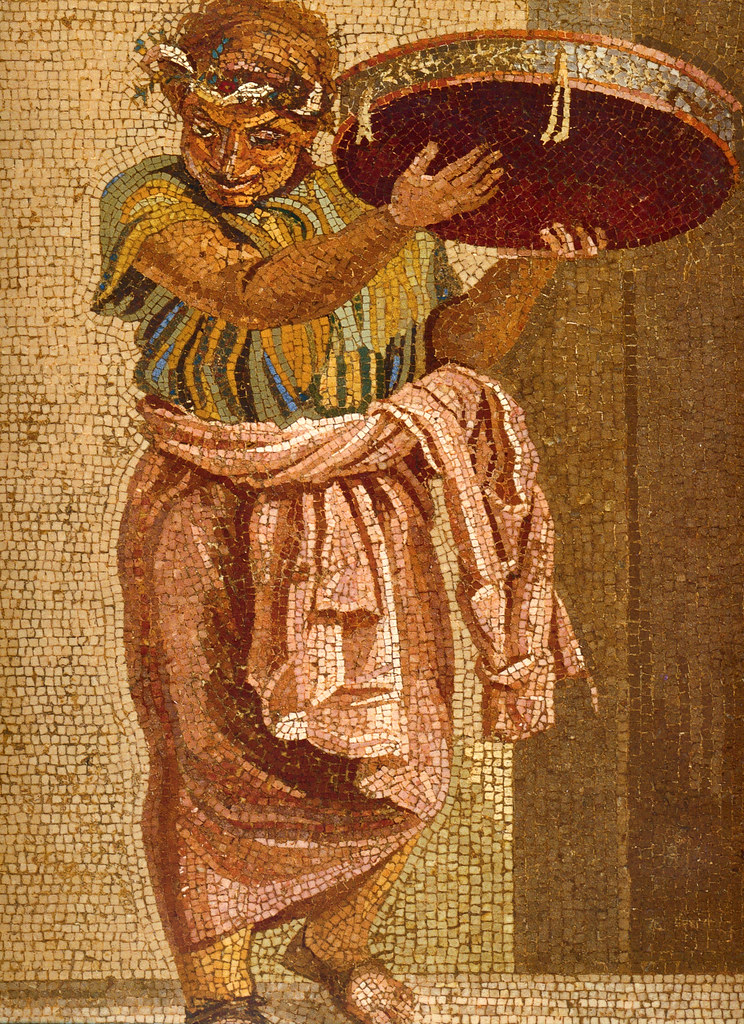
Dal museo di Capua vediamo un mosaico con coro sacro del terzo secolo dopo cristo, mentre dalla Villa del Cicerone di Pompei il mosaico di un musicista con timpano.
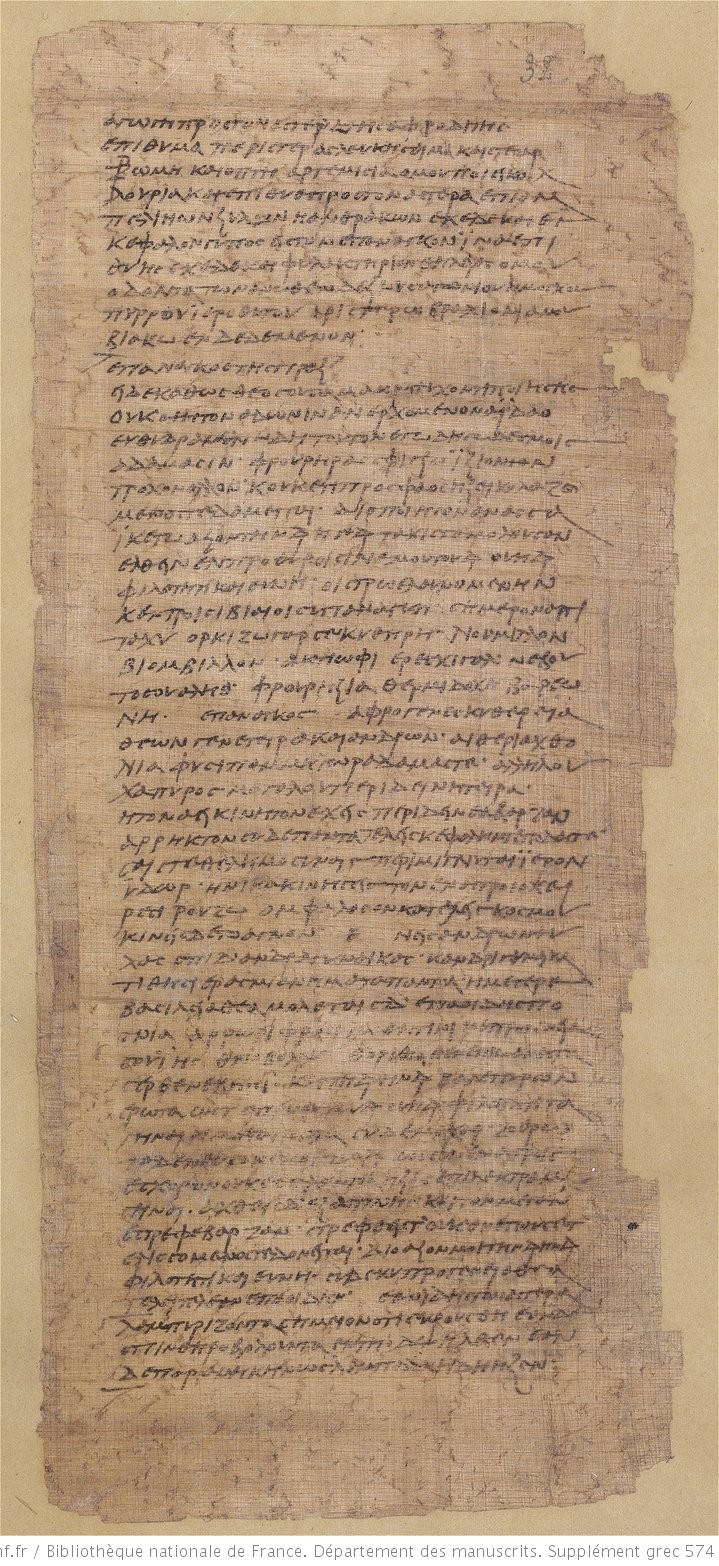
Nel Grande Papiro Magico di Parigi chiamato anche apathanatismos (ricetta di immortalità) e in altri papiri simili sono presenti intonazioni con vocali, fatte durante i logoi (parole di passo) corrispondenti a ciascun astro, durante il rito che mirava a pulire, lustrare, l’anima per l’ascesa agli astri, ovvero per l’immortalità.
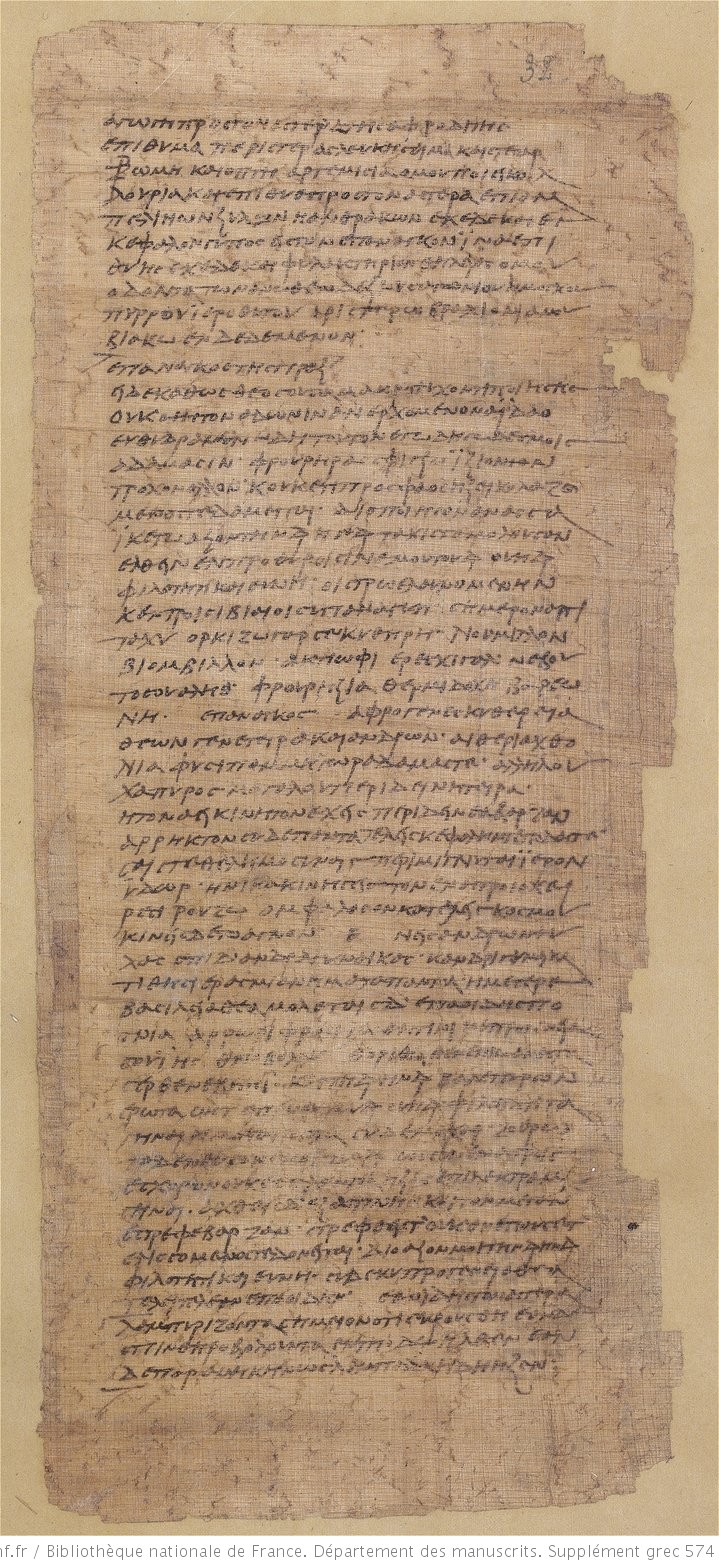

Qui una foto del papiro magico di Parigi e accanto una foto della struttura alveolare (oro?) del Sole fatta dall’osservatorio di Mauna Kea nelle Isole Hawaii.
Considerato che, nel rito, il logos del Sole viene subito dopo quello della Luna non vi sono, secondo noi, dubbi sull’attribuzione all’epoca ellenistico-alessandrina del papiro e non alla cultura mitraica, molto più tarda.
Ne consegue che il papiro magico per l’immortalità potrebbe essere stato verosimilmente usato dall’imperatore nei riti per la sua immortalità tramite ascesa agli astri.
Trattiamo ora della forma del cielo e delle similitudini col Pantheon.
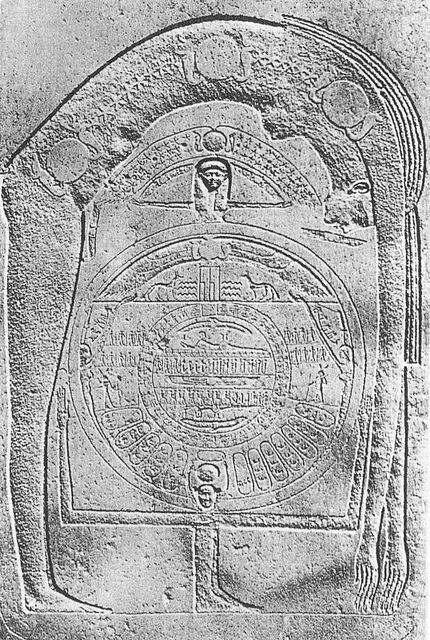

In questa stele egizia vediamo la dea Nut, con il corpo blu arcuato a cilindro, che sta a simboleggiare il firmamento. Qualche coincidenza con la struttura cilindrica originaria del Pantheon? Ovvero vi sono richiami egiziani, non solo nei riti ermetici, ma anche nella struttura?
Questo papiro raffigura un‘altra immagine della dea Nut arcuata sopra la terra, il dio Geb (Gaia) sdraiato. A metà sta il dio Shu che rappresenta l’aria.
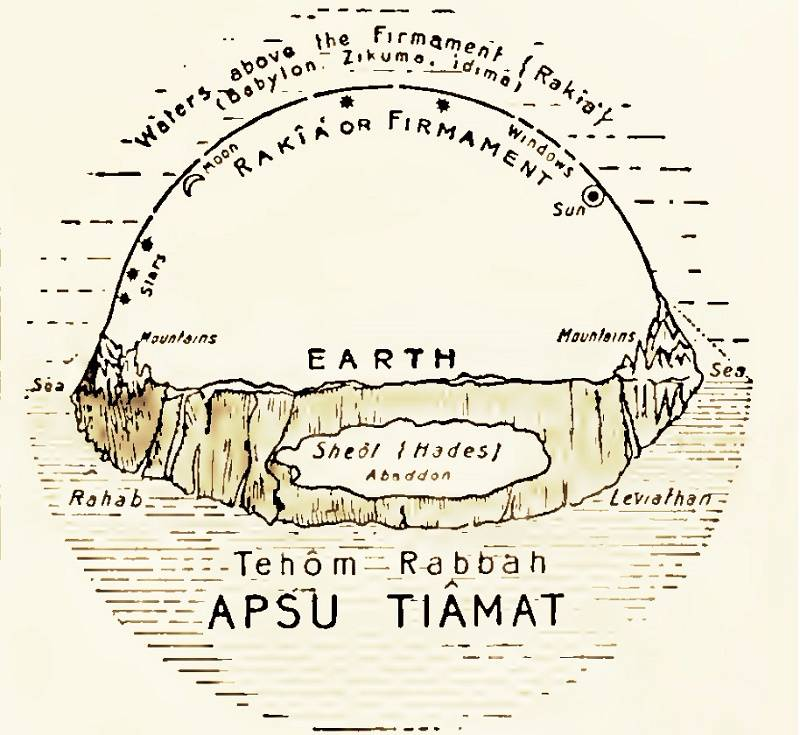
Qui vediamo una rappresentazione biblica del firmamento (raqia in ebraico) anch’esso arcuato a cilindro.
Se ne ricava che la strana forma del tempio del Pantheon, uguale al cilindro del cielo di cui parlava Ermete Trismegisto, sarebbe stata influenzata dalle concezioni cosmologiche egizie.

Oltre al richiamo alla cosmologia egizia, uno dei motivi della forma cilindrica era, secondo noi, l’uso rituale della struttura da usare per lustrazioni circumambulatorie.
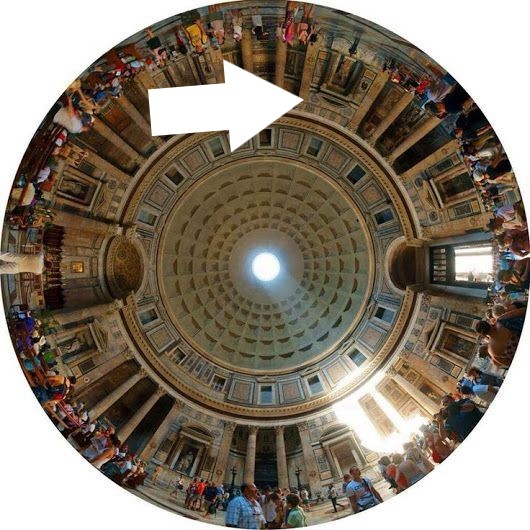
Crediamo che i riti lustrali circumambulatori, che riteniamo fossero tenuti all’interno per la purificazione dell’anima dell’imperatore, fossero svolti in direzione uguale al moto stellare, ovvero in senso orario (strofa).
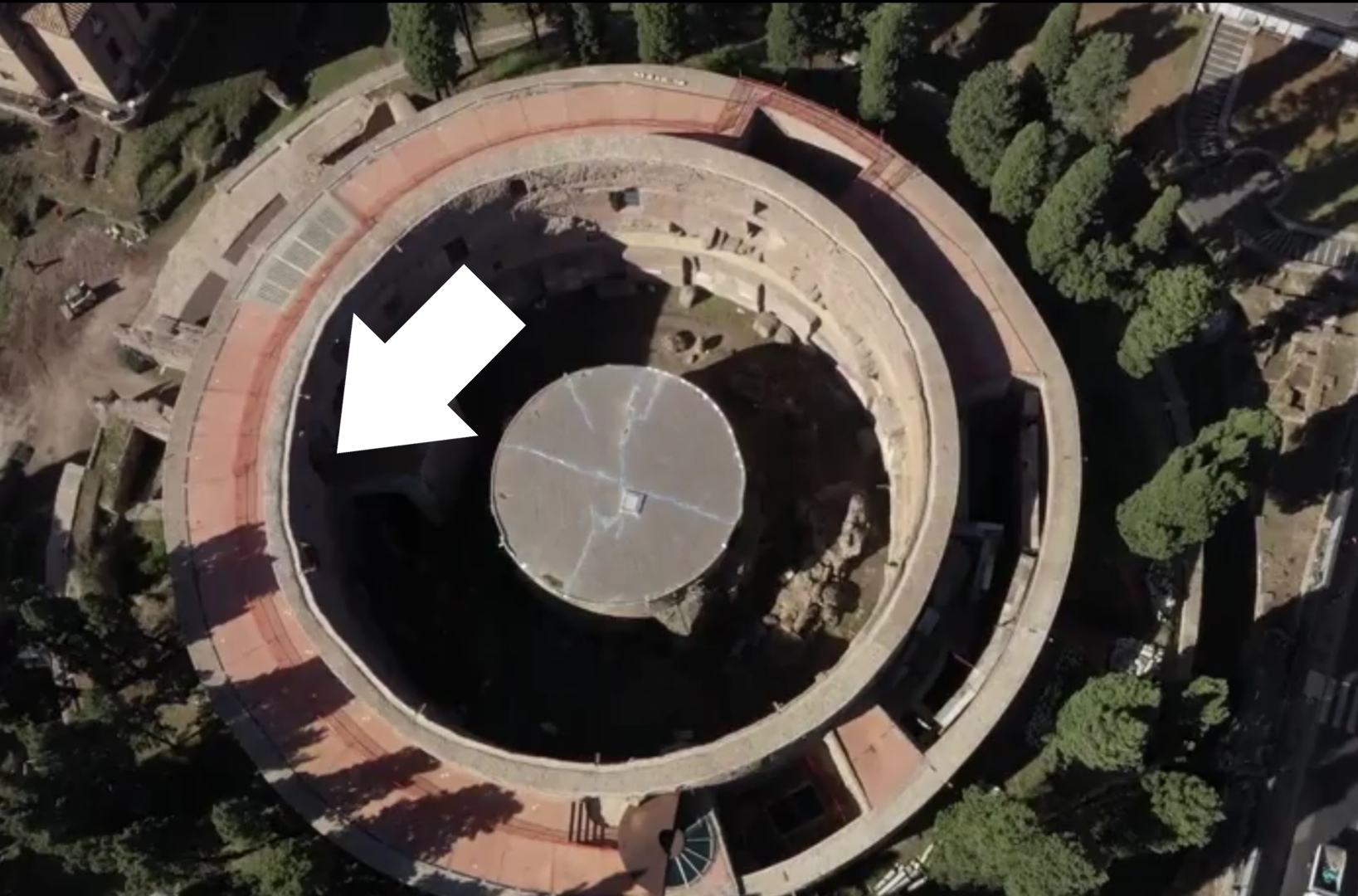
Supponiamo, poi che nel Mausoleo funebre di Augusto fossero tenuti riti circumambulatori in direzione contraria al moto stellare, ovvero in senso anti-orario (antistrofa).
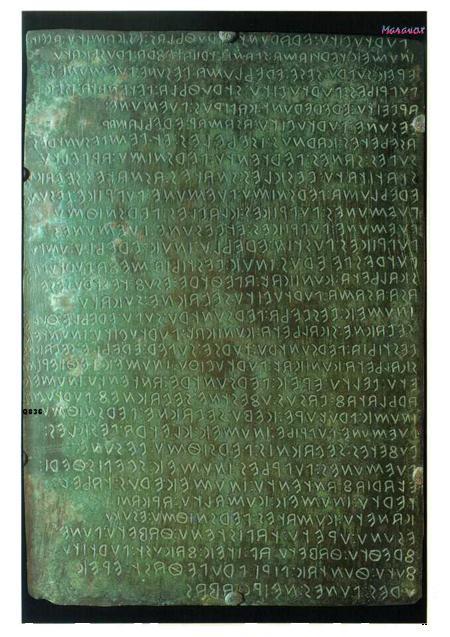
Nella foto le tabulae iguvinae : esse cono sette tavole bronzee rinvenute nell’antica Ikuvium (Gubbio). In esse sono descritti i cerimoniali di lustratio.
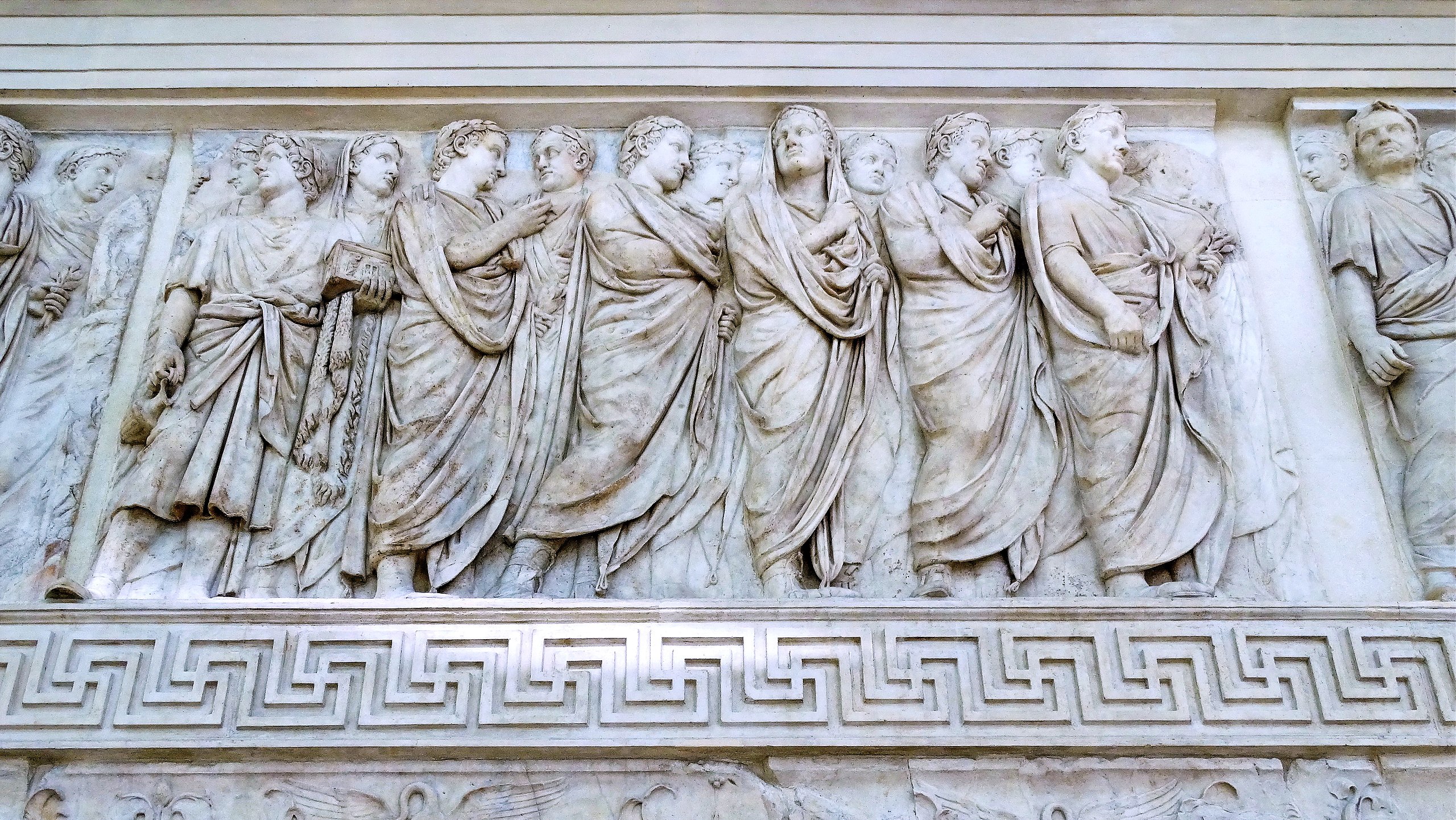
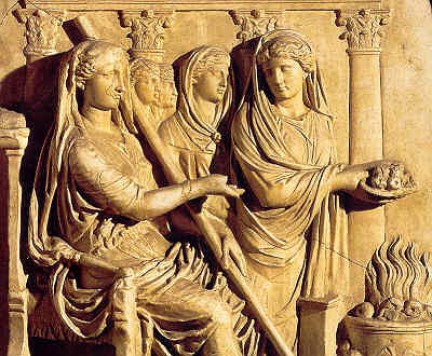
Sopra ammiriamo una processione imperiale ritratta nell’Ara Pacis di Roma.
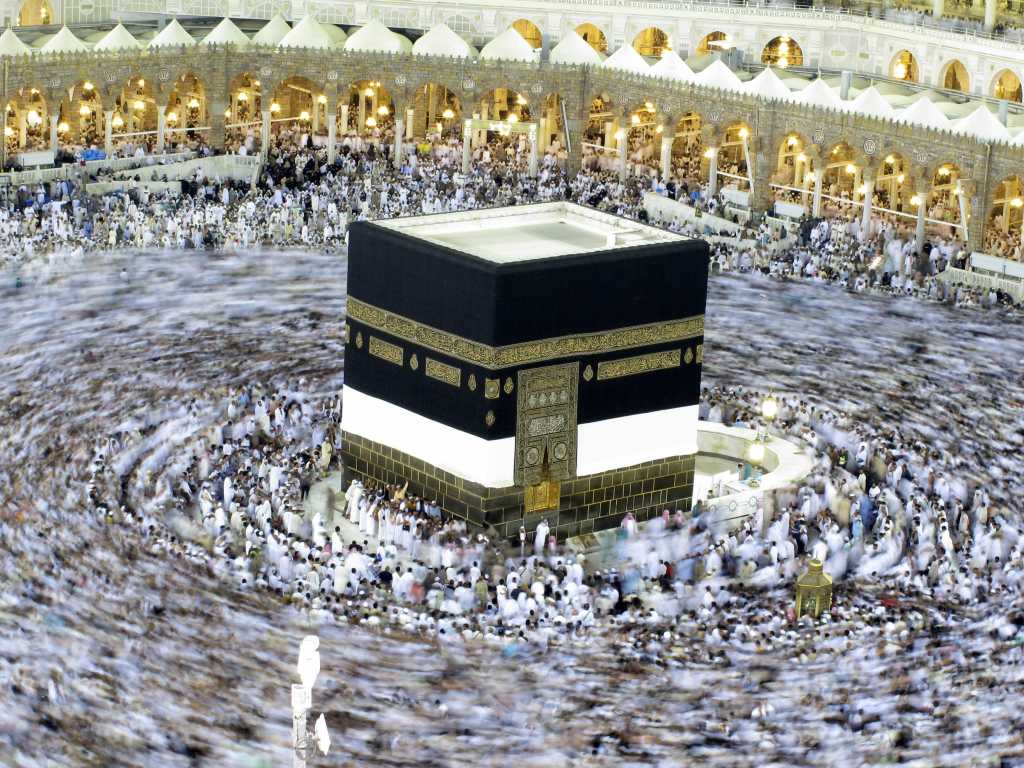
Una circumambulazione in senso antiorario è quella che si svolge oggi attorno alla Kaba, a La Mecca, in Arabia Saudita: ovvero il rito del ṭawaf.
Nella foto danze circumambulatorie odierne celebrate in Svezia attorno al midsommarstong, circumambulazione in senso orario attorno al palo, qui aggiunto di simbologie moderne.
Circa i concetti di strofa e antistrofa trattiamo ora delle danze dei pianeti e dei labirinti lustrali.
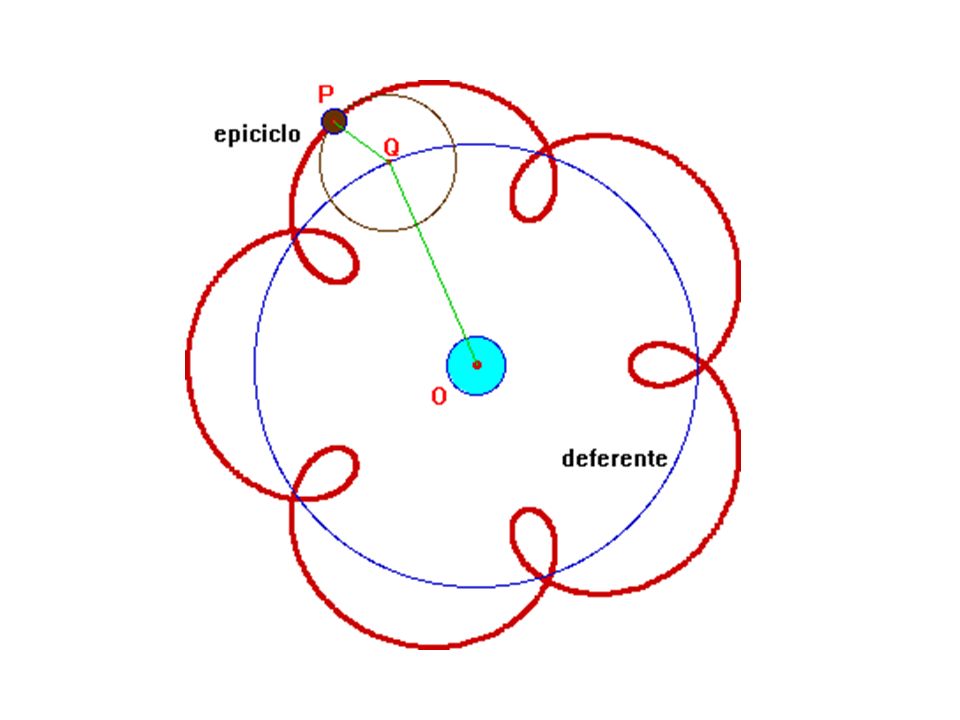

Di seguito una rappresentazione tolemaica della scoperta pitagorica del moto retrogrado. Esso sarebbe stato causato dalla combinazione di due orbite circolari (epiciclo e deferente).
Nell’immagine moti retrogradi di Marte (in rosso), Mercurio (in viola) e Venere (in verde) visti dalla Terra (tempo di percorrenza sette anni). E’ da notare che a ogni nodo corrisponde un moto retrogrado
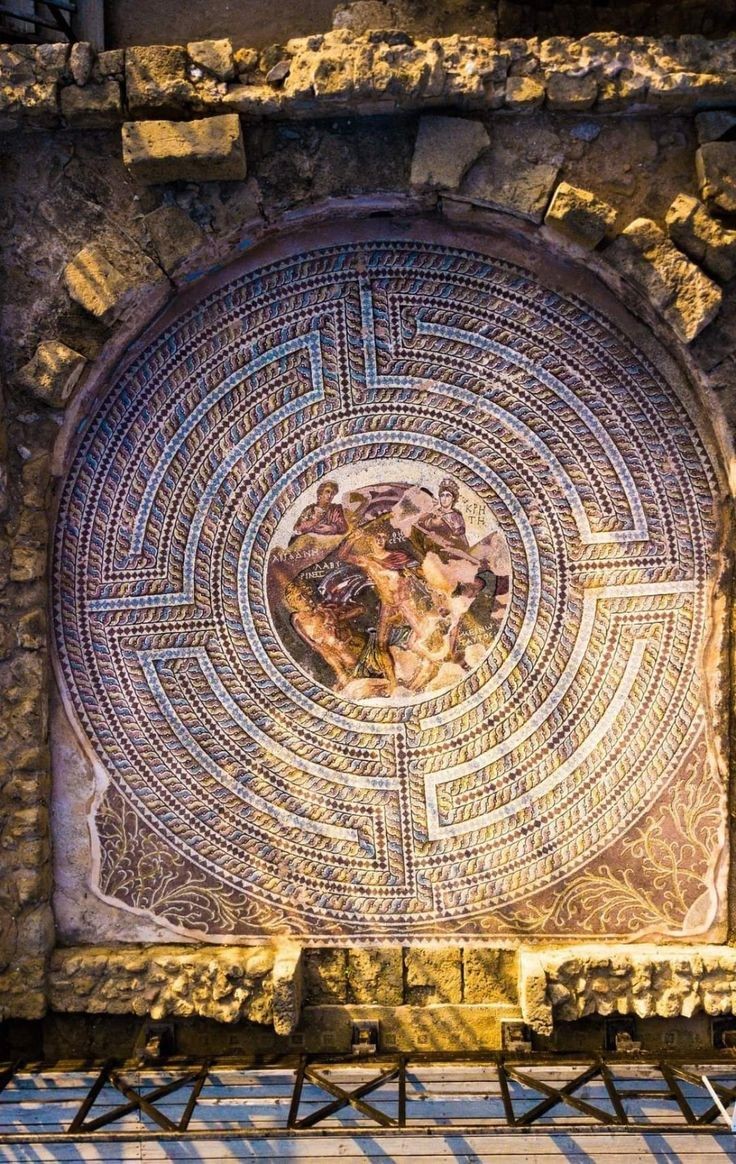
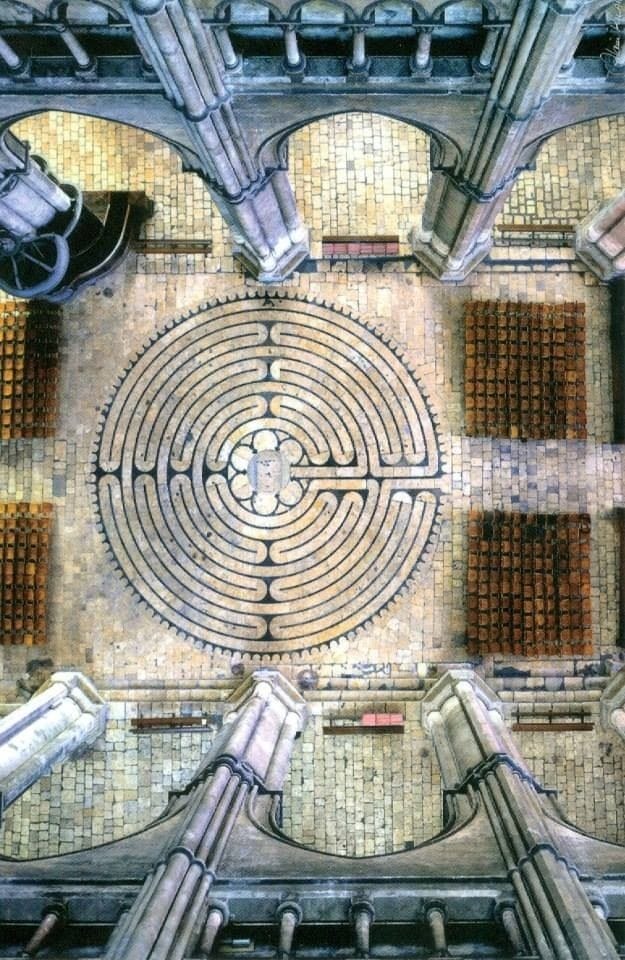
Riteniamo che nel labirinto (nella foto Teseo e Minotauro a Paphos, Cipro), imitando il moto dei pianeti, si praticassero cerimonie lustrali in strofa (avanti) e antistrofa (indietro). Qui il labirinto della la cattedrale di Chartres: notare la rosa interna.
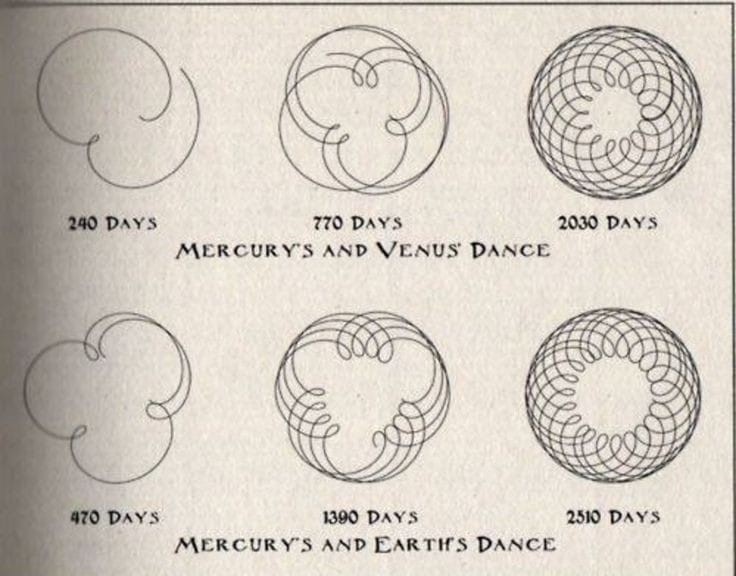

Nella foto la danza dei pianeti Mercurio e Venere negli anni. La danza di Mercurio assume la forma di una corona circolare. Il pianeta Venere assume la forma di una rosa cosmica (pentalfa) con i suoi moti retrogradi in otto anni.
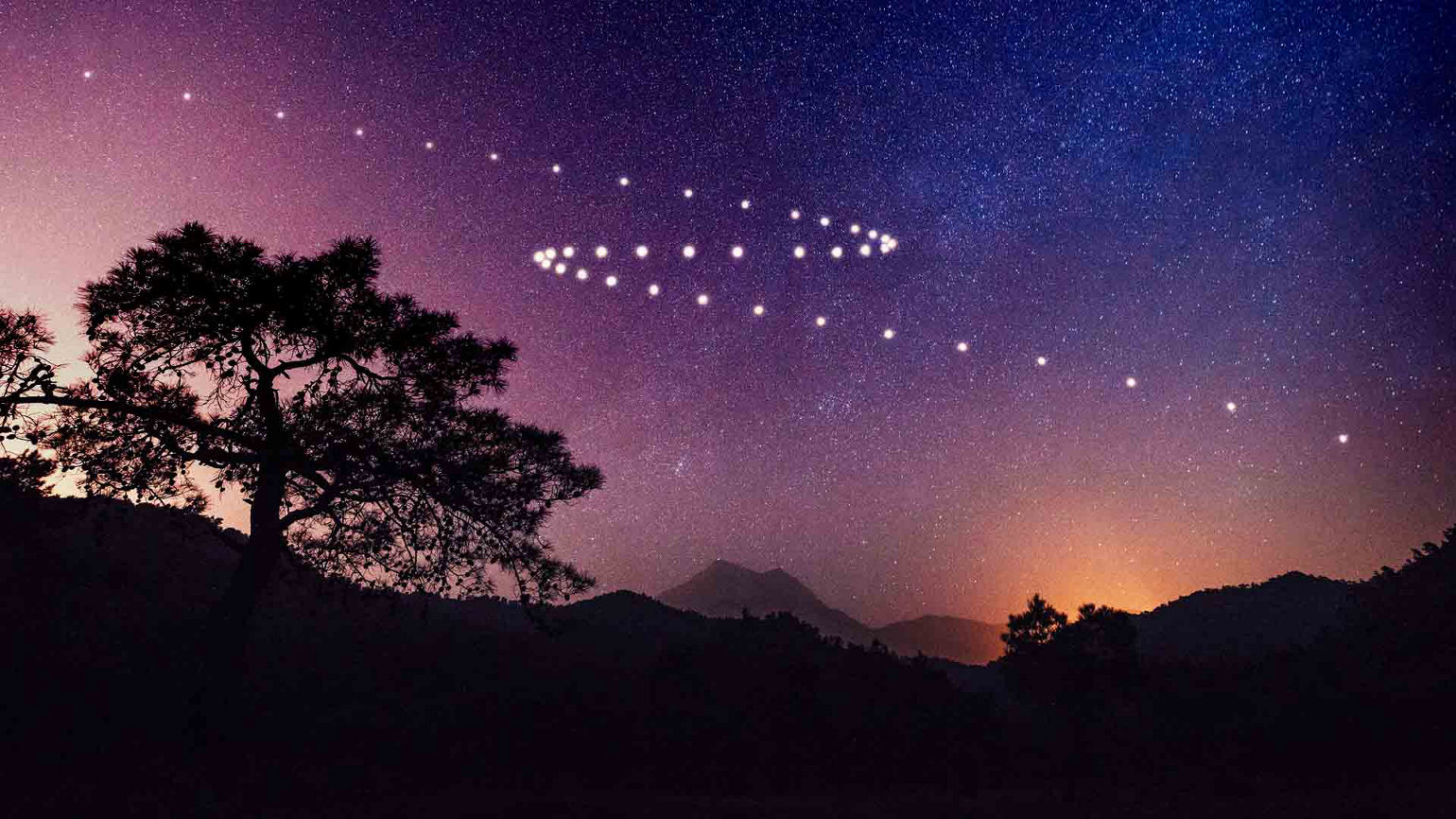
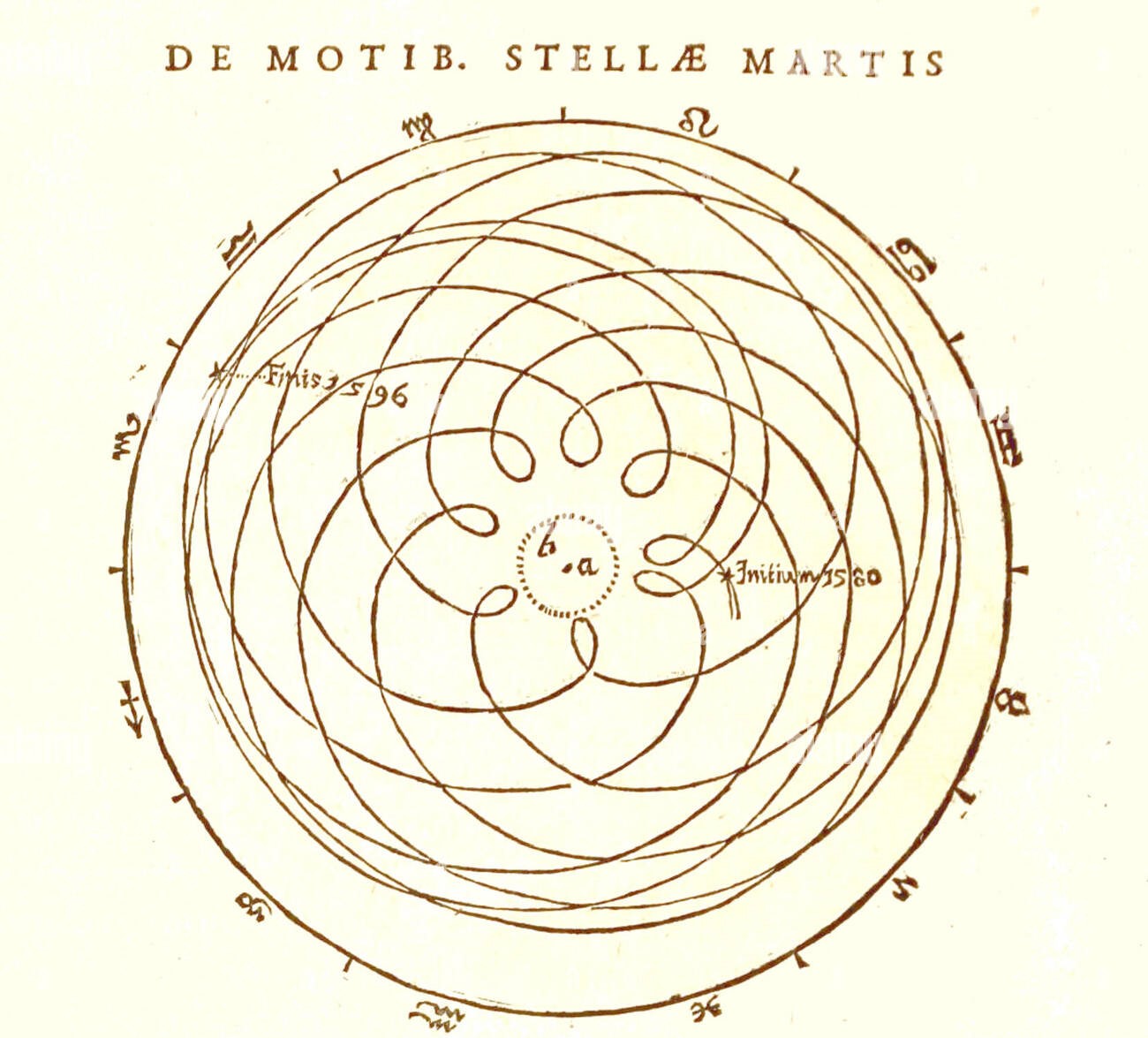
Nella foto la danza all’indietro del pianeta Marte e il moto retrogrado dello stesso pianeta descritto da Keplero.
Oltre alla concezione cosmologica, anche egizie erano le tecniche di ascesa stellare.
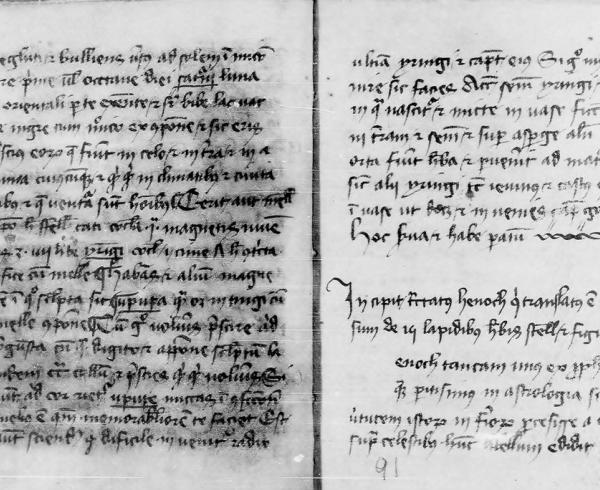
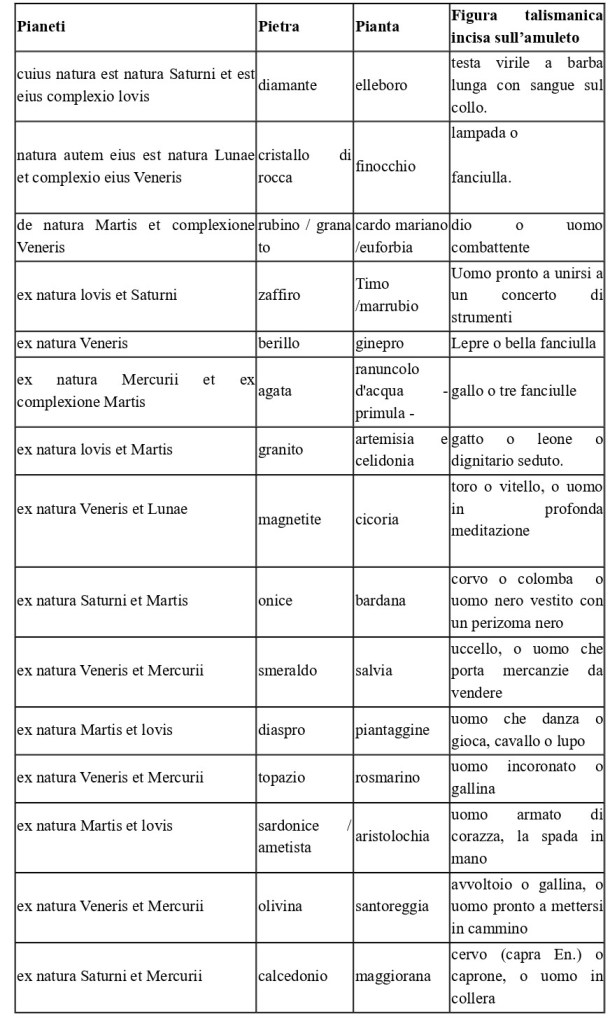
Nella foto il Liber de quindecim stellis di Hermes Abhaidimon, fonte usata per l’abbinamento tra astri, piante e pietre per i riti di ascesa alle stelle.
Nella foto successiva il Grande Papiro Magico di Parigi, chiamato anche manuale per l’immortalità, che riteniamo fosse stato usato da Ottaviano causa la sua origine egiziana alessandrina di poco precedente all’età augustea.
Nelle immagini vediamo un abbinamento tra astri, piante e pietre del Liber de quindecim stellis.
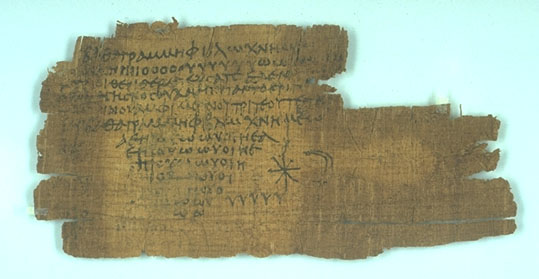
Qui è ritratto un papiro egiziano del terzo secolo dopo cristo: i vocalizzi alla fine così suonano: aeeiooouoieea – eeiooouoiee – eiouoouoie – iouoouoi- ouoououoou uuuuu- oo. Da notare la presenza della Stella e della Luna sui lati del papiro.
Nella foto un’amuleto egiziano di diaspro verde: nella fronte, osiride con due falchi in barca. Sul retro, incisione di vocalizzi aeêiouô. Il diaspro e’ pietra consacrata a marte e giove.
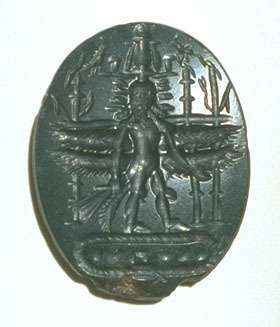
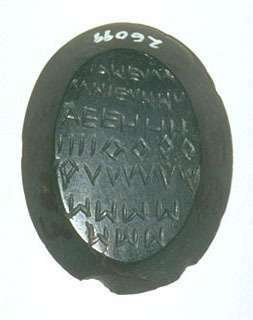
Nella foto un altro amuleto egiziano di diaspro verde. Nella fronte: una figura magica con quattro ali ed una coda. Su retro un’altra vocalizzazione: iaô eulamô ieuêêu a ee êêê iiii ooooo uuuuuu ôôôôôôô.

Nella foto una piantaggine (plantago lanceolata) : trattasi di una specie vegetale associata al diaspro e ai pianeti Marte e Giove.
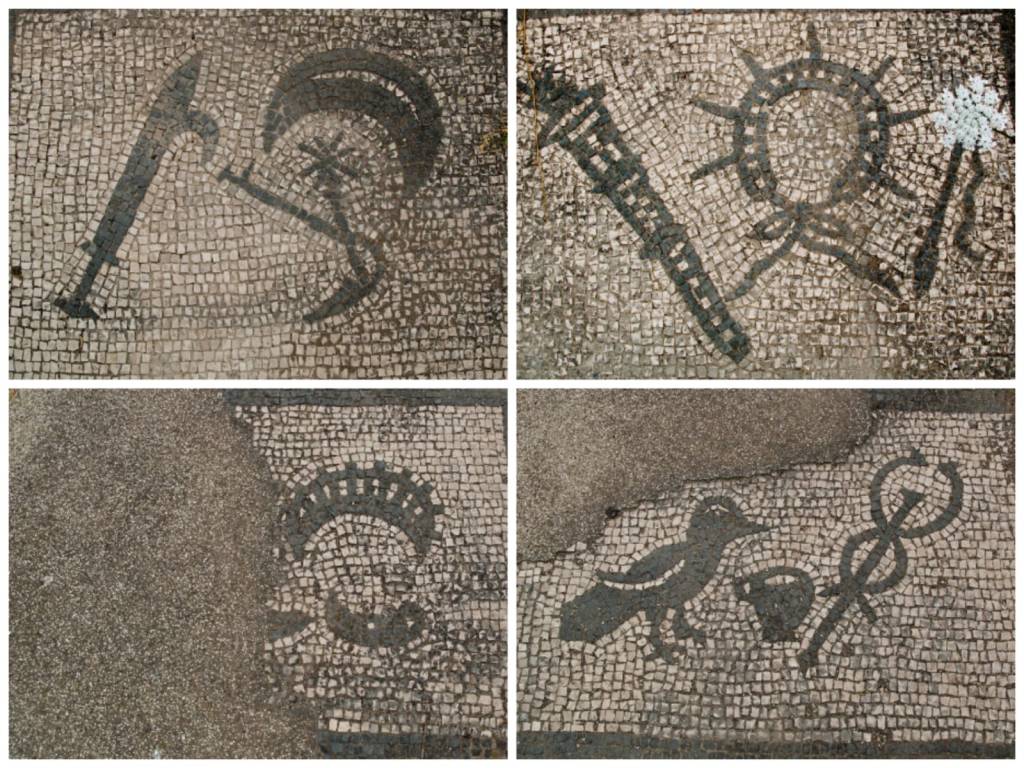
Co riferimento alla stessa tecnica rituale per l’ascesa agli astri vediamo nella foto simboli mitraici per l’ ascesa agli astri rappresentati nel Mitreo di Felicissimus a Ostia Antica risalente alla seconda metà del terzo secolo dopo cristo. Nel primo segmento quelli della Luna, nel secondo quelli del Sole, nel terzo quelli di Venere, nel quarto quelli di Mercurio.
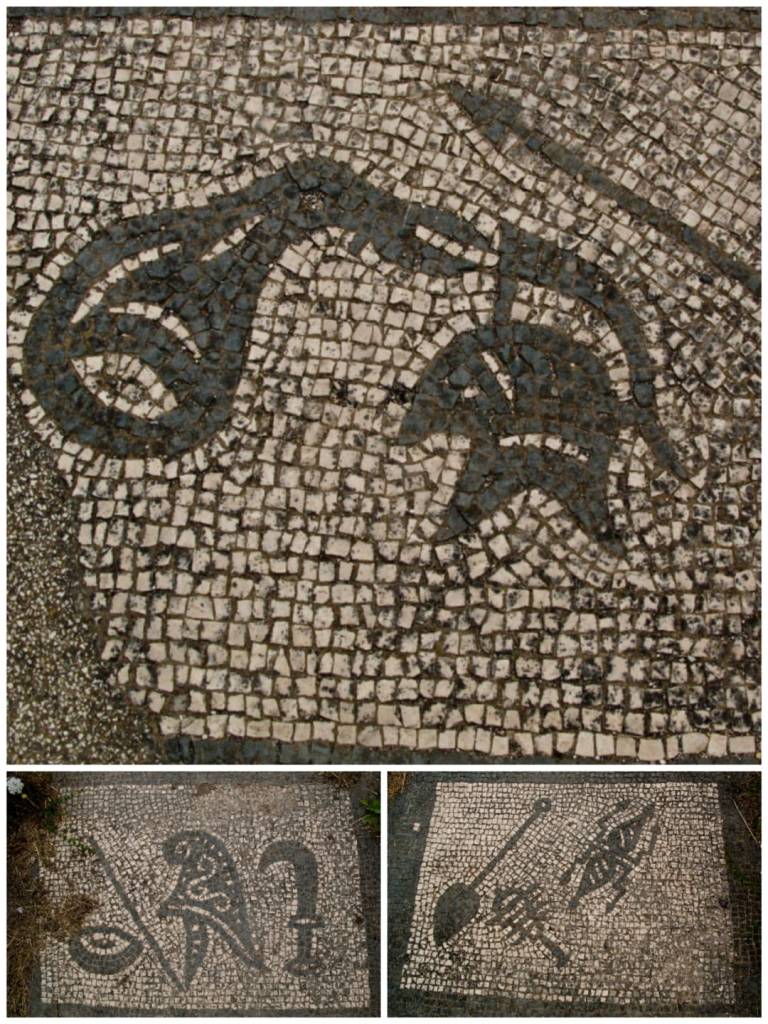
Altri simboli mitraici per l’ ascesa agli astri nel mitreo di Felicissimus sono nel primo segmento quelli di Marte, nel secondo quello di Giove, nel terzo quelli di Saturno.
Le tecniche rituali di ascesa erano, dunque, conoscenze dettagliatamente codificate nelle procedure rituali espresse in parole, suoni, simboli e segni.
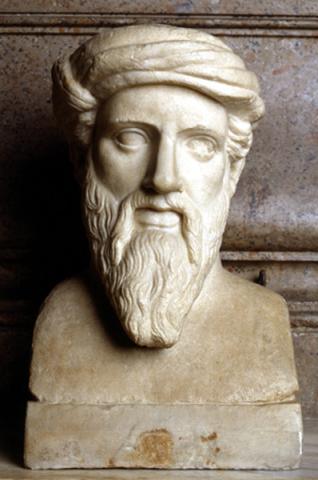
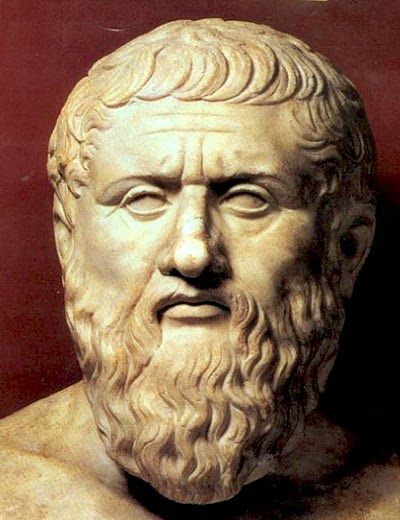
Tutto era fondato sulla tesi pitagorica e poi platonica della consustanzialità tra anima e stelle, costituite della stessa sostanza, l’etere, rotante nello stesso senso orario delle stelle.
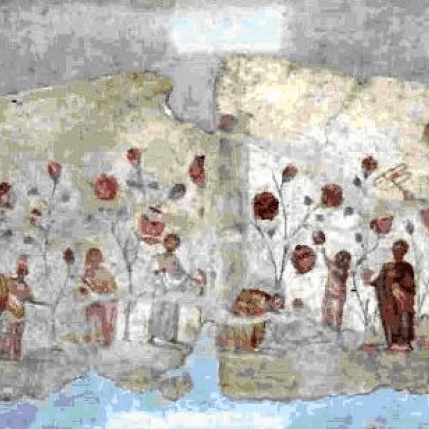

Nelle immagini vediamo scene delle anime nei Campi Elisi. Di seguito ritratti apposti su mummie di epoca romana.
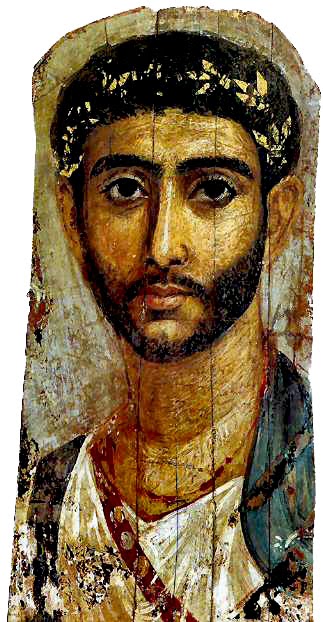
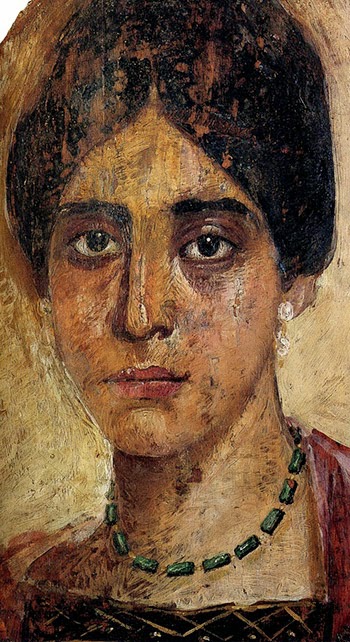
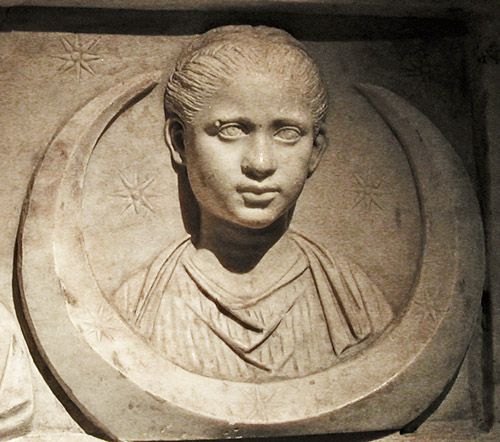
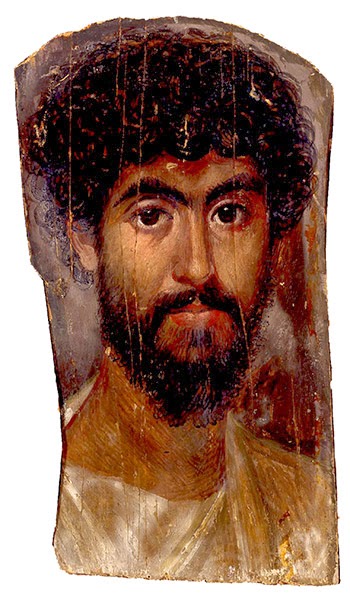
E infine l’immagine di un sarcofago con un giovane ritratto sopra la luna e tra gli astri.
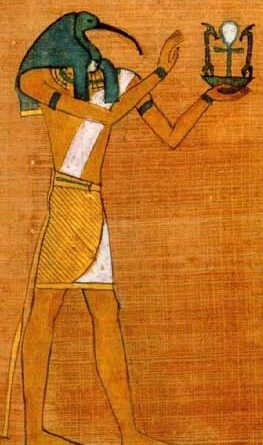
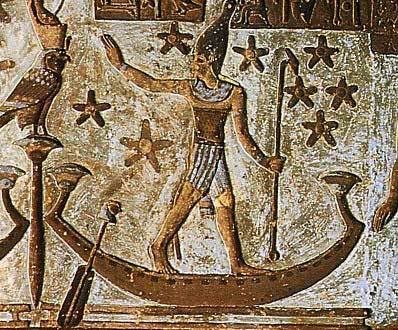
Se si voleva conseguire la peculiare qualità delle stelle, ovvero la perenne immortalità, occorreva seguirne lo stesso moto circumambulando nello stesso senso, in armonia tra corpo e anima, perché gli incorporei si riflettono nei corpi e i corpi negli incorporei, vale a dire il mondo sensibile nel mondo intelligibile e l’intelligibile nel sensibile, come insegnava Hermes Trismegistus
Un imperatore che avesse voluto consacrare, con la sua ascensio ad astra, l’inizio dell’impero fondato su un nuovo patto tra Roma e gli Dei, non avrebbe potuto non rispettare al dettaglio tali tecniche, a scanso di nefaste empietà.
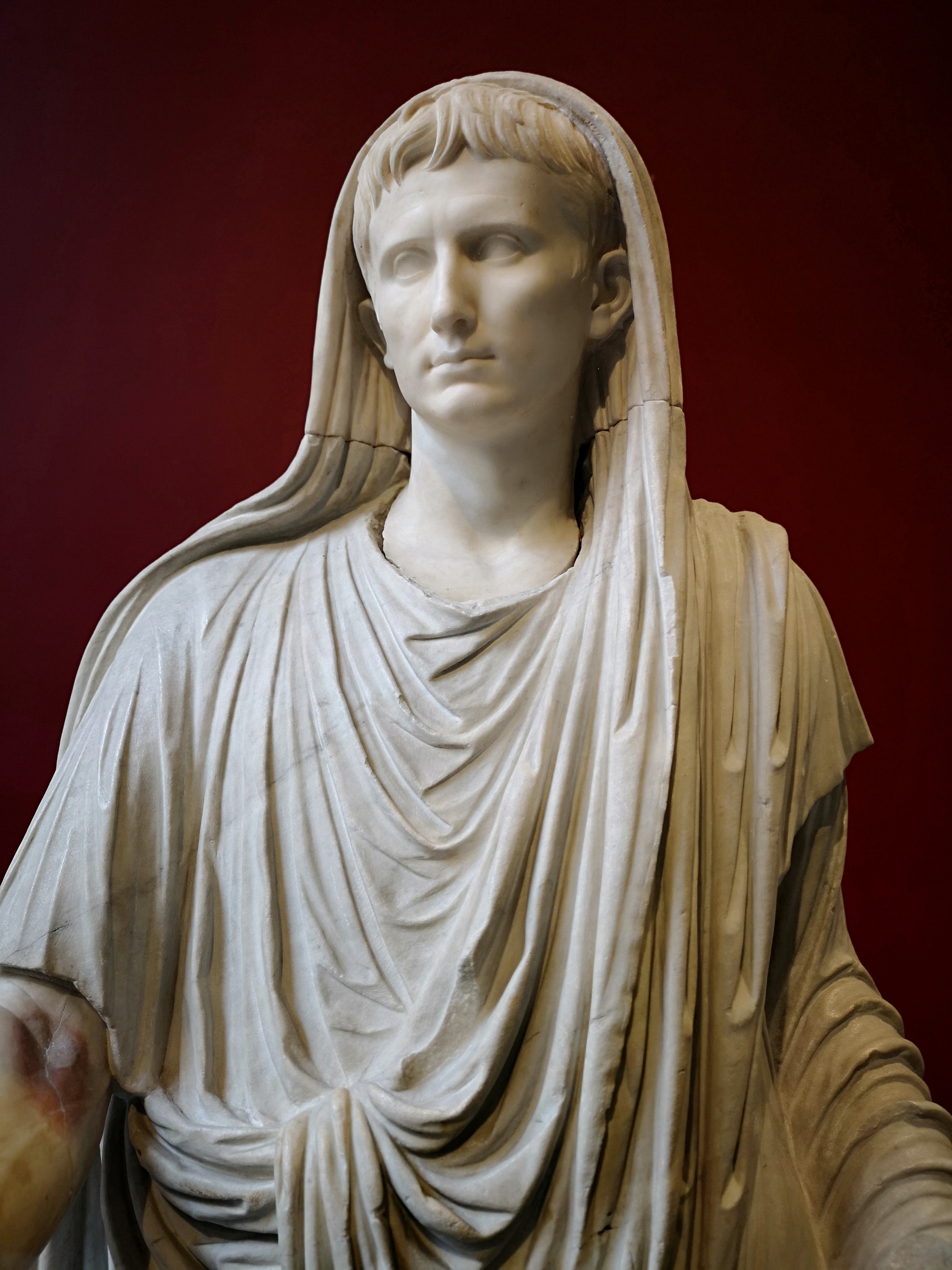
Immaginiamo, dunque, per un momento, Ottaviano durante la celebrazione del rito d’immortalità. Eccolo, vestito di bianco seguire la processione circumambulatoria, guidata dalle Vestali, all’interno del Pantheon. Lo sentiamo, urlare, imperioso, agli astri: Silenzio! Silenzio. Sono un astro che procede con voi e che splende dall’abisso, per come scritto nel Papiro Magico di Parigi.
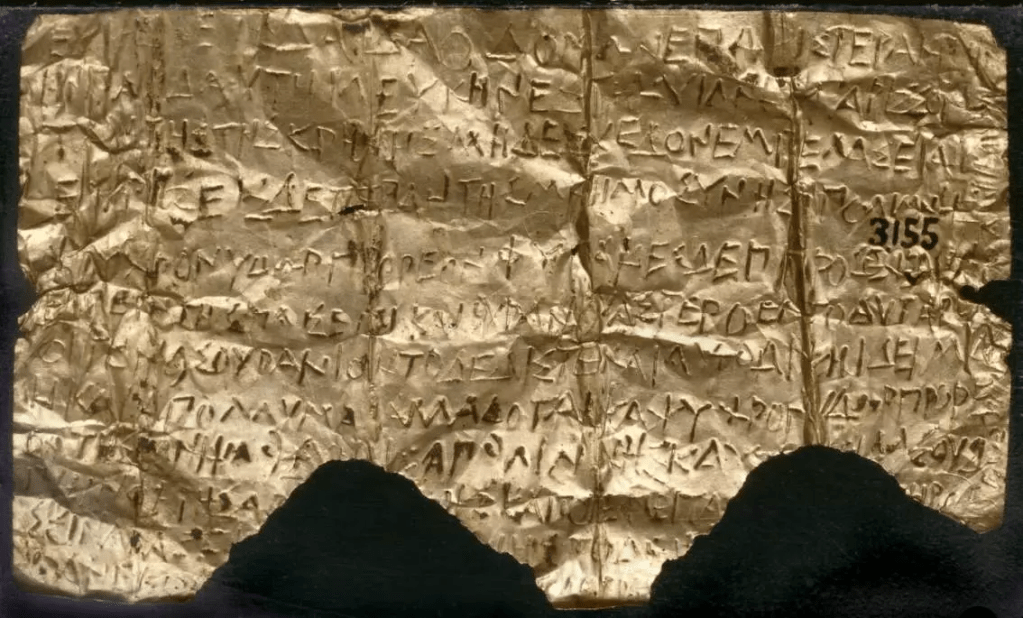
Lo vediamo alla fine stringere nella mano la lamina d’oro orfica su cui è scritto: Sono figlio della terra e del cielo stellato, sono di razza celeste, sappiatelo.
(temi tratti da “Il Pantheon del Cielo” di Aurelio Bruno, 2022, ISBN: 9798844154249)
https://www.termsfeed.com/live/745766ca-724f-4b41-a580-8e4251984660
Disclaimer
Last updated: February 26, 2023
Interpretation and Definitions
Interpretation
The words of which the initial letter is capitalized have meanings defined under the following conditions. The following definitions shall have the same meaning regardless of whether they appear in singular or in plural.
Definitions
For the purposes of this Disclaimer:
- Company (referred to as either “the Company”, “We”, “Us” or “Our” in this Disclaimer) refers to Il Pantheon del Cielo.
- Service refers to the Website.
- You means the individual accessing the Service, or the company, or other legal entity on behalf of which such individual is accessing or using the Service, as applicable.
- Website refers to Il Pantheon del Cielo, accessible from www.pantheondecoded.org
Disclaimer
The information contained on the Service is for general information purposes only.
The Company assumes no responsibility for errors or omissions in the contents of the Service.
In no event shall the Company be liable for any special, direct, indirect, consequential, or incidental damages or any damages whatsoever, whether in an action of contract, negligence or other tort, arising out of or in connection with the use of the Service or the contents of the Service. The Company reserves the right to make additions, deletions, or modifications to the contents on the Service at any time without prior notice. This Disclaimer has been created with the help of the TermsFeed Disclaimer Generator.
The Company does not warrant that the Service is free of viruses or other harmful components.
External Links Disclaimer
The Service may contain links to external websites that are not provided or maintained by or in any way affiliated with the Company.
Please note that the Company does not guarantee the accuracy, relevance, timeliness, or completeness of any information on these external websites.
Errors and Omissions Disclaimer
The information given by the Service is for general guidance on matters of interest only. Even if the Company takes every precaution to insure that the content of the Service is both current and accurate, errors can occur. Plus, given the changing nature of laws, rules and regulations, there may be delays, omissions or inaccuracies in the information contained on the Service.
The Company is not responsible for any errors or omissions, or for the results obtained from the use of this information.
Fair Use Disclaimer
The Company may use copyrighted material which has not always been specifically authorized by the copyright owner. The Company is making such material available for criticism, comment, news reporting, teaching, scholarship, or research.
The Company believes this constitutes a “fair use” of any such copyrighted material as provided for in section 107 of the United States Copyright law.
If You wish to use copyrighted material from the Service for your own purposes that go beyond fair use, You must obtain permission from the copyright owner.
Views Expressed Disclaimer
The Service may contain views and opinions which are those of the authors and do not necessarily reflect the official policy or position of any other author, agency, organization, employer or company, including the Company.
Comments published by users are their sole responsibility and the users will take full responsibility, liability and blame for any libel or litigation that results from something written in or as a direct result of something written in a comment. The Company is not liable for any comment published by users and reserves the right to delete any comment for any reason whatsoever.
No Responsibility Disclaimer
The information on the Service is provided with the understanding that the Company is not herein engaged in rendering legal, accounting, tax, or other professional advice and services. As such, it should not be used as a substitute for consultation with professional accounting, tax, legal or other competent advisers.
In no event shall the Company or its suppliers be liable for any special, incidental, indirect, or consequential damages whatsoever arising out of or in connection with your access or use or inability to access or use the Service.
“Use at Your Own Risk” Disclaimer
All information in the Service is provided “as is”, with no guarantee of completeness, accuracy, timeliness or of the results obtained from the use of this information, and without warranty of any kind, express or implied, including, but not limited to warranties of performance, merchantability and fitness for a particular purpose.
The Company will not be liable to You or anyone else for any decision made or action taken in reliance on the information given by the Service or for any consequential, special or similar damages, even if advised of the possibility of such damages.
Contact Us
If you have any questions about this Disclaimer, You can contact Us:
- By email: pantheondecoded@gmail.com
-
LA MUSICA DELLE SFERE
aureliobruno©2023
ASCESA PER MEZZO DELLA MUSICA
Torniamo al Pitagorismo. Esso, vedremo, fornirà a chiave per decodificare la funzione del Pantheon.
I Pitagorici, come disse Aristosseno, “purificavano il corpo con la medicina e l’anima con la musica”.
Pitagora usava soprattutto questo modo di purificazione, come egli chiamava la medicina esercitata mediante la musica, secondo Giamblico La musica, anticamente, fino ai Pitagorici, era ammirata e detta purificazione.
Pitagora “udiva l’armonia dell’universo, intendendo la generale armonia delle sfere e degli astri mossi da queste, che noi non possiamo ascoltare per l’insufficienza della natura” riporta Porfirio.
E gli “Oracoli caldaici” dicono che, dopo che l’anima si spoglia delle vesti delle sfere prima di giungere al Cielo supremo, arrivata al termine, “canta un peana”.
Abbiamo fatto prima cenno alla concezione dell’armonia pitagorica delle sfere che associava toni e semitoni agli otto cieli sopra la Terra.
Plutarco scrive:
Ora, che l’armonia sia augusta, cosa divina e grande, Aristotele, discepolo di Platone, lo segnala in questi termini: “L’armonia è celeste, e la sua natura è divina, tutta bella e meravigliosa. Costituita in valore da quattro membri”, ha due medie una aritmetica e l’altra armonica. Tutto in essa, membri, grandezze ed eccedenze, obbediscono manifestamente al numero e all’isometria in effetti è secondo due intervalli di quattro note che si misura il ritmo del canto.
Il sistema pitagorico della gamma armonica planetaria, cui abbiamo prima fatto cenno, fu importato a Roma da Varrone, a sua volta in qualche modo ripreso da Cicerone nel Somnium Scipionis.
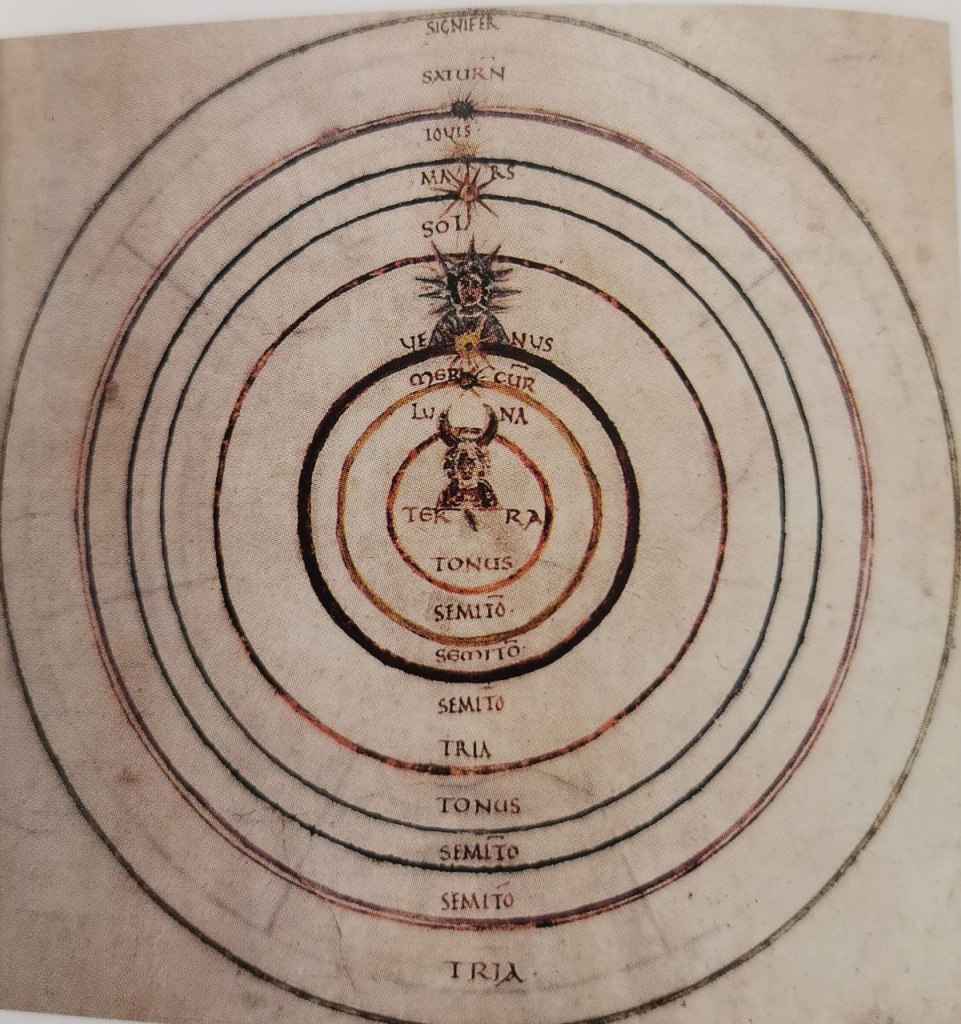
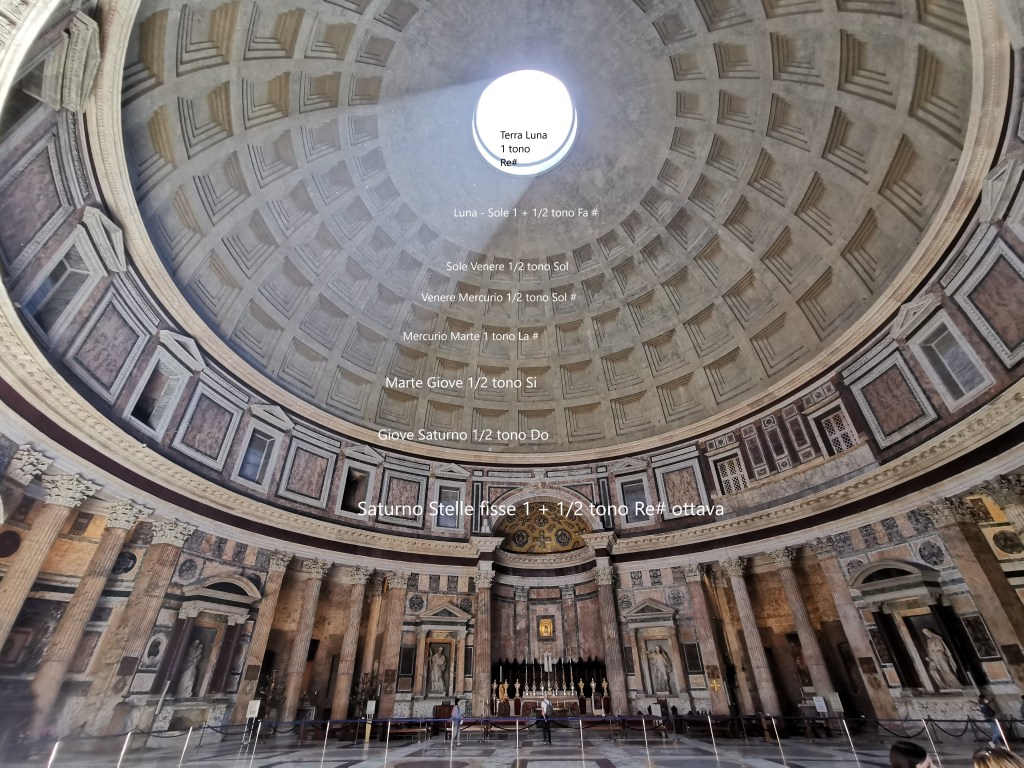
I rapporti di tonalità tra pianeta e pianeta, cioè tra corda e corda della cetra apollinea, erano i seguenti: 1 Luna, ½, Mercurio, ½ Venere, 1 Sole, 1 Marte, ½ Giove, ½ Saturno (½ Cielo delle stelle fisse).
Su probabile influsso di Nigidio Figullo, Igino, ha apportato qualche modifica alla sequenza tonale. Egli associava la gamma alla velocità di rotazione dei pianeti, cioè alla loro presumibile distanza dalla Terra e tra loro. Igino supponeva che ciascun pianeta avesse la stessa velocità di spostamento: più lento era il pianeta, più lontano lo stesso era. L’ordine seguito da Igino è quello caldeo-pitagorico con il Sole al centro, mentre Eratostene, Platone e Aristotele seguivano, come visto, l’ordine egizio, con il Sole subito dopo la Luna, poi gli altri pianeti.
L’analogia fra i movimenti armonici e le rivoluzioni dell’anima facevano dire a Plutarco che la musica esercita sull’anima un’azione tranquillizzante.
Nel “Sogno di Scipione” di Cicerone l’armonia cosmica era il prodotto di otto sfere in movimento, mentre la nona, la sfera della Terra, era immobile. Quando Scipione Emiliano, salito alle regioni celesti, chiede al suo avo: “Ma che suono è questo, così intenso e armonioso, che riempie le mie orecchie?” l’Africano risponde:
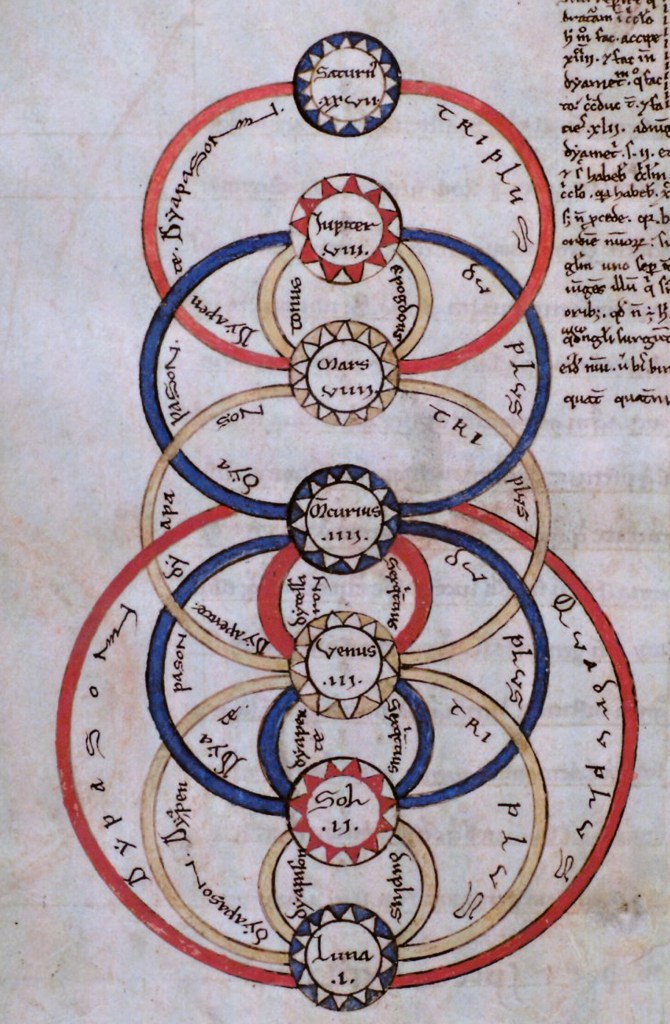
“È il suono che, separato in funzione d’intervalli ineguali eppure distinti da una razionale proporzione, è cagionato dalla spinta e dal moto delle sfere stesse che, temperando i toni acuti con i bassi, realizza varie e proporzionate armonie. […] L’orbita stellare suprema, la cui rotazione è la più veloce, si muove con suono più acuto e concitato, mentre questa sfera Lunare, la più bassa, produce il suono più grave. La Terra, infatti, nono globo, poiché resta immobile, rimane sempre fissa in un’unica sede, occupando il centro dell’universo. Le rimanenti otto orbite, poi, all’interno delle quali due hanno la medesima velocità, producono sette suoni distinti dai loro intervalli, il cui numero è, per così dire, il nodo di tutte le cose”.
E qui l’Africano aggiunge che “I dotti che hanno saputo imitare quest’armonia per mezzo delle budelle dei loro strumenti e con i canti si sono aperti la via del ritorno in questo luogo, come quegli altri che, grazie all’eccellenza dei loro ingegni, durante la loro esistenza terrena hanno coltivato gli studi divini.”
Fosse vero quanto riferito da Cicerone, lì si dovrebbero, dunque, incontrare i Mozart o Corelli.
Macrobio commenta scrivendo che l’Anima del Mondo è formata da numeri implicanti un rapporto di proporzione, essendo essa destinata a offrire un’armonia unificante all’universo intero. Essa è intessuta di numeri che generano da se stessi l’armonia musicale, in modo da realizzare, dal movimento al quale imprime il proprio impulso, dei suoni armoniosi, la cui origine stava nel modo di composizione della propria opera. Possiamo così avere
un’idea precisa sia della causa del moto dell’universo, dovuto al solo impulso dell’Anima, sia della necessità dell’armonia musicale che l’Anima imprime al movimento nato da essa, armonia che era in sé innata, fin dall’origine”. “A buon diritto, tutto deve essere, dunque, soggiogato al potere della musica, poiché l’Anima celeste, che tutto anima, deve la sua origine alla musica. Quando imprime al corpo dell’universo un movimento sferico, l’anima produce un suono che è separato in funzione d’intervalli ineguali, eppure distinti da una razionale proporzione, come essa stessa fu da principio intessuta”.
Anche nel papiro greco ermetico “Ricetta d’immortalità – Apathanatismos” si trova, infine, un passo che descrive un flauto celeste, simbolo iniziatico della musica cosmica suonata dalla siringa del Dio Pan:
(…) Poiché vedrai (…) il viaggio degli Dei visibili attraverso il disco solare (il dio, mio padre) ti diverrà palese, e anche ciò che viene detto “il flauto”, da cui parte il vento che è all’opera. Perché vedrai, sospeso sul disco, come un flauto, diretto di fatto dalla parte dell’Occidente, all’infinito, in quanto vento d’Est; se la direzione assegnata è dal lato dell’Est, allora il vento opposto (il vento d’Ovest) si presenterà similmente verso questa regione: vedrai il movimento rotatorio dell’immagine”.
LA MUSICA COSMICA NEL MITO DI ER
Riportiamo ora per esteso il mito platonico di Er, contenuto nel libro X della Repubblica:
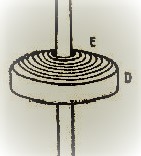
Tutti i gruppi di anime, dopo aver trascorso sette giorni nel prato, all’ottavo dovevano alzarsi e partire da lì, per giungere dopo quattro giorni in un luogo da dove scorgevano, distesa dall’alto lungo tutto il Cielo e la Terra, una luce diritta come una colonna, molto simile all’arcobaleno, ma più splendente e più pura. Dopo un giorno di cammino arrivavano lì e vedevano al centro della luce le estremità delle catene che pendevano dal Cielo; questa luce infatti teneva unito il Cielo e ne abbracciava l’intera orbita, come i canapi che fasciano la chiglia delle triremi. A quelle estremità stava appeso il fuso di Ananke, che dava origine a tutti i moti rotatori; l’asta e l’uncino erano d’acciaio, il fusaiolo era una mescolanza di questo e altri metalli. La natura del fusaiolo, che nella forma ricalcava quello usato quaggiù, era la seguente: stando alla descrizione che ne ha fatto Er, bisogna immaginare un grande fusaiolo cavo, completamente svuotato all’interno, nel quale era incastrato un altro più piccolo, come le scatole che si infilano una dentro l’altra, e così un terzo, un quarto e altri quattro ancora. Complessivamente i fusaioli erano dunque otto, incastrati l’uno nell’altro: in alto si vedevano i bordi, simili a cerchi, che formavano il dorso continuo di un solo fusaiolo intorno all’asta; quest’ultima era conficcata da parte a parte dentro l’ottavo. Il primo fusaiolo, il più esterno, aveva il bordo circolare più largo; venivano poi, in ordine decrescente di larghezza, il sesto, il quarto, l’ottavo, il settimo, il quinto, il terzo, il secondo. Il bordo del fusaiolo più grande era variegato, quello del settimo il più splendente, quello dell’ottavo riceveva il suo colore dal settimo, che lo illuminava, i bordi del secondo e del quinto, molto simili tra loro, erano più gialli dei precedenti, il terzo aveva un colore bianchissimo, il quarto rossastro, il sesto veniva per secondo in bianchezza. Il fuso si volgeva tutto quanto su se stesso con moto uniforme, e nella rotazione complessiva i sette cerchi interni giravano lentamente in direzione opposta all’insieme: il più rapido era l’ottavo, seguito dal settimo, dal sesto e dal quinto, che procedevano assieme; in questo moto retrogrado il quarto cerchio sembrava a quelle anime terzo in velocità, il terzo sembrava quarto e il quinto secondo. Il fuso ruotava sulle ginocchia di Ananke. Su ciascuno di quei cerchi, in alto, si muoveva una Sirena, che emetteva una sola nota di un unico tono; ma da tutte otto risuonava una sola armonia. Altre tre donne sedevano in cerchio a uguale distanza, ciascuna sul proprio trono: erano le Moire figlie di Ananke, Lachesi, Cloto e Atropo, vestite di bianco e col capo cinto di bende; sull’armonia delle Sirene Lachesi cantava il passato, Cloto il presente, Atropo il futuro. Cloto con la mano destra toccava a intervalli il cerchio esterno del fuso e lo aiutava a girare, e lo stesso faceva Atropo toccando con la sinistra i cerchi interni; Lachesi accompagnava entrambi i movimenti ora con l’una ora con l’altra mano. Appena giunti, essi dovettero subito presentarsi a Lachesi. Per prima cosa un araldo li mise in fila, poi prese dalle ginocchia di Lachesi le sorti e i modelli di vita, salì su un’alta tribuna e disse: “Proclama della vergine Lachesi, figlia di Ananke! Anime effimere, ecco l’inizio di un altro ciclo di vita mortale, preludio di nuova morte. Non sarà un demone a scegliere voi, ma sarete voi a scegliere il vostro demone.
Ananke (necessità), è simbolo della legge eterna e immutabile che regola l’universo. Qui rappresenta l’ordine razionale e morale del cosmo. Da lei nacquero per partenogenesi le Moire, ovvero le tre dee che presiedevano ai destini individuali degli uomini: Lachesi li assegnava per sorteggio, Cloto li filava, Atropo li rendeva immutabili e tagliava il filo al momento della morte. Per questo Ananke fila il fuso, che gira al centro della colonna di luce (lo axis mundi) e imprime il moto rotatorio a tutte le sfere celesti.
Le Sirene rappresentano, invece, il Cielo delle stelle fisse e i sette pianeti; il loro canto è quindi la musica delle sfere celesti.
Per come ovvio, risulta incomprensibile ai contemporanei la contestuale funzione cosmica e individuale delle Moire. Le stesse decidevano tanto i destini del Cosmo, quanto di ogni singolo individuo.
Com’è possibile?
Tutto è dovuto alla concezione ermetica dell’Uomo come centro dell’universo ed essere in parte divino.
In questa visione, il cosmo girava attorno alla Terra e agli uomini, creando il tempo e decidendo le sorti degli stessi.
Le arti dell’astrologia consistevano allora nel predire tali sorti, mentre quelle teurgiche servivano a influenzarle, se non a modificarle tout court.
Nella presente parte trattiamo delle tecniche teurgiche che sarebbero state usate per influenzare i destini degli uomini, sino a provocarne addirittura la trasformazione in stelle.
Va detto, infine, che mentre l’insieme del fuso ruota da oriente a occidente, i singoli fusaioli ruotano talvolta in senso contrario, a eccezione del primo quello delle stelle fisse.
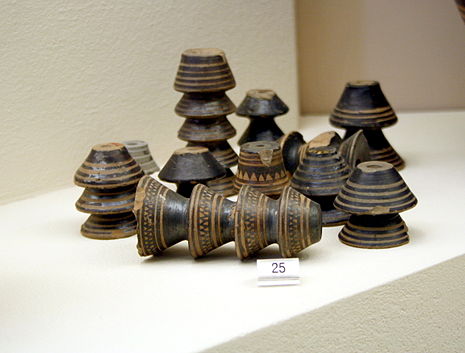
Proviamo, dunque, a riassumere i fusaioli nella loro identità astronomica.
L’asta, ovvero l’asse del mondo, dei fusaioli era conficcata dentro l’ottavo fusaiolo, ovvero quello della Luna e dello spazio celeste vicino la Terra, più interno e più rapido di tutti.
L’ottavo fusaiolo riceveva la propria luce (il colore) dal settimo fusaiolo, il Sole, che lo illuminava.
Il settimo fusaiolo, quello più splendente, era il Sole (individuato, diversamente da Cicerone, Ermete, etc., subito dopo la Luna, secondo l’ordine egizio), secondo per velocità dopo la Luna.
Il sesto fusaiolo era quello di Venere, secondo in bianchezza, rispetto a quello di Giove. Esso era pure secondo in grandezza e terzo per velocità.
I bordi del quinto fusaiolo, quello di Mercurio, erano simili a quelli del secondo, Saturno ed erano più gialli dei precedenti. Mercurio orbitava con Venere attorno al Sole e nel moto retrogrado aveva la stessa velocità del Sole e Venere che orbitavano insieme.
Il quarto fusaiolo, Marte, era rossastro ed era terzo in grandezza e velocità.
Il terzo fusaiolo, Giove, aveva un colore bianchissimo ed era quarto in velocità.
Il secondo fusaiolo era quello di Saturno: i suoi bordi erano simili a quelli di Mercurio e più gialli dei precedenti.
Il primo fusaiolo, il più esterno, era quello delle Stelle fisse e presenta un bordo circolare più largo ed era variegato di colori.
I fusaioli avevano un bordo od orlo. Da ciò si intuiva che avessero la forma di ciotole o spirali (sphandulos).

Nel mito di Er non è chiaro perché Platone abbia scelto questa disposizione relativa delle dimensioni dei fusaioli: in un passaggio notoriamente criptico del Timeo si trova una disposizione circolare simile per il cosmo derivata dalle “proporzioni di armonia musicale”.
La descrizione di questa armonia nel Timeo è tratta dalla filosofia matematico-musicale del suo contemporaneo Archita di Taranto, Pitagorico del 4 ° secolo a.C.. Tra le altre cose, Archita aveva sviluppato teorie del suono in funzione del movimento e di diverse varietà di scale musicali derivate da particolari rapporti. Concepì, dunque, intervalli musicali di quinte (3: 2), quarti (4: 3), ottave (2: 1), toni (9: 8) e semitoni (256: 243).
Queste relazioni armoniche costituiscono una manifestazione matematica emergente dai fenomeni naturali e sono esattamente usate come tali da Platone nel Timeo, sebbene non sia del tutto ovvio come questi intervalli si manifestassero fisicamente.
Di seguito una tabella che riassume le qualità e le dimensioni dei fusaioli platonici (ns adattamento dal Newsome):
Fusaiolo più piccolo o più largo 1°(8°) 2°(7°) 3°(6°) 4°(5°) 5°(4°) 6°(3°) 7°(2°) 8°(1°) Sfera Luna Sole Venere Mercurio Marte Giove Saturno Stelle fisse Grandezza relativa di ciascun fusaiolo 4° 5° 2° 6° 3° 7° 8° Più piccolo 1° Più grosso Colore di ogni fusaiolo Riflesso dal Sole Più brillante 2° più brillante giallognolo Rosso pallido Più bianco giallognolo multicolorate Velocità di rotazione contraria a quella delle stelle fisse Più veloce veloce veloce veloce media lento Più lento Rotazione giornaliera (della Necessità) Di seguito la rappresentazione grafica dei rapporti matematici sopra citati, sempre tratta da Newsome.
Come vedremo in seguito, tale rappresentazione dei fusaioli, a forma di scudo, riproduce con sorprendente esattezza la cupola capovolta del Pantheon.
Sentiamo ora come Platone espone, nel Timeo, il rapporto tra i diversi movimenti astrali:
Dopoché ciascuno degli astri, che sono necessari per la formazione del tempo, giunse nell’orbita che gli era più adatta, e i loro corpi, collegati con legami animati, divennero esseri viventi, e appresero il loro compito, allora secondo il movimento dell’altro che è obliquo e passa attraverso il movimento del medesimo e ne è dominato, gli uni percorsero un’orbita maggiore, gli altri un’orbita minore, e quelli che percorrevano un’orbita minore erano più rapidi, quelli che percorrevano un’orbita maggiore erano più lenti. Grazie al movimento del medesimo gli astri che giravano più rapidamente sembravano essere raggiunti da quelli che giravano più lentamente, anche se li raggiungevano: infatti questo movimento volgeva tutte le loro orbite a spirale, e muovendosi gli uni in un senso e gli altri in senso contrario, faceva in modo che quel pianeta che si allontanava più lentamente da questo movimento, che è il più veloce, sembrasse il più vicino.
I numeri del Timeo hanno un significato che va oltre il loro significato matematico; la matematica è impiegata analogicamente per esprimere una parentela intrinseca tra principi metafisici e i loro effetti di bellezza e ordine nella realtà. Di conseguenza, una scala musicale fatta di numeri altisonanti (rapporti= logoi) rende possibile la contemplazione simbolica (symbolike theoria) dei paradigmi nei loro effetti o immagini.
La concezione platonico-pitagorica del mousikè corrisponde a un’ampia nozione di musica che racchiude l’ordine armonioso di ogni cosa nell’universo.
Per i Pitagorici, la derivazione del numero e la mediazione della musica ha prodotto l’intero cosmo, come dice Aristotele nella Metafisica:
[i Pitagorici] videro che le modificazioni e le proporzioni delle scale musicali erano esprimibili in numeri; poiché, allora, tutte le altre cose sembravano, nella loro natura essere modellate sui numeri, e i numeri sembravano essere la prima cosa della natura, supponevano che gli elementi dei numeri fossero gli elementi di tutte le cose, e che l’intero cielo fosse una scala musicale (armonia) e un numero. E tutte le proprietà di numeri e scale che poterono dimostrare di concordare con attributi, parti e l’intera disposizione dei cieli, hanno raccolto e inserito nel loro schema.
Ci sono echi di questa concezione pitagorica nel racconto di Platone dell’origine dell’ordine dei circuiti celesti e della loro dipendenza dai cerchi armonici e dagli intervalli musicali all’interno dell’Anima Mundi composta come una scala musicale (Timeo 35b-37a). Secondo il Timeo l’universo è un kosmos (insieme splendidamente disposto), come risultato di una combinazione di armonia (un armonioso adattarsi insieme/sintonizzazione, dal verbo harmottein) e taxis (ordine e regolarità).
Ma ritorniamo all’illustrazione dei fusaioli platonici.
Platone scrive nel mito di Er che “su ciascuno di quei cerchi, in alto, si muoveva una Sirena, che emetteva una sola nota di un unico tono; ma da tutte otto risuonava una sola armonia”. Le Sirene non erano le sole a cantare. Sedute su troni equidistanti, lungo i bordi, vi erano le tre Moire, “le figlie della Necessità” (come si vede nell’illustrazione del Newsome). Lachesi cantava il passato, Cloto il presente, Atropo il futuro.
Esse erano anche responsabili della regolazione delle rotazioni dei fusaioli.
“Cloto con la mano destra toccava a intervalli il cerchio esterno del fuso (quello delle stelle fisse) e lo aiutava a girare.”
Cloto era dunque responsabile per il mantenimento della rotazione quotidiana dei cieli. Atropo invece toccava con la sinistra, ovvero in direzione contraria alla rivoluzione delle stelle fisse, i cerchi interni, quelli delle sfere planetarie.
Lachesi accompagnava entrambi i movimenti ora con l’una ora con l’altra mano.
Cloto era la Moira che canta il presente. Con la mano destra, regola la velocità di rotazione della sfera più esterna come se facesse girare la ruota di una roulette. In altre parole, essa regola il ritmo quotidiano, fisso che costituisce la base di tutto il movimento meccanico e immutabile dei cieli, quello del Circolo dello Stesso.
È all’interno di questa sfera più ampia che le altre sfere sono trasportate. Il Sole, la Luna e i pianeti hanno i movimenti loro propri, ma i loro movimenti principali sono determinati in relazione alla sfera delle stelle fisse, il cui movimento costituisce il più evidente di tutti i cicli.
Atropo, con la mano sinistra, è invece responsabile della regolazione delle rotazioni delle sfere interne.
“In altre parole lei manteneva la velocità delle sette sfere con diverse traiettorie radiali, lanciate contro il movimento della ruota della roulette esterna.”
Atropo è la Moira che canta il futuro. È dalla conoscenza dei movimenti delle sfere interne, infatti, che è possibile trarre pronostici e previsioni. In particolare, la conoscenza dei cicli stagionali (“sapienti”) del Sole e della Luna è cosa di somma importanza per l’agricoltura, l’attività e gli affari umani.
Nel Timeo leggiamo che il giorno e la notte “rappresentano il periodo del movimento circolare unico e più sapiente: il mese nacque invece quando la Luna raggiunge il Sole dopo aver percorso la sua orbita, e l’anno quando il Sole ha percorso la sua orbita.”
Più arduo è cercare di comprendere il ruolo di Lachesi, che canta il passato e controlla alternativamente l’interno e l’esterno delle sfere con entrambe le mani, la destra e la sinistra, consentendo l’accelerazione e la decelerazione degli astri.
È ragionevole presumere che Platone si riferisse ai moti meno prevedibili nei cieli: ovvero ai moti retrogradi, quelli del Circolo del Diverso, di cui abbiamo parlato prima, e alle variazioni di velocità apparente dei pianeti.
Egli scrive nel Timeo:
Quanto ai periodi degli altri pianeti, poiché gli uomini non li conoscono, salvo alcuni pochi, non sono stati neppure nominati e non si misurano in numeri, mediante l’osservazione, i loro rapporti reciproci, sicché, così per dire, gli uomini non sanno che il tempo è misurato anche dai loro giri, infinitamente molteplici e straordinariamente vari: non di meno è tuttavia possibile capire che il numero perfetto del tempo realizza l’anno perfetto allorquando le velocità di tutti e gli otto periodi, compiendosi reciprocamente, ritornano al punto di partenza, misurate secondo “L’orbita dello Stesso” che si muove in modo uniforme.
Newsome afferma che, giacché i pianeti (letteralmente, planetes ovvero “vagabondi”) avevano movimenti così intricati, riferiti a moti retrogradi e simili, essi non fossero utili per le previsioni nel futuro.
Poiché “non si misurano i loro rapporti reciproci” (tra pianeti e tra questi e il Sole e la Luna), ciò avrebbe precluso la previsione di dove e quando si sarebbe trovato un pianeta in relazione ai tempi e ai luoghi prevedibili del Sole e della Luna.
Dunque, l’autore sospetta che siano stati più probabilmente utili per localizzare eventi nel passato. Da qui la loro associazione con Lachesi. Newsome fa un esempio: “Marte potrebbe essere stato in Bilancia quando un terremoto ha colpito Atene molti anni fa”.
Crediamo più verosimile ritenere che il “canto del passato” di Lachesi sia da riferire ai pianeti proprio in ragione del loro moto retrogrado. Tale moto costituisce, infatti, uno “strappo” nel “continuum spazio temporale” dell’immutabile rotazione stellare. Ritornando indietro (verso il passato), il moto retrogrado dei pianeti interrompe la regolarità dei corsi ciclici.
Il fatto che Lachesi utilizzasse entrambe le mani, consentendo accelerazioni, decelerazioni e ritorni all’indietro, non può non riportare alla memoria quanto detto sulle lustrationes labirintiche: cerimonie di purificazione basate su moti in avanti e indietro (con antistrofe musicali, vedi avanti), potrebbero essere immagine rituale della superna gestualità di Lachesi.
Detto dell’aspetto simbolico gestuale, ritorniamo sul tema musicale. Anche perché è arrivato il momento di un chiarimento concettuale. Se Lachesi con il suo movimento determina un ritorno al passato che coincide con il moto retrogrado di alcuni pianeti, per come sopra asserito, tale moto contrario (detto da Macrobio, tra poco lo vedremo, antistrofa) non può non determinare un cambio della direzione musicale. Ovvero, la scala musicale, secondo noi, da ascendente, come nell’ascesa di Filologia (ne parleremo a breve), dovrebbe, in senso inverso cioè in antistrofa, tramutare la scala musicale da ascendente in discendente.
Su un immaginario fusaiolo o piramide, se si vuole, il movimento verso l’alto dei cieli sarebbe sviluppato con note ascendenti, quello in discesa dal cielo, con note discendenti.
Se si considera il cosmo descritto nel Timeo è possibile che i toni cantati da ciascuna Sirena fossero determinati dai raggi armonici pitagorici sopra esposti.
In proposito, un tentativo (imperfetto) di ricostruzione del modello platonico di cosmo musicale è stato quello operato da Stephenson sulla base della distanza (raggi) dalla Terra qui di seguito esposto.
Sfera Terra Luna Sole Venere Mercurio Marte Giove Saturno Stelle fisse Raggi misurati dal centro della terra N.a. 1 2 3 4 8 9 27 ? Intervalli ricostruiti per il pianeta precedente silenzio 1(1:0) 1:2 2:3 3.4 4.8 (1:2) 8:9 9:27 (1:3) 27? Intervalli musicali dal più basso al più alto N.a. Unisono?Tono? ottava quinta quarta ottava tono Ottava + quinta ? Altra possibilità è che i toni fossero correlati con le velocità orbitali per come detto da Cicerone nel Sonno di Scipione.
Nei successi paragrafi vedremo altre ricostruzioni più convincenti di armonia cosmica.
Vorremmo chiudere tornando a Platone nel Timeo:
E l’armonia, dotata di movimenti affini ai circoli della nostra anima, a chi con intelligenza si serve delle Muse non sembra utile, come si crede ora, a procurare un piacere irragionevole: ma essa è stata data dalle Muse per ordinare e rendere consono con se stesso il circolo della nostra anima che fosse diventato discorde.
Attraverso il filosofo Macrobio, pur essendo nato tre secoli e oltre dopo Augusto (385 circa –430 circa), possiamo tracciare un affresco complessivo del pensiero neoplatonico.
Fu studioso di astronomia e, come quasi tutti all’epoca, seguiva la teoria geocentrica, che pone la Terra, stazionaria, in posizione centrale rispetto all’Universo.
Scrisse un commentario in due libri del Somnium Scipionis di Cicerone, dedicato al figlio Eustazio.
L’obiettivo di Macrobio è quello di mostrare come l’intero pensiero antico e soprattutto le dottrine neoplatoniche siano contenuti nel testo ciceroniano. Egli sostiene che Dio, origine di tutto ciò che esiste, crea la Mente (nous), e che la Mente crea l’Anima del Mondo; l’Anima del Mondo, incorporea, “volgendo indietro lo sguardo”, degenera poco a poco fino a diventare matrice dei corpi.
Nel suo Commentario, Macrobio si dilunga sul tema dei rapporti matematici che presiedono all’armonia.
Leggiamo qualche passaggio del Libro II, nella nostra traduzione, ove specificamente egli tratta della musica delle sfere. E’ un tema di raro pregio per le informazioni contenute. Cominciamo da uno stralcio del capitolo I.
Ora è ben noto che nei cieli nulla accade per caso o per caso, e che tutte le cose di sopra procedono ordinatamente secondo la legge divina. Perciò è indiscutibilmente giusto presumere che i suoni armoniosi provengano dalla rotazione delle sfere celesti, poiché il suono deve venire dal movimento, e la ragione, che è presente nel divino, è responsabile per i suoni essendo melodiosi
Pitagora fu il primo di tutti i greci ad afferrare questa verità. Capì che i suoni che uscivano dalle sfere erano regolati dalla Ragione divina, che è sempre presente nel Cielo, ma ebbe difficoltà a determinarne la causa sottostante e a trovare modi per scoprirla. Quando fu stanco della sua lunga indagine su un problema così fondamentale eppure così recondito, un avvenimento casuale gli presentò ciò che il suo pensiero profondo aveva trascurato.
Da qui in poi Macrobio narra della nota leggenda della scoperta dell’armonia fatta da Pitagora in un officina di fabbro. Passa poi a trattare delle combinazioni armoniche.
Presentando l’argomento una certa oscurità dobbiamo, per motivi di sintesi, rimandare alla spiegazione matematica di tali rapporti nel testo citato in nota.Continuiamo al capitolo II.
Così l’Anima Mundi, che ha mosso il corpo dell’universo al movimento che ora vediamo, deve essere intrecciata con quei numeri che producono l’armonia musicale per rendere armoniosi i suoni che ha instillato dal suo impulso vivificante. Ha scoperto la fonte di questi suoni nel tessuto della sua stessa composizione.”
Platone riferisce, come abbiamo detto prima, che il divino Creatore dell’Anima, dopo averla tessuta di numeri disuguali, riempiva gli intervalli fra loro di sesquialteri, sesquiterziani, superottave, e semitoni. Nel passaggio successivo Cicerone mostra molto abilmente la profondità della dottrina di Platone: “Cos’è questo suono grande e piacevole che riempie le mie orecchie?” “Questa è una concordia di toni separati da intervalli disuguali ma tuttavia accuratamente proporzionati, causati dal rapido movimento delle sfere stesse.” Vedete qui come fa menzione degli intervalli e afferma che sono diseguali e che sono separati in proporzione; giacché nel Timeo di Platone gli intervalli dei numeri disuguali sono intercalati da numeri a essi proporzionali, cioè sesquialteri, sesquiterziani, superottave e mezzitoni, nei quali è abbracciata ogni armonia. Quindi vediamo chiaramente che queste parole di Cicerone non sarebbero mai state comprensibili se non avessimo incluso una discussione dei sesquialteri, sesquiterziani e superottave inseriti negli intervalli, e dei numeri con cui Platone costruì l’Anima del Mondo, insieme al motivo per cui l’Anima era intessuta di numeri che producevano armonia. Così facendo non abbiamo solo spiegato le rivoluzioni nei cieli, delle quali solo l’Anima è responsabile; abbiamo anche mostrato che i suoni che ne scaturivano dovevano essere armoniosi, perché erano innati nell’Anima che spingeva l’universo al movimento.
Continuiamo col terzo capitolo del II libro.
In una discussione nella Repubblica sul moto vorticoso delle sfere celesti, Platone dice che una Sirena siede su ciascuna delle sfere, indicando così che dai moti delle sfere le divinità erano fornite di canto; poiché una Sirena che canta è equivalente a un dio nell’accettazione greca della parola.” Inoltre, i cosmogonisti hanno scelto di considerare le nove Muse come il canto armonioso delle otto sfere e l’unica armonia predominante che proviene da tutte loro.” Inoltre, chiamano Apollo, dio del Sole, il “capo delle Muse”, come a dire che è il capo e il capo delle altre sfere, così come Cicerone, riferendosi al Sole, lo chiamò capo, capo e regolatore degli altri pianeti, mente e moderatore dell’universo. Anche gli Etruschi riconoscono che le Muse sono il canto dell’universo, poiché il loro nome è Camenae, una forma di Canenae, derivata dal verbo canere. Che i sacerdoti riconoscano che i cieli cantano è indicato dal loro uso della musica nelle cerimonie sacrificali, poiché alcune nazioni preferiscono la lira o la cetra, e alcuni flauti o altri strumenti musicali. Anche negli inni agli dei si mettevano in musica i versi della strofa e dell’antistrofa, in modo che la strofa rappresentasse il moto in avanti della sfera celeste e l’antistrofa il moto inverso delle sfere planetarie; questi due movimenti produssero il primo inno della natura in onore del Dio Supremo. Anche nelle processioni funebri, le usanze dei diversi popoli hanno decretato l’uso dell’accompagnamento musicale, per la credenza che le anime dopo la morte ritornano alla sorgente della dolce musica, cioè al Cielo. Ogni anima in questo mondo è allettata da suoni musicali così che non solo coloro che sono più raffinati nelle loro abitudini, ma anche tutti i popoli barbari, hanno adottato canti dai quali sono infiammati di coraggio o corteggiati al piacere; poiché l’anima porta con sé nel corpo un ricordo della musica che conobbe nel Cielo, ed è così affascinata dal suo fascino che non c’è seno così crudele o selvaggio da non essere afferrato dall’incantesimo di un tale appello. (…) Abbiamo appena spiegato che le cause dell’armonia sono ricondotte al Anima Mundi, essendo state intrecciate in essa; l’Anima Mundi, inoltre, fornisce a tutte le creature la vita: “Di qui la razza dell’uomo e degli animali, la vita delle cose alate e le strane forme che l’oceano porta sotto il suo pavimento di vetro”. Di conseguenza è naturale che ogni cosa che respira sia rapita dalla musica poiché l’Anima celeste che anima l’universo è scaturita dalla musica. Nell’accelerare le sfere al movimento produce toni separati da intervalli disuguali ma tuttavia accuratamente proporzionati, secondo il suo tessuto primordiale.
Macrobio nel passo qui riportato fa menzione di strofa e antistrofa. L’assunto del filosofo platonico era che la strofa rappresentasse il moto in avanti della sfera celeste mentre l’antistrofa il moto inverso delle sfere planetarie.
Dato che, per dirla come Ermete, ciò che è in Cielo è come ciò che è in Terra, secondo noi, il movimento a strofa rappresenterebbe il moto ascensionale verso le stelle, mentre il moto inverso dell’antistrofa il moto discensionale.
Ovvero se si vuole ascendere alle stelle, per “apoteosizzarsi”, bisogna usare versi musicali con note in scala ascendente, mentre per chiedere la discesa della potenza divina dall’alto sulla Terra occorrono note in scala discendente.
Ora dobbiamo chiederci se questi intervalli, che nell’Anima incorporea sono appresi solo nella mente e non dai sensi, governano le distanze tra i pianeti in bilico nell’universo corporeo. Archimede, infatti, credeva di aver calcolato in stadi le distanze tra la superficie terrestre e la Luna, tra Luna e Mercurio, Mercurio e Venere, Venere e il Sole, il Sole e Marte, Marte e Giove, Giove e Saturno, e che aveva anche stimato la distanza dall’orbita di Saturno alla sfera celeste. Ma le figure di Archimede furono respinte dai platonici per non aver rispettato gli intervalli nelle progressioni dei numeri due e tre. Decisero che non poteva esserci che un’opinione, che la distanza dalla Terra al Sole fosse il doppio di quella dalla Terra alla Luna, che la distanza dalla Terra a Venere fosse tre volte maggiore di quella dalla Terra al Sole, che la distanza dalla Terra a Mercurio era quattro volte maggiore che dalla Terra a Venere, che la distanza dalla Terra a Marte era nove volte maggiore della distanza dalla Terra a Mercurio, che la distanza dalla Terra a Giove era otto volte più grande che dalla Terra a Marte, e che la distanza dalla Terra a Saturno era ventisette volte più grande che dalla Terra a Giove. Porfirio include questa convinzione dei platonici nei suoi libri che illuminavano le oscurità del Timeo, e dice che credevano che gli intervalli nell’universo corporeo, che erano pieni di sesquiterziani, sesquialteri, superottave, mezzitoni e una leimma, seguissero il modello del tessuto dell’Anima, e l’armonia era tale che i suoi intervalli proporzionali erano intrecciati nel tessuto dell’Anima e che sono stati anche iniettati nell’universo corporeo che è vivificato dall’Anima.” Da qui l’affermazione di Cicerone, che l’armonia celeste è una concordia di toni separati da intervalli disuguali ma tuttavia accuratamente proporzionati, è sotto tutti gli aspetti saggia e vera.
Con le tesi sopraccitate, Macrobio avrà, supponiamo, partecipato a qualche complessa contesa erudita sul tema della platonicità dei contenuti del Somnium ciceroniano.
Certamente, non avrebbe potuto immaginare che ci avrebbe fornito, secoli dopo, anche a noi “scimmie vestite” con lo smartphone, alcuni argomenti per l’interpretazione della funzione del Pantheon.
ASCESA PER MEZZO DELL’ARMONIA DELLE SFERE E DELLE MUSE
Per Omero le Muse sono nove, sono figlie di Zeus e stanno sull’Olimpo. Nel prologo della sua Teogonia Esiodo parla anch’egli di nove Muse, “arricchendo il Cielo e gli astri di divinità”.
Riguardo alla denominazione di “Muse”, Proclo diceva che, poiché, la filosofia, platonicamente “musica grandissima”, fa muovere le nostre potenze psichiche in modo armonioso rispetto agli enti e ai loro movimenti, noi entriamo in accordo con l’universo in quanto rendiamo i nostri cicli dell’anima simili a quelli dell’universo, è per questo che noi ricaviamo da questa ricerca il nome che diamo alle Muse. E continua:
[…] E in verità noi sappiamo che le Muse sono quelle che inculcano nelle anime la ricerca della verità, nei corpi la molteplicità delle potenze, ovunque la verità delle armonie.
Dunque, le Muse sono Dee delle sfere, ruolo originariamente attribuito alle Sirene, poi assegnato alle Muse, che risultano essere loro superiori. Diceva infatti Proclo che la divisione del Cielo fosse in otto sfere, quella di tutto il Mondo in nove sfere, e che la prima divisione, nella Repubblica di Platone, fosse stata dedicata alle Sirene, mentre la seconda a tutto l’insieme delle Muse, sotto le quali sono le Sirene.
In uno dei discorsi attribuiti da Giamblico a Pitagora, le Muse erano deputate a vegliare sull’armonia universale. Esse non venivano, però, identificate con ognuna delle sfere planetarie. Pitagora aveva suggerito di costruire un tempio alle Muse per mantenere la concordia nella città,
perché queste Dee, diceva, portavano tutte insieme lo stesso nome, erano note alla tradizione come una comunità e si compiacevano in sommo grado del culto comune; e poi il coro delle Muse era sempre uno e costantemente il medesimo, e in più racchiudeva in sé accordo, armonia e ritmo, cioè tutto quanto crea la concordia. Infine mostrava come il loro potere si estendesse non solo fino ai più alti principi scientifici ma anche all’accordo e all’armonia dell’universo.
Con riguardo alle Muse, Macrobio scrive nel Commentario:
Anche i teologi hanno inteso con le nove Muse gli accenti melodiosi delle otto sfere celesti con il supremo accordo unico che risulta dal tutto. Ecco perché Esiodo, nella sua Teogonia, dà all’ottava musa il nome di Urania: perché dopo le sette sfere erranti, che sono poste sotto di essa, l’ottava, la sfera stellare che sta loro di sopra, è il Cielo propriamente detto; e per farci intendere che ce n’è una nona, più grande di tutte, che risulta dall’unione di tutte le armonie assieme, aggiunge: Calliope: è questa fra tutte egregia, significando con questo nome che la nona Musa è designata dalla dolcezza stessa della voce. Calliope, infatti, significa in greco “dotata di bellissima voce”, e per indicare espressamente che è un insieme armonico risultante da tutte le altre, il poeta le assegna un’espressione che indica l’universalità: è fra tutte egregia.
E Proclo, sullo stesso tema:
gli Antichi hanno dato la sovrintendenza sull’Universo alle Muse e ad Apollo Musagete, l’uno che provvede all’unificazione dell’armonia complessiva; le altre che mantengono insieme la progressione divisa di questa armonia, avendo accordato il loro numero con quello delle otto sirene della Repubblica. Le Muse e Apollo Musagete sono infatti stati creati dal Demiurgo, “così come la catena di Ermete. In lui dunque vi sono anzitutto il calcolo demiurgico e l’armonia, giacché l’uno appartiene a Ermete, l’altra ad Apollo e, in quanto colma di entrambi, l’anima partecipa sia al calcolo che all’armonia.
In epoca successiva Marsilio Ficino fece riferimento a Le nozze di Filologia e Mercurio di Marziano Capella quando, nel trattare dell’armonia delle sfere, dice che Urania occupa la sfera più esterna del Firmamento stellato, che gira velocemente, echeggiando di un suono acuto, Polimnia regola la sfera di Saturno, Euterpe quella di Giove, Erato controlla la sfera di Marte, Melpomene la sfera mediana, dove il Sole abbellisce l’universo con luce fiammante, Terpsicore si unisce all’oro di Venere, Calliope abbraccia il giro del Cillenio, ossia Mercurio, Clio pone la sua residenza nella sfera più vicina ossia la Luna, la quale risuona di note gravi, con modi musicali più rochi; Talia invece è abbandonata sulla Terra, priva di suono. Questa rappresentazione coincide con quella di Gaffurio ove, accanto ad Apollo, sono raffigurate le tre Grazie e sotto le Muse nell’ordine planetario sopraccitato.
ASCESA PER MEZZO DI VOCALIZZAZIONI E MUSICA
Un Dio o uomo divino”, chiamato Thot in Egitto, “distinse le vocali” scrive Platone nel Filebo.
In greco, come in sanscrito, le vocali sono sette; in latino e in italiano cinque, salgono tuttavia a sette se le vocali “o” ed “e” vengono conteggiate ciscuna per due volte, una per il suono aperto e l’altra per il suono chiuso. Gli Egizi avevano un Canto delle sette vocali.
Giacché le sette vocali erano usate al posto dei sette toni della lira a sette corde (accordata sul tetracordo congiunto della scala dorica), secondo i pitagorici si possono leggere le lettere come note. Secondo la dottrina pitagorica, infatti, ogni tono della scala rappresentava la nota di uno dei sette pianeti.Ciascuna vocale pertanto rappresenta una sorta di simbolo magico della musica delle sfere. L’indicazione per determinare il diapason di ciascuno dei toni simboleggiati da una vocale fu trovata nell’Armonia di Nicomaco di Gerasa, che dai pitagorici riprendeva appunto la concezione armonica del mondo. Scrive infatti nel suo Manuale di Armonica: “I suoni di ciascuna delle sette sfere producono un certo rumore, in cui la prima sfera produce il primo suono, e a tali suoni si è dato il nome di vocali.”
Precisa ancora:
Tutti coloro che hanno impiegato la sinfonia a sette suoni in quanto naturale, la prendevano in prestito a questa fonte: non alle sfere ma ai suoni accordati nell’universo, gli unici suoni che noi chiamiamo, fra le lettere, suoni-vocali e suoni musicali. Ma poiché l’analisi di questi punti è di una semplicità elementare, che non può bastare a spiegare questioni complesse, occorre comprendere la concezione dell’Universo dall’affinità, analoga a quella delle corde, e mediante l’accomodamento di una cosa a un’altra
Giovanni Lido assimilava i sette astri alle sette specie di ottava ed alle sette vocali dell’alfabeto greco.
La concordanza di vocali, pianeti, toni, fu fatta propria anche dagli gnostici. Secondo Ireneo, lo gnostico Marco “Il Mago” scrisse: “Il primo Cielo suona la A, il seguente la E, il terzo la E lunga, il quarto nel mezzo grida forte la Potenza (dynamis) della I, il quinto la O, il sesto la U, il settimo e quarto a partire dal mezzo evoca l’elemento dell’Omega”.
Ecco il sistema di Marco, per come riproposto dal Lindsay:
A Luna Nete Re diesis E Venere Paranete Do diesis H / È Mercurio Paramese Si bemolle I Sole Mese La O Marte Lichanos Sol U Giove Parhypate Fa Ω / Ò Saturno Hypate Mi Ipotizzando un’invocazione agli dei planetari cantata sulle sette vocali nei templi dell’antico Egitto, prima di Lindsay, Edmond Bailly scrisse che: ciascuna delle sette vocali greche corrispondeva a uno dei sette corpi del sistema planetario degli Antichi, esprimendo nel contempo una delle sette note della lira di Ermete. Lo schema è un triplice settenario di astri, note e vocali, nel quale si conserva: “alle vocali il loro vocalismo radicale, senza tener conto delle modifiche d’accento causate da tempi e luoghi”:
A Luna Re E Venere Do H / È Mercurio Si I Sole La O Marte Sol U Giove Fa Ω / Ò Saturno Mi Correttamente Boella e Galli osservano che “il sistema descritto discensionale coincide alla scala cosmica e planetaria, non però nella scala musicale ascensionale, di cui al frontespizio della Practica musice di Gaffurius del 1496 (vedasi nelle immagini).
Non ne traggono però le conseguenze, ovvero non imputano l’inversione a errore.
Esaminiamo i due schemi ripartiti in vocali, astri, corde e note. Crediamo che sia il Bailly (che pur era musicologo) che il Lindsay abbiano fatto confusione e qualche errore. Riportando lo schema di Marco, citato da Ireneo, hanno correttamente riportato la sequenza vocalica ascensionale (da Luna a Saturno), ma hanno errato nell’associare a essa la sequenza delle corde e delle note che, invece, ha indicato come discensionale. Inoltre hanno errato nell’associare i rapporti agli astri.
Tornando alle corde, si nota che quelle prima citate nello schema erano le più alte. I nomi greci delle corde delle lire a sette e a otto corde, vedevano la prima nota come più alta e più vicina al suonatore. Le corde erano le seguenti: Nete, Paranete, Paramese; Mese, Lichanos, Parhypate, Hypate (questo lo schema proposto dal Lindsay); oppure Nete, Paranete, Trite, Paramese; Mese, Lichanos, Parhypate, Hypate – le ultime quattro da Mese a Hypate essendo il dito tetracordo, le altre toccate col plettro.
Diverso ancora lo schema ascensionale delle corde del musicista pitagorico Gaffurius, esposto nelle illustrazioni, ove, del precedente schema, sono riportate solo le corde Lichanos, Parhypate, Hypate corrispondenti agli astri Sole, Venere e Mercurio, in senso (ascensionale) ovvero contrario a quello seguito dal Lindsay (che risulta discensionale).
Se si segue la sequenza corretta, ove Nete è la nota più alta e le altre via via più basse, ne risulta che l’ordine è invertito. Ovvero l’ordine corretto dovrebbe essere
A Luna Hypate E Venere Parhypate H / È Mercurio Lichanos I Sole Mese O Marte Paramese U Giove Paranete Ω / Ò Saturno Nete Corrispondentemente anche le note musicali indicate da Bailly e Lindsay dovrebbero essere invertite. Problema: vediamo delle incongruenze e degli errori. Per citarne uno, la nota di Saturno sarebbe un MI che non è ottava del RE diesis (e comunque l’ottava dovrebbe essere nelle stelle fisse!).
Serve fare una breve digressione al fine di capire le sequenze corrette di pianeti, corde e note, ovvero l’armonia stellare. Cominciamo da un ricordo “pitagorico” di Plinio.
Plinio tratta il tema dell’armonia delle sfere inserito nella più vasta trattazione della questione delle distanze astrali.
Molti hanno anche cercato di tracciare gli intervalli delle stelle dalla terra, e hanno dimostrato che il sole dista dalla luna diciannove parti quanto la luna stessa dalla terra. Ma Pitagora, uomo dalla mente sagace, sagace, dedusse che dalla Terra alla Luna c’erano 126.000 stadi, dalla Luna al Sole il doppio da essa, e quindi triplicati fino ai dodici segni (zodiaco), della stessa opinione era anche Sulpicius Gallus.
Ma Pitagora a volte fa appello alla musica anche per la distanza della Luna dalla Terra, dalla Luna a Mercurio mezzo spazio, come da Mercurio a Venere, da Venere al Sole sei volte, dal Sole a Marte un tono [cioè quanto dalla Terra alla Luna], da Marte a Giove un semitono come anche da Giove a Saturno, e quindi sei volte fino allo zodiaco; Così si fanno i sette toni che chiamano διὰ πασῶν ἁρμονίαν Διὸς, questo è il concerto dell’universo. In esso Saturno era mosso al modo dorico, Giove al tono frigio, e così di seguito tutti gli altri, con una sottigliezza piacevole piuttosto che necessaria.
Sentiamo il Pizzani: “All’affermazione che Pitagora avrebbe fissato in 126.000 stadi la distanza dalla terra alla luna —cifra che duplicata e triplicata ci fornirebbe, secondo un’opinione condivisa anche da Sulpicio Galo, l’esatta determinazione delle distanze intercorrenti fra la Luna e il Sole e fra il Sole e la sfera delle Stelle fisse— fa seguito una vera e propria serie di note, pure attribuita a Pitagora, nella quale le distanze fra le otto sfere celesti della tradizione antica (Terra compresa) vengono tradotte in altrettanti intervalli musicali.
La somma di tali intervalli, ammontante a sette toni, corrisponderebbe, secondo Plinio, a quella che gli antichi denominavano diapason harmonia, o intervallo di ottava (che, in realtà, di toni ne comprendeva solamente sei!).”
Il Tannery aveva osservato che questa è la testimonianza più antica della leggenda secondo la quale Pitagora avrebbe previsto la distanza fra la Terra e la Luna e avrebbe, nel contempo, tradotto le distanze astrali in intervalli musicali.
Per quello che importa ai fini di questo saggio, la scala di Plinio sopraccitata risulta quasi identica in Censorino e in Marziano Capella. Questi due autori fissano entrambi in 126.000 stadi la distanza della Luna dalla Terra.
Solo Plinio e Marziano Capella affermano che il suono emesso da ogni corpo celeste corrisponde a un modo (corda) definito.
Mentre Censorino e Marziano Capella identificano tout court la cifra di 126.000 stadi con il primo tono della gamma pitagorica, Plinio non è d’accordo. Egli s’esprime nel senso che il filosofo di Samo avrebbe proposto due criteri del tutto differenti per definire le distanze fra gli astri, senza confonderli o assimilarli l’uno all’altro. Tale distinzione risulterebbe confermata dalla successiva affermazione di Plinio che, secondo un’opinione condivisa anche da Sulpicio Galo, raddoppiando e triplicando la cifra iniziale si otterrebbero, rispettivamente, la distanza fra la Luna e il Sole e fra il Sole e la sfera delle Stelle fisse. La scala pitagorica assumeva, al contrario, che la distanza fra la Luna e il Sole corrisponde a due volte e mezzo (come visibile questa scala non è quella platonica ove il Sole è subito dopo la Luna) e quella fra il Sole e le Stelle fisse a tre volte e mezzo la distanza fra la Terra e la Luna.
Pizzani ne ricava l’ipotesi che
“Plinio avrebbe attinto i suoi dati a due fonti distinte. Varrone gli avrebbe fornito lo schema musicale dell’armonia astrale e la cifra di 126.000 stadi con l’esplicita attribuzione di queste dottrine a Pitagora; da un’opera di Sulpicio Galo, invece, opera esplicitamente menzionata dallo stesso Plinio poco più addietro, deriverebbero le ulteriori indicazioni circa il modo per calcolare le distanze del sole e delle stelle fisse.”
Tornando alle similitudini tra le scale di Plinio, Censorino e Marziano Capella, l’unica consistente differenza fra Plinio e Marziano riguarda un particolare della gamma astrale. Mentre in Plinio si legge che fra il Sole e Marte intercorrerebbe un tono, con l’ulteriore precisazione id est quantum ad lunam a terra, Marziano riduce tale intervallo a un semitono, per come vedremo nel paragrafo relativo.
Vale la pena notare che anche per Igino, la distanza Marte-Sole è assimilata a un semitono.
Su questo punto ancora il Pizzani dice: “Per converso penso esistano fondate ragioni per ritenere che in questo punto il testo di Marziano sia corrotto. Un amanuense, indotto in errore da questa falsa impressione, potrebbe aver creduto di migliorare il testo sostituendo hemitonio sublevatam all’esatta lezione tono sublevatam. Restituendo quest’ultima lezione nel testo di Marziano lo schema ivi descritto verrebbe a coincidere in tutto e per tutto con quello di Plinio e la dipendenza di Marziano dalla Naturalis Historia di Plinio ne verrebbe ulteriormente confermata.”
Dunque, le scale di Plinio e Marziano sono uguali.
Torniamo alla gamma pliniana. S’è detto che essa è quasi identica a quella di Censorino.
L’unica differenza riguarda l’intervallo fra Saturno e le Stelle fisse valutato da Censorino in un semitono e da Plinio in un tono e mezzo.
Pizzani dice
Il fatto però che la serie di Censorino, non meno, del resto, di quella, pur così singolare, descritta da Igino— comprende esattamente sei toni, realizza cioè la diapason harmonia, parrebbe assicurargli una maggiore attendibilità rispetto a quella pliniana comprendente, come s’è detto, ben sette toni. (…)
Occorre osservare che tutte le serie qui menzionate attribuiscono alla terra un suono definito, quasi si trattasse di un corpo celeste qualsiasi. Se è vero che per Filolao la Terra ruotava assieme all’antiterra attorno al fuoco centrale, ma né nei testi più antichi né in quelli successivi, in cui s’accenna all’armonia delle sfere, la Terra viene mai computata. Come abbiamo visto, in origine la gamma astrale prevalente comprendeva solo i sette astri (comprendenti, come sappiamo, la Luna e il Sole) ai quali solo successivamente fu aggiunta la sfera armonica delle stelle fisse.
Dopo, quando le distanze astrali vennero riportate in intervalli musicali, venne inserito nel computo l’intervallo fra la Terra e la Luna; rifacendosi a Anassimandro, per il quale tale intervallo aveva sempre costituito la misura cosmica, l’unità di misura valida per definire ogni distanza nel cosmo, non si trovò di meglio che identificarla col tono, che ne costituiva corrispettivo nella musica. Al contrario sappiamo che, in realtà, per i pitagorici la Terra ove stava immersa nel silenzio e la musa Talia era sorda (si veda l’immagine di Gaffurius).
L’aggiunta del suono della Terra è presentata come un’opinione non universalmente accettata anche se, in effetti, esso risultava indispensabile per raggiungere la diapason harmonia.
E Pinzani scrive: “Tornando alla gamma pliniana siamo costretti ad ammettere che non è stato il caso a determinarne la struttura. In effetti è sufficiente togliere a questa successione il tono interposto fra la Terra e la Luna per ottenere una serie di note del tutto regolare dal punto di vista musicologico, una serie che comprende esattamente sei toni e che si rivela composta da due tetracordi disgiunti modulati nel genere cromatico. La gamma pliniana, come s’è detto, pur se modificata dall’aggiunta del suono della terra e dalla trasposizione dal diatonico al cromatico, riproduce esattamente la struttura dell’octacordo descritto da Boezio e ciò è sufficiente a provare ch’essa non è al di fuori della tradizione musicologica antica e non dipende, come sostenuto a suo tempo dal Tannery, da errori presenti nel testo di Varrone.”
Una finale notazione. Abbiamo fatto cenno al Sogno di Scipione, che vedremo meglio tra breve. Boyancé ipotizza che nell’espressione ciceroniana septem distinctos intervallis sonos il numerale septem si accordi con intervallis anziché con sonos e che le parole in quibus eadem vis est duorum designino non Venere e Mercurio, come sostenuto da Macrobio, ma i due suoni estremi della gamma in consonanza di ottava. Dice Pinzani: “Sembra difficile che l’Arpinate abbia indicato indirettamente e non direttamente il numero dei corpi celesti realizzanti l’armonia astrale, a meno che non si postuli la caduta di un octo dinanzi a septem. Tutto però lascerebbe pensare che Cicerone abbia voluto semplicemente affermare che degli otto suoni emessi dalle sfere sette soltanto sono distincti intervallis, avendo due di essi la stessa altezza.”
Chiudiamo qui le complesse tecniche musicali e torniamo al tema.
Per potere trovare, dunque, la giusta sequenza nei rapporti tra le note occorre, secondo noi, rifarsi a Plinio, alle Nozze di Filologia e Mercurio di Marziano Capella e a uno straordinario documento quale quello contenuto nella collezione dei Manoscritti Astronomici del 820 d.C. circa, conservato a Salisburgo.
Se ci riferiamo a tali documenti potremo essere in grado di correggere la sequenza di note e il rapporto tra di esse.
Vocale Rapporto Planetario Modo Nota Terra silenzio silenzio A Luna Hypate Re diesis E Venere Parhypate Mi H / È Mercurio Lichanos Fa I Sole Mese La bemolle O Marte Paramese Si bemolle U Giove Paranete Si Ω / Ò Saturno Nete Do A Stelle fisse Hypate ottava Re diesis ottava La sequenza di rapporti per l’ascesa musicale sarebbe dunque così ripartita in un tono tra Terra e Luna, un semitono tra Luna e Venere, un semitono tra Venere e Mercurio, tre semitoni tra Mercurio e Sole, un tono tra Sole e Marte, un semitono tra Marte e Giove, un’altro semitono tra Giove e Saturno e tre semitoni per arrivare alle stelle fisse.
Infine, confrontiamo il superiore schema da noi rivisto con quello di Stephenson, già esaminato, con quello dell’ascesa di Filologia e con quello delle sfere concentriche astrali (viste dall’alto) ritratte nell’immagine sopra riportata. Confrontando i relativi rapporti tra di essi, ricaviamo il seguente schema sinottico dei rapporti computati in
semitoni:
Astro Nostro schema Stephenson Collezione Salisburgo Marziano Capella / Favonius Eulogius/Plinio Censorino Terra -Luna 1 1 1 1 1 Luna-Venere 1/2 1/2 1/2 1/2 1/2 Venere-Mercurio 1/2 2/3 1/2 1/2 1/2 Mercurio-Sole 1 + 1/2 3/4 1 + 1/2 1 + 1/2 1 + 1/2 Sole-Marte 1 4/8 (1/2) 1 1/2 1/2 Marte-Giove 1/2 8/9 1/2 1/2 1/2 Giove-Saturno 1/2 9/27 (1/3) 1/2 1/2 1/2 Saturno-Stelle fisse 1+1/2 27 1+1/2 1+1/2 1/2 Osserviamo che esiste una stretta corrispondenza tra la sequenza di Plinio, Marziano Capella e quella di Salisburgo. Unica discrasia è che, nel rapporto tra Sole e Marte, Capella parla di un semitono, mentre il manoscritto di Salisburgo parla di un tono. Noi propendiamo per l’ipotesi “di Salisburgo” giacché non bisogna dimenticare che tra Sole e Marte insiste la grande fascia degli asteroidi/planetoidi.
Per il resto, la corrispondenza tra Plinio, Capella e Salisburgo è totale.
Tanto puntualizzato torniamo al tema vocalico.
E’ dubbio che le vocali-note fossero davvero cantate. Lindsay dice che Nicomaco sembrava considerare una specie di mormorio mistico, in quanto affermava che gli iniziati invocano il dio emettendo suoni sibilanti, inarticolati e incoerenti. Le vocali erano presenti in modo che l’iniziato potesse trasferire il suono da una sfera terrena a una celeste; le note terrestri dovevano essere trasformate in musica delle sfere.
Il silenzio, Sige, era, poi, considerato “il primo compagno del nome divino”, per come vedremo tra poco.
Il Papiro di Leyda riporta qualche esempio di invocazione vocalizzata:
Io ti invoco, Signore, con un inno cantato; celebro la tua santa potenza AEHIOYΩΩΩ e quella ancor più importante: “Il tuo nome è composto di sette lettere, secondo l’accordo dei sette suoni che hanno intonazioni corrispondenti alle 28 luci della Luna.
Notevole è poi la preghiera ermetica cosmica al Dio supremo (Aiòn):
(…) A te appartiene l’eterna sala delle feste dove si erge, come un’immagine sacra, il tuo nome, l’eptagramma, secondo l’armonia delle sette vocali i cui suoni corrispondono alle ventotto case della Luna. Da te provengono le buone influenze degli astri, demoni, fortune e Destini (…)
.
Come si vede in questa preghiera le sette vocali hanno sette vocali e corrispondono alle 28 case della Luna. Sarà un caso che i lacunari della cupola del Pantheon sono in numero di 28 per ognuno delle cinque file?
In un’altra ricetta magica ermetica, il “Kosmopoiia di Leida” si legge:
Signore, io riproduco la tua immagine con le sette vocali, vieni da me e ascoltami: a éé êêê iiii ooooo uuuuuu ôôôôôôô
.
Sempre nel papiro ultimo citato, “Kosmopoiia di Leida”, troviamo un ulteriore vocalizzazione arricchita da riferimenti a nove Dei e ai sette pianeti:
E dopo aver preso ai nove Dei con la loro potenza anche gli apici dei loro nomi, fu chiamato Bosbeadii, e quando ebbe fatto lo stesso per i sette pianeti, fu chiamato Aeeiouo, Eeiouo, Eiouo, louo, Ouo, Uo, O, Ouoieea, Uoieea, Oieea, Ieea, Eea, Ea, A (anagramma potente e ammirevole). Quanto al suo nome più grande, è questo nome grande e santo, di 27 lettere (PM, alla fine Iao); sotto un altro forma: PM, poi Iao ou aeeiouo. Quando dunque sarà venuto il dio, abbassa gli occhi, ecc.
Dal Rituale del Gran Papiro Magico di Parigi traiamo il seguente eccezionale passo:
(…) io invoco gli immortali venerati tuoi Nomi viventi, quelli che ancor mai scesero in natura mortale, che ancor mai si articolarono in lingua d’uomo, in voce o lingua mortale!
ÈEÒ. OÈÈÒ. IÒÒ. OÈ. ÈEÒ. ÈEÒ. OÈEÒ IÒÒ. OÈÈE. OÈÈ. ÒOÈ. IÈ. ÈÒ. OÒ. OÈ. IEÒ OÈ. ÒOÈ. IEÒOÈ. IEEÒ. EÈ IÒ. OÈ IOÈ. ÒÈÒ. EOÈ. OEÒ. ÒIÈ ÒIÈE Ò. OI. III. ÈOÈ. ÒEÙ. ÈÒ. OÈE. EÒÈIA AÈAEÈA ÈEEÈ. EEÈ. EEÈ. IEÒ ÈEÒ OÈEEOÈ ÈEÒ EYÒ. OÈ. EIÒ EÒ OÈ. ÒÈ ÒÈ EE. OOOYIOÈ
Di tutto ciò con fuoco e spirito dal principio alla fine, poi una seconda volta (e così via) finché (tu) abbia realizzato i sette immortali Dei del cosmo
Anche in questo estratto del rituale si connettono i sette astri alle sette vocali. Si tenga, in proposito, presente la corrispondenza tra H = È (H/È, nota= si, astro=Venere) e Ω = Ò (Ω /Ò, nota=mi, astro= Saturno).
Nel trattato “De elocutione”, Demetrio Falereo (345 a.C. -282 a.C. ca.), scrisse che i sacerdoti egiziani cantavano in lode agli dei a mezzo delle sette vocali,
pronunciate nel dovuto ordine e poi ripetute, realizzando un suono armonioso quanto quello del flauto e della citara; e che altrettanto il mago persiano Ostanes pronunciasse ogni nome divino secondo sette vocali, le quali hanno un rapporto diretto con i sette pianeti.
Demetrio lodava l’effetto armonico di una successione di vocali in una composizione letteraria, citando le forme omeriche come èelios od oreion.
Nomi strani e combinazioni di vocali svolgono una parte considerevole negli incantesimi:
Il tuo Nome composto di Sette Lettere secondo l’Armonia dei Sette Toni che hanno il loro suono in accordo alle Ventotto Luci della Luna, Saraphara, Araphaira, Braamarapha, Abraach, Pertaomech, Akmech, Iao: ouee, iaõ, oue, eiou, aēë, e éou, eeou, lao.“Io ti invoco Signore in un canto a forma d’inno, io celebro la tua Sacra Possanza, a e é ioooo. Sacrifica dopo il canto: é i ovo…
Anche Demetrio parla delle 28 case lunari (o luci), dunque.
Infine, Dione Cassio spiegava che la lista dei pianeti rappresentava l’ordine assegnato ai sette giorni della settimana.
In epoca moderna, il Seyffarth ha osservato che fosse noto che alle sette sfere planetarie corrispondessero le sette note dell’ottava e le sette vocali, tanto da pensare che le sette note delle sfere planetarie fossero le sette vocali.
“L’anima è fisicamente costretta a muoversi”, scrisse Aristide Quintiliano, ove sotto l’influsso esercitato dalla musica strumentale.
Come, secondo l’aritmetica pitagorica, l’anima è un’armonia risultante da rapporti di numeri, similmente l’armonia musicale è costituita da simili rapporti:
la stessa costituzione fisica dell’anima comporta gli stessi elementi di cui sono costituiti anche gli strumenti musicali: vi è una corrispondenza tra le fibre dell’anima e le corde della lira e della citara, fra l’alito dell’anima e l’aria prodotta dal suono degli strumenti a fiato.
Anche nei Miti d’Igino si legge che le Moire o Parche avrebbero inventato alcune delle sette vocali.
La consapevolezza pitagorica della scala armonica delle sfere astrali faceva parte, dunque, della cultura spirituale dell’epoca. Tale scala armonica avrebbe “costretto fisicamente l’anima a muoversi” in armonia con le superiori sfere astrali con cui condivideva, ricordiamo, la sostanza vivificante dell’etere.
Abbiamo, dunque, esaminato alcune delle tecniche teurgiche di epoca romana che potrebbero essere state impiegate dall’imperatore Ottaviano per ascendere agli astri, come era stato annunciato dai prodigi, voluto dal popolo e, infine, decretato dal Senato.
I raggi solari, le pietre, le erbe e, sopratutto, le vocalizzazioni, con le note musicali riferite alle Muse e alle divinità planetarie, secondo le fonti dell’epoca, erano altrettante componenti tecniche utilizzate ritualmente per la purificazione propedeutica all’ascesa.
Resta da esaminare come avvenisse la purificazione dell’anima a mezzo della riproduzione del movimento stellare in Terra, secondo il principio ermetico quod est inferius est sicut quod est superius.
AURELIO BRUNO
(temi tratti da “Il Pantheon del Cielo” di Aurelio Bruno, 2022, ISBN: 9798844154249)
https://www.termsfeed.com/live/745766ca-724f-4b41-a580-8e4251984660
Disclaimer
Last updated: February 26, 2023
Interpretation and Definitions
Interpretation
The words of which the initial letter is capitalized have meanings defined under the following conditions. The following definitions shall have the same meaning regardless of whether they appear in singular or in plural.
Definitions
For the purposes of this Disclaimer:
- Company (referred to as either “the Company”, “We”, “Us” or “Our” in this Disclaimer) refers to Il Pantheon del Cielo.
- Service refers to the Website.
- You means the individual accessing the Service, or the company, or other legal entity on behalf of which such individual is accessing or using the Service, as applicable.
- Website refers to Il Pantheon del Cielo, accessible from www.pantheondecoded.org
Disclaimer
The information contained on the Service is for general information purposes only.
The Company assumes no responsibility for errors or omissions in the contents of the Service.
In no event shall the Company be liable for any special, direct, indirect, consequential, or incidental damages or any damages whatsoever, whether in an action of contract, negligence or other tort, arising out of or in connection with the use of the Service or the contents of the Service. The Company reserves the right to make additions, deletions, or modifications to the contents on the Service at any time without prior notice. This Disclaimer has been created with the help of the TermsFeed Disclaimer Generator.
The Company does not warrant that the Service is free of viruses or other harmful components.
External Links Disclaimer
The Service may contain links to external websites that are not provided or maintained by or in any way affiliated with the Company.
Please note that the Company does not guarantee the accuracy, relevance, timeliness, or completeness of any information on these external websites.
Errors and Omissions Disclaimer
The information given by the Service is for general guidance on matters of interest only. Even if the Company takes every precaution to insure that the content of the Service is both current and accurate, errors can occur. Plus, given the changing nature of laws, rules and regulations, there may be delays, omissions or inaccuracies in the information contained on the Service.
The Company is not responsible for any errors or omissions, or for the results obtained from the use of this information.
Fair Use Disclaimer
The Company may use copyrighted material which has not always been specifically authorized by the copyright owner. The Company is making such material available for criticism, comment, news reporting, teaching, scholarship, or research.
The Company believes this constitutes a “fair use” of any such copyrighted material as provided for in section 107 of the United States Copyright law.
If You wish to use copyrighted material from the Service for your own purposes that go beyond fair use, You must obtain permission from the copyright owner.
Views Expressed Disclaimer
The Service may contain views and opinions which are those of the authors and do not necessarily reflect the official policy or position of any other author, agency, organization, employer or company, including the Company.
Comments published by users are their sole responsibility and the users will take full responsibility, liability and blame for any libel or litigation that results from something written in or as a direct result of something written in a comment. The Company is not liable for any comment published by users and reserves the right to delete any comment for any reason whatsoever.
No Responsibility Disclaimer
The information on the Service is provided with the understanding that the Company is not herein engaged in rendering legal, accounting, tax, or other professional advice and services. As such, it should not be used as a substitute for consultation with professional accounting, tax, legal or other competent advisers.
In no event shall the Company or its suppliers be liable for any special, incidental, indirect, or consequential damages whatsoever arising out of or in connection with your access or use or inability to access or use the Service.
“Use at Your Own Risk” Disclaimer
All information in the Service is provided “as is”, with no guarantee of completeness, accuracy, timeliness or of the results obtained from the use of this information, and without warranty of any kind, express or implied, including, but not limited to warranties of performance, merchantability and fitness for a particular purpose.
The Company will not be liable to You or anyone else for any decision made or action taken in reliance on the information given by the Service or for any consequential, special or similar damages, even if advised of the possibility of such damages.
Contact Us
If you have any questions about this Disclaimer, You can contact Us:
- By email: pantheondecoded@gmail.com
-
THE MUSIC OF THE SPHERES
aureliobruno©2023
COSMIC MUSIC IN THE MYTH OF ER
We now report in full the Platonic myth of Er, contained in Book X of The Republic:
All the groups of souls, after having spent seven days in the meadow, at the eighth had to get up and leave from there, to arrive after four days in a place from where they could see, stretched from above along all Heaven and Earth, a light straight as a column, much like the rainbow, but brighter and purer. After a day of walking, they arrived there and saw in the center of the light the ends of the chains that hung from Heaven; this light in fact held Heaven together and embraced its entire orbit, like the ropes that wrap the keel of the triremes. At those ends hung the whorl of Ananke, which gave rise to all the rotational motions; the rod and hook were made of steel, and the whorl was a mixture of this and other metals. The nature of the whorl, which in the form was similar to the one used here below, was the following: according to the description that Er made of it, we must imagine a large hollow whorl, completely emptied inside, in which another smaller one was embedded, such as the boxes that fit one inside the other, and so a third, a fourth and four more. Altogether there were therefore eight whorls, wedged one into the other: at the top, you could see the edges, similar to circles, which formed the continuous back of a single whorl around the shaft; the latter was stuck from side to side inside the eighth. The first whorl, the outermost one, had the widest circular edge; then came, in decreasing order of width, the sixth, fourth, eighth, seventh, fifth, third, and second. The edge of the largest whorl was variegated, that of the seventh the brightest, that of the eighth received its color from the seventh, which illuminated it, the edges of the second and fifth, very similar to each other, were more yellow than the previous ones, the third had a very white color, the fourth reddish, the sixth was second in whiteness. The whorl turned everything on itself with uniform motion, and in the overall rotation the seven inner circles slowly turned in the opposite direction to the whole: the eighth was the fastest, followed by the seventh, sixth and fifth, which proceeded together; in this retrograde motion the fourth circle seemed to those souls third in speed, the third seemed fourth and the fifth second. The whorl rotated on Ananke’s lap. Above each of those circles, a Siren moved, emitting a single note of a single tone, but from all eight a single harmony rang out. Three other women sat in a circle at equal distances, each on their own throne: they were the Moirae daughters of Ananke, Lachesis, Clotho, and Atropos, dressed in white and with their heads girded with bandages; on the harmony of the Sirens Lachesis sang the past, Clotho the present, Atropos the future. Clotho with his right hand touched at intervals the outer circle of the whorl and helped it to turn, and the same was done by Atropos touching the inner circles with his left; Lachesis accompanied both movements, now with one, now with the other hand. As soon as they arrived, they immediately had to present themselves to Lachesis. First, a herald lined them up, then he took the fates and models of life from Lachesis’s knees, went up to a high platform, and said: “Proclamation of the virgin Lachesis, daughter of Ananke! Ephemeral souls, here is the beginning of another cycle of mortal life, aprelude to new death. It will not be a demon that chooses you, but you choose your demon.
Ananke (necessity) is a symbol of the eternal and immutable law that regulates the universe. Here she represents the rational and moral order of the cosmos. From her were born the Moirae by parthenogenesis, or the three goddesses who presided over the individual destinies of men: Lachesis assigned them by lot, Clotho spun them, Atropos made them immutable, and cut the thread at the moment of death. For this, Ananke spins the whorl, which rotates in the center of the column of light (the axis mundi ) and imparts rotational motion to all the celestial spheres.
The Sirens, on the other hand, represent the Heaven of the fixed stars and the seven planets; their song is therefore the music of the celestial spheres.
Obviously, the contextual cosmic and individual function of the Moirae is incomprehensible to contemporaries. It was there that decided both the destinies of the Cosmos and of every single individual.
How is it possible?
Everything is due to the hermetic conception of Man as the center of the universe and partly divine being.
In this vision, the cosmos revolved around the Earth and men, creating time and deciding their fate.
The arts of astrology then consisted in predicting such fate, while the theurgic ones served to influence them, if not to modify them tout court.
In the present part, we deal with the theurgical techniques that would have been used to influence the destinies of men, even to cause their transformation into stars.
Finally, it must be said that while the whole whorl rotates from east to west, the individual whorls sometimes rotate in the opposite direction, with the exception of the former that of the fixed stars.
Let’s try, therefore, to summarize the whorls in their astronomical identity.
The rod, or the axis of the world, of the whorls was stuck inside the eighth whorl, or that of the Moon and the celestial space near the Earth, more internal and faster than all.
The eighth whorl received its light (the color) from the seventh whorl, the Sun, which illuminated it.
The seventh whorl, the brightest one, was the Sun (identified, unlike Cicero, Hermes, etc., immediately after the Moon, according to the Egyptian order), second for speed after the Moon.
The sixth whorl was that of Venus, second in whiteness, to that of Jupiter. It was also second in size and third in speed.
The edges of the fifth whorl, that of Mercury, were similar to those of the second, Saturn and were more yellow than the previous ones. Mercury orbited with Venus around the Sun and in retrograde motion had the same speed as the Sun and Venus orbiting together.
The fourth whorld, Mars, was reddish and third in size and speed.
The third whorl, Jupiter, had a very white color and was fourth in speed.
The second whorl was that of Saturn: its edges were similar to those of Mercury and more yellow than the previous ones.
The first whorl, the outermost, was that of the fixed stars and has a wider circular border and was variegated of colors.
Whorls had a rim. From this, it was assumed that they were in the shape of bowls or spirals (sphandulos).
These whorls all fit together concentrically, resulting in a concave shape similar to a shield, graphically represented in a figure made by Newsome. The edge of each whorl is characterized by color and luminous quality (e.g. the edge of Mars is reddish) and each spins on the common axis mundi (pillar of light) in a direction contrary to the daily rotation of the fixed stars. Each edge has a particular width.
In the myth of Er is not clear why Plato has chosen this relative arrangement of the dimensions of the whorls: in a notoriously cryptic passage of the Timaeus we find a similar circular arrangement for the cosmos derived from the “proportions of musical harmony“.
The description of this harmony in the Timaeus is taken from the mathematical-musical philosophy of his contemporary Archytas of Taranto, Pythagorean of the 4th century BC. Among other things, Archytas had developed theories of sound in the function of movement and of different varieties of musical scales derived from particular relationships. He, therefore, conceived musical intervals of fifths (3: 2), quarters (4: 3), octaves (2: 1), tones (9: 8) and semitones (256: 243).
Archytas had not only used the particular ratios of a monochord, 4:3:2:1, and its interrelationships, but he had fixed the arithmetic and harmonic averages between the intervals of 2n where n is an integer or zero (i.e. 2 0, 2 1, 2 2, 2 3,… = 1, 2, 4, 8,…) and the intervals between 3 n (i.e. 1, 3, 9, 27,… etc.).
These harmonic relations constitute a mathematical manifestation emerging from natural phenomena and are exactly used as such by Plato in the Timaeus,, although it is not entirely obvious how these intervals physically manifested themselves.
Below is a table summarizing the qualities and dimensions of whorl whorls (our adaptation from Newsome):
Smaller or wider whorl 1st(8th) 2nd(7th) 3rd(6th) 4th(5th) 5th(4th) 6th(3rd) 7th(2nd) 8th(1st) Ball moon Sun Venus Mercury Mars Jupiter Saturn Fixed stars Relative size of each whorl 4th 5th 2nd 6th 3rd 7th 8th Smallest 1st biggest Color of each whorl Reflected by the sun More brilliant 2nd brightest yellowish Pale red Whiter yellowish multicolored Rotation speed opposite to that of fixed stars Faster rapid rapid rapid average slow Slower Daily rotation (of Necessity) Below is the graphical representation of the above-mentioned mathematical relationships, again taken from Newsome.
As we will see later, this shield-shaped representation of the whorls reproduces the upturned dome of the Pantheon with surprising accuracy.
Let us now hear how Plato exposes, in the Timaeus, the relationship between the different astral movements:
After each of the celestial bodies, which are necessary for the formation of time, arrived in the orbit that was most suitable for it, their bodies, connected by animate bonds, became living beings and learned their task, then according to the movement of the other which is oblique and passes through its movement and is controlled by it, some traveled a greater orbit, the others a smaller orbit and those who traveled a smaller orbit were faster, those who traveled a greater orbit were slower. Thanks to the movement of the same, the celestial bodies that revolved more rapidly seemed to be reached by those that revolved more slowly, even if they reached them: in fact, this movement turned all their orbits into a spiral and moving one in one direction and the other in the opposite direction, made that planet that moved away the slowest from this movement, which is the fastest, seem the closest.
The numbers of the Timaeus have a significance that goes beyond their mathematical meaning; mathematics is employed analogically to express an intrinsic kinship between metaphysical principles and
their effects of beauty and order in reality.
Accordingly, a musical scale made of harmonious numbers (ratios= logoi) makes possible the symbolic contemplation (symbolike theoria) of the paradigms in their effects or images.
The Platonic-Pythagorean conception of mousikè corresponds to a broad notion of music that encompasses the harmonious order of everything in the universe.
For the Pythagoreans, the derivation of number and the mediation of music produced the whole cosmos, as Aristotle says
they [the Pythagoreans] saw that the modifications and the ratios of the musical scales were expressible in numbers; since, then, all other things seemed in their whole nature to be modelled on numbers, and numbers seemed to be the first things in the whole of nature, they supposed the elements of numbers to be the elements of all things, and the whole heaven to be a musical scale (harmonia) and a number. And all the properties of numbers and scales which they could show to agree with the attributes and parts and the whole arrangement of the heavens, they collected and fitted into their scheme.
There are echoes of this Pythagorean conception in Plato’s account of the origin of the order of the heavenly circuits and their dependence on harmonic circles and musical intervals within a World-Soul composed as a musical scale. According to the Timaeus the universe is a kosmos (beautifully arranged whole), as the result of a combination of harmonia (a harmonious fitting together/attunement, from the verb harmottein) and taxis (order and regularity).
But let us return to the illustration of the Platonic whorls.
Plato writes in the myth of Er that “On each of those circles, at the top, a Siren moved, emitting a single note of a single tone; but from all eight only one harmony resounded”. The Sirens weren’t the only ones singing. Seated on equidistant thrones, along the edges, were the three Moirae, “the daughters of Necessity” (as seen in the illustration in the Newsome). Lachesis sang the past, Clotho the present, and Atropos the future.
They were also responsible for regulating the whorl rotations.
“Clotho with his right hand touched at intervals the outer circle of the whorl (that of the fixed stars) and helped it to turn.”
Clotho was therefore responsible for maintaining the daily rotation of the heavens. Atropos, on the other hand, touched the inner circles, those of the planetary spheres, with his left hand, or in the opposite direction to the revolution of the fixed stars.
Lachesis accompanied both movements now with one now with the other hand.
Clotho was the Moira who sings the present. With her right hand, adjust the speed of rotation of the outermost sfere as if she was spinning a roulette wheel. In other words, she regulates the daily, fixed rhythm which forms the basis of all the mechanical and immutable movement of the heavens, that of the Circle of the Same.
It is within this larger sphere that the other spheres are carried. The Sun, the Moon, and the planets have their own motions, but their principal motions are determined in relation to the sphere of the fixed stars, whose motion constitutes the most evident of all cycles.
Atropos, with her left hand, is instead responsible for regulating the rotations of the internal spheres.
“In other words, she maintained the speed of the seven spheres with different radial trajectories, thrown against the movement of the external roulette wheel.”
Atropos is the Moira who sings about the future. It is from the knowledge of the movements of the internal spheres, in fact, that it is possible to draw predictions and forecasts. In particular, the knowledge of the seasonal (“wise”) cycles of the Sun and the Moon is of utmost importance for agriculture, activity, and human affairs.
In the Timaeus we read that day and night “Represent the period of the unique and wiser circular movement: the month was born instead when the Moon reaches the Sun after having traveled its orbit, and the year when the Sun has traveled its orbit.”
It is more difficult to try to understand the role of Lachesis, who sings the past and alternately controls the inside and outside of the spheres with both hands, right and left, allowing the acceleration and deceleration of the stars.
We think that Plato was referring to the least predictable motions in the heavens: that is, to the retrograde motions, those of the Circle of the Different, of which we spoke earlier, and to the variations in the apparent speed of the planets.
He writes in the Timaeus :
As for the periods of the other planets, since men do not know them, except for a few, they have not even been named and their mutual relations are not measured in numbers by observation, so that, so to speak, men do not know that time is also measured by their revolutions, infinitely multiple and extraordinarily varied: nevertheless it is possible to understand that the perfect number of time realizes the perfect year when the velocities of all eight periods, completing each other, return to the point starting point, measured according to “The orbit of the Same” which moves uniformly.
Newsome argues that since the planets (literally, planetes or “wanderers”) had such intricate motions, related to retrograde motions and the like, they were not useful for predictions into the future.
So long as “their mutual relationships are not measured” (between planets and between planets and the Sun and Moon), this would have precluded prediction of where and when a planet would be found in relation to the foreseeable times and places of the Sun and Moon.
Thus, the author suspects that they were more likely to have been useful for locating events in the past. Hence their association with Lachesis. Newsome gives an example: “Mars may have been in Libra when an earthquake hit Athens many years ago .”
We believe more likely to believe that the “song of the past” of Lachesis is to be referred to the planets precisely because of their retrograde motion. This motion constitutes, in fact, a “tear” in the “space-time continuum” of the immutable stellar rotation. Going back (towards the past), the retrograde motion of the planets interrupts the regularity of the cyclical courses.
The fact that Lachesis used both hands, allowing accelerations, decelerations, and backward returns, cannot fail to bring to mind what has been said about labyrinthine lustrationes: purification ceremonies based on forward and backward motions (with musical antistrophe, see ahead), could be a ritual image of the supernal gestures of Lachesis.
Having said the symbolic gestural aspect, let us return to the musical theme. Also because the time has come for a conceptual clarification. If Lachesis with her movement determines a return to the past which coincides with the retrograde motion of some planets, as stated above, this contrary motion (called by Macrobius, we will soon see it, antistrophe) cannot fail to determine a change of direction musical. That is, the musical scale, in our opinion, from ascending, as in the ascent of Philology (we will talk about it shortly), should, in the opposite direction, i.e. in antistrophe, be transformed from ascending into descending.
On an imaginary spindle whorl or pyramid, if you like, the upward movement of the heavens would be developed with ascending notes, the downward movement from the heavens with descending notes.
If you consider the cosmos described in the Timaeus it is possible that the tones sung by each Siren were determined by the above Pythagorean harmonic rays.
In this regard, an (imperfect) attempt to reconstruct the Platonic model of the musical cosmos was that made by Stephenson on the basis of the distance (rays) from the Earth, described below.
Sphere Earth Moon Sun Venus Mercury Mars Jupiter Saturn Fixed stars Radii measured from the center of the earth none 1 2 3 4 8 9 27 ? Ranges reconstructed for the previous planet silence 1(1:0) 1:2 2:3 3.4 4.8(1:2) 8:9 9:27 (1:3) 27? Musical intervals from low to high none Unison?Tone? octave fifth fourth octave tone Octave + fifth ? Another possibility is that the tones were correlated with the orbital speeds as mentioned by Cicero in the Sleep of Scipio.
In the following paragraphs, we will see other more convincing reconstructions of cosmic harmony.
We would like to close by going back to Plato in Timaeus :
And harmony, endowed with similar movements to circles of our soul, to those who intelligently use the Muses it does not seem useful, as is now believed, to procure unreasonable pleasure: but it was given by the Muses to order and make consonant with itself the circle of our soul that was become discordant.
THE COSMIC MUSIC OF MACROBIUS
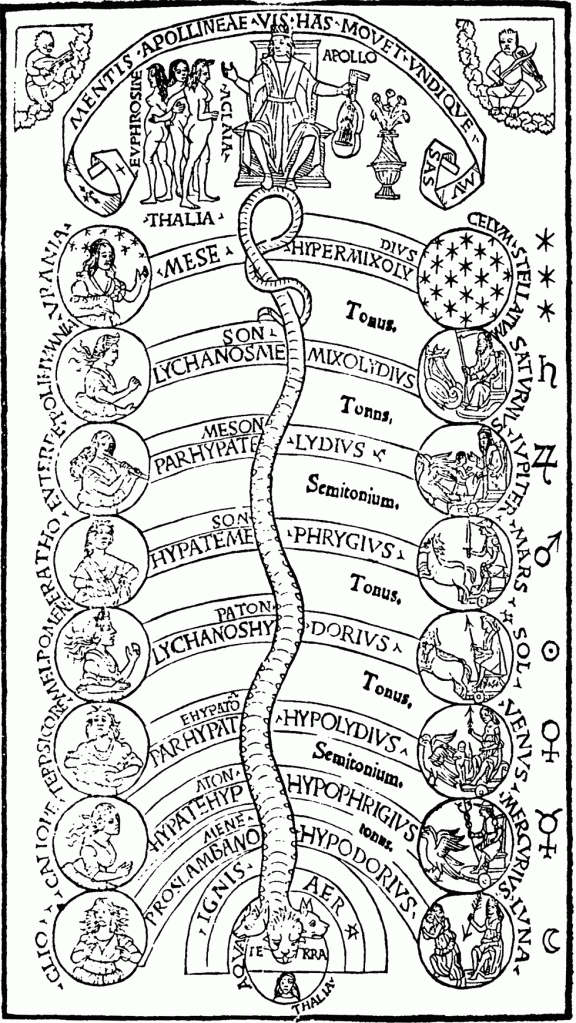
Through the philosopher Macrobius, although he was born more than three centuries after Augustus (about 385 – about 430), we can trace an overall fresco of Neoplatonic thought.
He was a scholar of astronomy and, like almost everyone at the time, followed the geocentric theory, which places the Earth, stationary, in a central position with respect to the Universe.
He wrote a commentary in two books of Cicero’s Somnium Scipionis, dedicated to his son Eustazio.
Macrobius’ goal is to show how all of the ancient thought, and above all the Neo-Platonist doctrines are contained in the Ciceronian text. He holds that God, origin of all that exists, creates Mind (nous), and that Mind creates the Soul of the World; the Soul of the World, incorporeal, “looking back”, gradually degenerates until it becomes the matrix of bodies.
In his Commentary, Macrobius dwells on the theme of the mathematical relationships that preside over harmony.
We read some passages of Book II, in our translation, where he specifically deals with the music of the spheres. It’s a subject of rare value for the information contained. Let’s start with an excerpt from chapter I.
Now it is well known that in the heavens nothing happens by chance or chance and that all the things above proceed in order according to the divine law. Therefore, it is indisputably fair to assume that harmonious sounds come from the rotation of the celestial spheres since the sound must come from movement, and the reason, which is present in the divine, is responsible for the sounds being melodious
Pythagoras was the first of all Greeks to grasp this truth. He understood that the sounds coming out of the spheres were regulated by the divine Reason, which is always present in Heaven, but he had difficulty in determining the underlying cause and finding ways to discover it. When he was tired of his lengthy investigation of a problem so fundamental yet so hidden, a chance event presented him with what his deep thought had overlooked.
From here on, Macrobius tells of the well-known legend of the discovery of harmony made by Pythagoras in a blacksmith’s workshop. He then moves on to dealing with harmonic combinations.
Presenting the subject a certain obscurity, we must, for reasons of synthesis, refer to the mathematical explanation of these relationships in the text cited in the note. We continue to chapter II.
So the Soul Mundi, which moved the body of the universe to the movement we now see, must be intertwined with those numbers that produce musical harmony to harmonize the sounds it instilled by its life-giving impulse. He discovered the source of these sounds in the fabric of his own composition.
Plato reports, as we have said before, that the divine Creator of the Soul, after having woven it of unequal numbers, filled the intervals between them with sesquialters, sesquitertians, superoctaves, and semitones. In the next passage, Cicero very skillfully shows the depth of Plato ‘s doctrine: “What is this great and pleasant sound that fills my ears?” “This is a concord of tones separated by unequal but yet carefully proportioned intervals, caused by the rapid movement of the spheres themselves.” You see here how he mentions intervals and claims that they are unequal and that they are separated in proportion; since in Plato’s Timaeus the intervals of unequal numbers are interspersed with numbers proportional to them, that is, sesquialters, sesquitertians, super octaves and half tones, in which every harmony is embraced. So we clearly see that these words of Cicero would never have been intelligible had we not included a discussion of the sesquialters, sesquitertians and superoctaves inserted into the intervals, and of the numbers with which Plato constructed the Soul of the World, together with why the Soul it was interwoven with numbers that produced harmony. In so doing we have not only explained the revolutions in the heavens, for which the Soul alone is responsible; we have also shown that the resulting sounds must have been harmonious because they were innate in the Soul which propelled the universe into motion.
We continue with the third chapter of the second book.
In a discussion in the Republic of the whirling motion of the celestial spheres, Plato says that a Siren sits on each of the spheres, thus indicating that by the motions of the spheres the deities were provided with song; for a singing Siren is equivalent to a god in the Greek acceptance of the word. “Furthermore, cosmogonists have chosen to regard the nine Muses as the harmonious song of the eight spheres and the only predominant harmony that comes from all of them.” Furthermore, they call Apollo, god of the Sun , the “leader of the Muses”, as if to say that he is the leader and the leader of the other spheres, just as Cicero, referring to the Sun, called him leader, leader, and regulator of the other planets, mind, and moderator of the universe. Even the Etruscans recognize that the Muses are the song of the universe, as their name is Camenae, a form of Canenae, derived from the verb canere. That priests recognize that the heavens sing is indicated by their use of music in sacrificial ceremonies, as some nations prefer the lyre or lyre, and some flutes or other musical instruments. Even in the hymns to the gods the verses of the verse and the antistrophe were set to music so that the verse represented the forward motion of the celestial sphere and the antistrophe the reverse motion of the planetary spheres; these two movements produced the first hymn of nature in honor of the Supreme God. Even in funeral processions, the customs of different peoples have decreed the use of musical accompaniment, due to the belief that souls after death return to the source of sweet music, that is, to Heaven. Every soul in this world is enticed by musical sounds so that not only those who are more refined in their habits, but also all the barbarian peoples, have adopted songs from which they are inflamed with courage or courted with pleasure; for the soul carries with it in the body a memory of the music it knew in Heaven, and is so fascinated by its charm that there is no breast so cruel or savage as not to be seized by the spell of such a plea. (…) We have just explained that the causes of harmony are traced back to Soul Mundi, having been entwined in it; the Soul Mundi, moreover, provides all creatures with life: “Hence the race of man and animals, the life of winged things and the strange shapes that the ocean carries under its glass floor”. Consequently, it is natural that everything that breathes is enraptured by the music since the celestial Soul that animates the universe has sprung from the music. In accelerating the spheres to movement it produces tones separated by unequal intervals but nevertheless carefully proportioned according to its primordial fabric.
Macrobius in the passage reported here mentions a strophe and an antistrophe. The assumption of the Platonic philosopher was that the verse represented the forward motion of the celestial sphere while the antistrophe represented the inverse motion of the planetary spheres.
Given that, to put it like Hermes, what is in Heaven is like what is on Earth, according to us, the verse movement would represent the upward motion towards the stars, while the reverse motion of the antistrophe would represent the downward motion.
That is, if you want to ascend to the stars, to “apotheosize” yourself, you need to use musical verses with notes in an ascending scale, while to ask for the descent of the divine power from above onto the Earth, you need notes in a descending scale.
Now we must ask ourselves if these intervals, which in the incorporeal Soul are learned only in the mind and not by the senses, govern the distances between the planets hovering in the corporeal universe. Archimedes, in fact, believed that he had calculated in stages the distances between the earth’s surface and the Moon, between the Moon and Mercury, Mercury and Venus, Venus and the Sun, the Sun and Mars, Mars and Jupiter, Jupiter and Saturn, and that he had also estimated the distance from Saturn’s orbit to the celestial sphere. But the figures of Archimedes were rejected by the Platonists for not respecting the intervals in the progressions of the numbers two and three. They decided that there could only be one opinion, that the distance from the Earth to the Sun was twice that from the Earth to the Moon, that the distance from the Earth to Venus was three times greater than that from the Earth to the Sun, that the distance from Earth to Mercury was four times greater than from Earth to Venus, that the distance from Earth to Mars was nine times greater than the distance from Earth to Mercury, that the distance from Earth to Jupiter was eight times greater than that from Earth to Mars, and that the distance from Earth to Saturn was twenty-seven times greater than that from Earth to Jupiter. Porphyry includes this belief of the Platonists in his books that illuminated the darkness of the Timaeus, and says that they believed that the intervals in the bodily universe, which were filled with sesquiterzians, sesquialters, superoctaves, midtones and a leimma, followed the pattern of the fabric of the body. Soul and the harmony was such that its proportional intervals were woven into the fabric of the Soul and that they were also injected into the bodily universe which is vivified by the Soul. “Hence Cicero’s claim that celestial harmony is a concordance of tones separated by unequal intervals but nevertheless carefully proportioned, it is in all respects wise a and true.
With the aforementioned theses, Macrobius will have, we suppose, participated in some complex erudite dispute on the theme of the Platonicity of the contents of Cicero ‘s Somnium.
Certainly, he could not have imagined that centuries later he would have provided us “dressed monkeys” with smartphones as well , some arguments for the interpretation of the function of the Pantheon.
ASCENT BY MEANS OF THE HARMONY OF THE SPHERES AND OF THE MUSES
For Homer the Muses are nine, they are daughters of Zeus and are on Olympus. In the prologue of his Teogonia Hesiod also speaks of nine Muses, “enriching Heaven and the stars with divinity.”
Regarding the denomination of “Muse”, Proclus said that, since philosophy, platonically “great music,” makes our psychic powers move harmoniously with respect to entities and their movements, we enter into an agreement with the universe as we make our soul cycles similar to those of the universe, this is why that we derive from this research the name we give to the Muses. And goes on:
[…] And in truth we know that the Muses are those who inculcate the search for truth in souls, the multiplicity of powers in bodies, everywhere the truth of harmonies.
Therefore, the Muses are Goddesses of the spheres, a role originally attributed to the Sirens, then assigned to the Muses, who appear to be superior to them. In fact, Proclus said that the division of Heaven was into eight spheres, that of the whole World into nine spheres and that the first division, in Plato’s Republic, had been dedicated to the Sirens, while the second to the whole set of Muses, under which are the Sirens.
In one of the speeches attributed by Iamblichus to Pythagoras, the Muses were appointed to watch over universal harmony. They were not, however, identified with each of the planetary spheres. Pythagoras had suggested building a temple to the Muses to maintain harmony in the city because these Goddesses, he said, all bore the same name together, were known to tradition as a community and delighted in the highest degree in common worship, and then the chorus of the Muses was always one and constantly the same, and in addition, it contained chord, harmony, and rhythm, that is, everything that creates concord. Finally, it showed how their power extended not only to the highest scientific principles but also to the harmony and harmony of the universe.
With regard to the Muses, Macrobius writes in the Commentary:
Even the theologians have understood with the nine Muses the melodious accents of the eight celestial spheres with the supreme single chord that results from the whole. This is why Hesiod, in his Teogonia, gives the eighth muse the name of Urania: because after the seven wandering spheres, which are placed under it, the octave, the star sphere that is above them, is Heaven properly said; and to make us understand that there is a ninth, greater than all, which results from the union of all the harmonies together, he adds: Calliope: this is excellent among all, meaning with this name that the ninth Muse is designated by sweetness same as the voice. Calliope, in fact, means in Greek “endowed with a beautiful voice”, and to expressly indicate that it is a harmonious whole resulting from all the others, the poet assigns it an expression that indicates universality: it is excellent above all.
And Proclus, on the same theme:
the Ancients gave the superintendency over the Universe to the Muses and Apollo Musagete, the one who provides for the unification of the overall harmony; the others keeping together the divided progression of this harmony, their number having accorded with that of the eight sirens of the Republic. The Muses and Apollo Musagete were, in fact, created by the Demiurge, “as well as the chain of Hermes. In him therefore there are above all demiurgic calculation and harmony, since one belongs to Hermes, the other to Apollo, and, when filled with both, the soul participates in both calculation and harmony.
In the following period Marsilio Ficino referred to Martianus Capella‘s Le nozze di Filologia e Mercurio when, in dealing with the harmony of the spheres, he says that Urania occupies the outermost sphere of the starry Firmament, which rotates quickly, echoing with a high-pitched sound, Polyhymnia regulates the sphere of Saturn, Euterpe that of Jupiter, Erato controls the sphere of Mars, Melpomene the median sphere, where the Sun embellishes the universe with flaming light, Terpsichore joins the gold of Venus, Calliope embraces the circle of Cillenium, that is Mercury, Clio places his residence in the nearest sphere, namely the Moon, which resounds with low notes, with rougher musical modes; Thalia, on the other hand, is abandoned on Earth, devoid of sound. This representation coincides with that of Gaffurius where, next to Apollo, the three Graces are depicted, and under the Muses in the aforementioned planetary order.
ASCENT BY MEANS OF VOCALIZATIONS
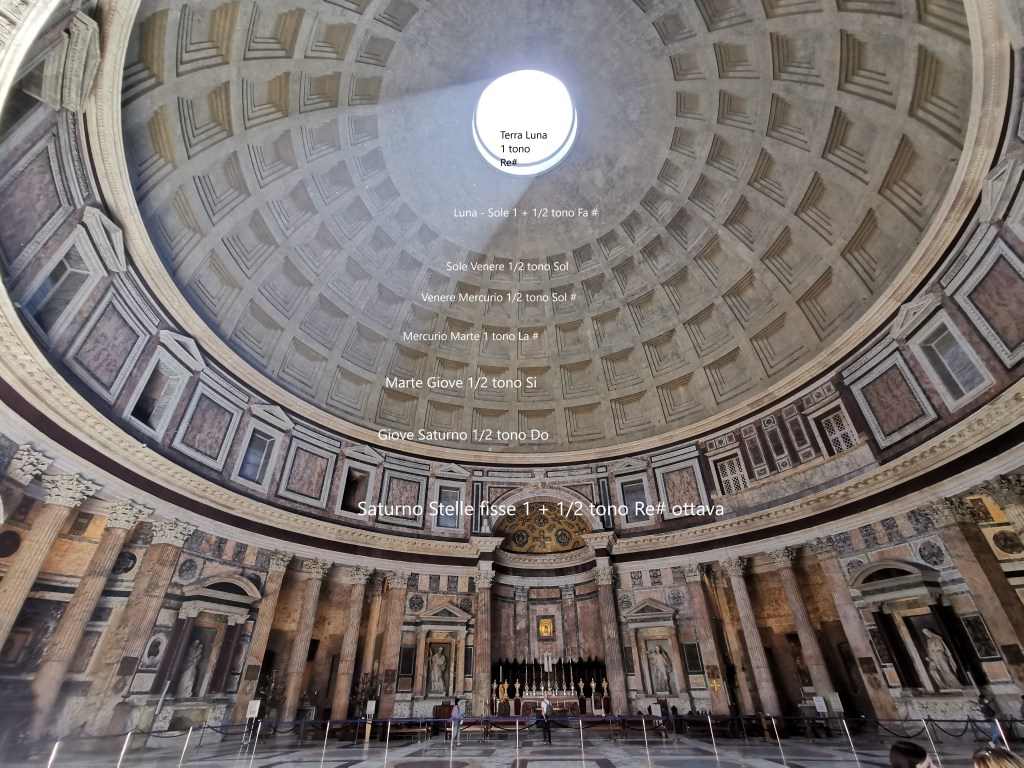
A God or divine man “called Thoth in Egypt, distinguished the vowels” writes Plato in Philebus.
In Greek, as in Sanskrit, there are seven vowels; in Latin and Italian five, however, they rise to seven if the vowels “o” and “e” are each counted twice, one for the open sound and the other for the closed sound. The Egyptians had a Song of the seven vowels.
Since the seven vowels were used in place of the seven tones of the seven-stringed lyre (tuned on the joint tetrachord of the Doric scale), according to the Pythagoreans the letters can be read as notes. According to the Pythagorean doctrine, in fact, each tone of the scale represented the note of one of the seven planets. Each vowel, therefore, represents a kind of magical symbol of the music of the spheres. The indication to determine the tuning fork of each of the tones symbolized by a vowel was found in the Harmony of Nicomachus of Gerasa, which from the Pythagoreans took up precisely the harmonic conception of the world. In fact, he writes in his Harmonica Manual: “The sounds of each of the seven spheres produce a certain noise, in which the first sphere produces the first sound, and these sounds have been given the name of vowels.”
He further specifies:
All those who have used the seven-tone symphony as natural borrowed it from this source: not from the spheres but from the sounds tuned into the universe, the only sounds that we call, among letters, vowel-sounds and musical sounds. But since the analysis of these points is of an elementary simplicity, which cannot suffice to explain complex questions, it is necessary to understand the conception of the Universe from the affinity, analogous to that of the strings, and through the accommodation of one thing to another.
John the Lydian assimilated the seven stars to the seven species of octave and to the seven vowels of the Greek alphabet.
The concordance of vowels, planets, tones was made even by the Gnostics. According to Irenaeus, the Gnostic Mark “The Magician” wrote: “The first Heaven plays the A, the following the E, the third the long E, the fourth in the middle shouts loudly the Power (dynamis) of the I, the fifth the O, the sixth the U, the seventh and fourth starting from the middle evoke the element of Omega.”
Here is Marcus’s system, as proposed by Lindsay:
A moon Nete D sharp E Venus Paranete C sharp H / È Mercury Paramese B flat I Sun Month A O Mars Lichanos G U Jupiter Parhypate F Ω / Ò Saturn Hypate E Assuming an invocation to the planetary gods sung on the seven vowels in the temples of ancient Egypt, before Lindsay, Edmond Bailly wrote that: each of the seven Greek vowels corresponded to one of the seven bodies of the planetary system of the Ancients, expressing at the same time one of the seven notes of the lyre of Hermes. The scheme is a triple septenary of stars, notes and vowels, in which: “the vowels have their radical vocalism, without taking into account the changes in accent caused by times and places”:
A Moon D E Venus C H / È Mercury B I Sun A O Mars G U Jupiter F Ω / Ò Saturn E Boella and Galli correctly observe that “the descending system described coincides with the cosmic and planetary scale, but not with the ascending musical scale, referred to in the title page of Gaffurius’ Practica musice of 1496 (see in the images).
However, they do not draw the consequences, i.e. they do not impute the inversion as an error.
Let’s examine the two schemes divided into vowels, stars, chordii and notes. We believe that both Bailly (although he was a musicologist) and Lindsay have made some confusion and mistakes. Reporting Marco’s scheme, cited by Irenaeus, they correctly reported the ascending vowel sequence (from the Moon to Saturn), but they made a mistake in associating it with the sequence of strings and notes which, instead, they indicated as descending. They also erred in associating relationships with the stars.
Going back to the strings, we note that those first mentioned in the diagram were the highest. The Greek names for the strings of the seven- and eight-string lyres saw the first note as higher and closer to the player. The strings were as follows: Nete, Paranete, Paramese; Mese, Lichanos, Parhypate, Hypate (this is the scheme proposed by Lindsay); or Nete, Paranete, Trite, Paramese; Mese, Lichanos, Parhypate, Hypate – the last four from Mese to Hypate being the finger tetrachord, the others being played with the plectrum.
The ascending pattern of the strings of the Pythagorean musician Gaffurius is still different, as shown in the illustrations, where, of the previous pattern, only the strings Lichanos, Parhypate, Hypate are shown corresponding to the asters Sun, Venus and Mercury, in an (ascensional) direction or contrary to the one followed by the Lindsay (which is descendant).
If you follow the correct sequence, where Nete is the highest note and the others progressively lower, the result is that the order is reversed. That is, the correct order should be.
A moon Hypate E Venus Parhypate H / È Mercury Lichanos I Sun Mese O Mars Paramese U Jupiter Paranete Ω / Ò Saturn Nete Correspondingly the musical notes indicated by Bailly and Lindsay should also be reversed. Problem: We see inconsistencies and errors. To name one, the note of Saturn would be an E which is not an octave of D sharp (and in any case the octave should be in the fixed stars!).
It is necessary to make a brief digression in order to understand the correct sequences of planets, strings and notes, or rather stellar harmony. Let’s start with a “Pythagorean” memory of Pliny.
Pliny deals with the theme of the harmony of the spheres inserted in the broader treatment of the question of astral distances.
Many have also attempted to trace the intervals of the stars from the earth, and have shown that the sun is nineteen parts as distant from the moon as the moon itself is from the earth. But Pythagoras, a man of sagacious, sagacious mind, deduced that from the Earth to the Moon there were 126,000 stadia, from the Moon to the Sun twice as far from it, and then tripled up to the twelve signs (zodiac), of the same opinion was also Sulpicius Gallus.
But Pythagoras sometimes appeals to music also for the distance of the Moon from the Earth, from the Moon to Mercury half a space, as from Mercury to Venus, from Venus to the Sun six times, from the Sun to Mars a tone [i.e. how much from the Earth to the Moon ], from Mars to Jupiter a semitone as also from Jupiter to Saturn, and therefore six times up to the zodiac; Thus are made the seven tones which they call διὰ πασῶν ἁρμονίαν Διὸς, this is the concert of the universe. In it Saturn was moved to the Dorian mode, Jupiter to the Phrygian tone, and so on all the others, with a subtlety that is pleasant rather than necessary.
Let us listen to Pizzani: “To the affirmation that Pythagoras would have fixed the distance from the earth to the moon at 126,000 stadiums – a figure which, doubled and tripled, would provide us, according to an opinion also shared by Sulpicius Galo, with the exact determination of the distances between the Moon and the Sun and between the Sun and the sphere of the fixed stars— followed by a real series of notes, also attributed to Pythagoras, in which the distances between the eight celestial spheres of the ancient tradition (including the Earth) are translated into as many intervals musical.
The sum of these intervals, amounting to seven tones, would correspond, according to Pliny, to what the ancients called diapason harmonia, or octave interval (which, in reality, included only six tones!).”
Tannery had observed that this is the oldest evidence of the legend according to which Pythagoras would have foreseen the distance between the Earth and the Moon and would have, at the same time, translated the astral distances into musical intervals.
As far as it matters for the purposes of this essay, the aforementioned Pliny scale is almost identical in Censorinoand in Martianus Capella. These two authors both set the distance of the Moon from the Earth at 126,000 stadia.
Only Pliny and Martianus Capella affirm that the sound emitted by each celestial body is a definite mode.
While Censorino and Martianus Capella identify tout court the figure of 126,000 stadia with the first tone of the Pythagorean range, Pliny does not agree. He expresses himself in the sense that the philosopher of Samos would have proposed two completely different criteria to define the distances between the stars, without confusing or assimilating them to each other. This distinction would be confirmed by Pliny’s subsequent affirmation that, according to an opinion also shared by Sulpicius Galo, by doubling and tripling the initial figure one would obtain, respectively, the distance between the Moon and the Sun and between the Sun and the sphere of the fixed stars . The Pythagorean scale assumed, on the contrary, that the distance between the Moon and the Sun corresponds to two and a half times (as visible this scale is not the Platonic one where the Sun is immediately after the Moon) and that between the Sun and the fixed stars three and a half times the distance between the Earth and the Moon.
Pizzani derives the hypothesis that
“Pliny drew his data from two distinct sources. Varro would have provided him with the musical scheme of astral harmony and the figure of 126,000 stadiums with the explicit attribution of these doctrines to Pythagoras; on the other hand, from a work by Sulpicius Galo, a work explicitly mentioned by Pliny himself a little further back, further indications about the way to calculate the distances of the sun and the fixed stars would derive.In order to find, therefore, the right sequence in the relationships between the notes, we need, in our opinion, to refer to Pliny, to Martianus Capella’s Nozze di Filologiavii and Mercury and to an extraordinary document such as the one contained in the collection of Astronomical Manuscripts of 820 AD. circa, preserved in Salzburg.
If we refer to these documents we may be able to correct the sequence of notes and the relationship between them.– Earth silence silence A Moon Hypate D sharp E Venus Parhypate E H / È Mercury Lichanos F I Sun Mese A flat O Mars Paramese B flat U Jupiter Paranete B Ω / Ò Saturn Nete octave C A Moon Hypate D sharp octave
The sequence of ratios for the musical ascent would thus be divided into a tone between the Earth and the Moon, a semitone between the Moon and Venus, a semitone between Venus and Mercury, three semitones between Mercury and the Sun, a tone between the Sun and Mars, a semitone between Mars and Jupiter, another semitone between Jupiter and Saturn and three semitones to get to the fixed stars.
Finally, let us compare the superior scheme we have revised with that of Stephenson, already examined, with that of the rise of Philology and with that of the concentric astral spheres (seen from above) portrayed in the image above. By comparing the relative ratios between them, we obtain the following synoptic scheme of the ratios calculated in semitones:Aster Our scheme Stephenson SalzburgCollection Martianus Capella / Favonius Eulogius /Plinius Censorinus Earth- Moon 1 1 1 1 1 Moon -Venus 1/2 1/2 1/2 1/2 1/2 Venus-Mercury 1/2 2/3 1/2 1/2 1/2 Mercury-Sun 1 + 1/2 3/4 1 + 1/2 1 + 1/2 1 + 1/2 Sun-Mars 1 4/8 (1/2) 1 1/2 1/2 Mars-Jupiter 1/2 8/9 1/2 1/2 1/2 Jupiter-Saturn 1/2 9/27 (1/3) 1/2 1/2 1/2 Saturn-Fixed Stars 1+1/2 27 1+1/2 1+1/2 1/2 We observe that there is a close correspondence between the sequence of Pliny, Martianus Capella and that of Salzburg. The only difference is that, in the relationship between the Sun and Mars, Capella speaks of a semitone, while the Salzburg manuscript speaks of a tone. We lean towards the “Salzburg” hypothesis since we must not forget that the great belt of asteroids/planetoids insists between the Sun and Mars.
For the rest, the correspondence between Pliny, Capella and Salzburg is total.Having said this, let’s go back to the vocal theme.
It is doubtful that the note-vowels were really sung. Lindsay says that Nicomachus seemed to consider some kind of mystical murmuring, as he claimed that initiates invoke the god by making hissing, inarticulate and incoherent sounds. The vowels were present so that the initiate could transfer the sound from an earthly sphere to a celestial one; the earthly notes had to be transformed into the music of the spheres.
Silence, Sige, was then considered “the first companion of the divine name,” as we will see shortly.
The Leyden Papyrus reports some examples of vocalized invocation:
I call upon you, Lord, with a hymn sung; I celebrate your holy power AEHIOYΩΩΩ and the even more important one: “Your name is composed of seven letters, according to the agreement of the seven sounds that have intonations corresponding to the 28 lights of the Moon.
Also noteworthy is the cosmic hermetic prayer to the supreme God (Aiòn):
(…) To you belongs the eternal party hall where your name, the heptagram, stands like a sacred image, according to the harmony of the seven vowels whose sounds correspond to the twenty-eight houses of the Moon. From you come the good influences of the stars, demons, fortunes, and Destinies (…)
As can be seen in this prayer, the seven vowels have seven notes and correspond to the 28 houses of the Moon. Could it be a coincidence that the lacunaries of the dome of the Pantheon are 28 in number for each of the five rows?
In another hermetic magic recipe, the “Kosmopoiia of Leiden” reads:
Lord, I reproduce your image with the seven vowels, come to me and listen to me: a éé êêê iiii ooooo uuuuuu ôôôôôôô
Also in the last cited papyrus, “Kosmopoiia di Leiden“, we find a further vocalization enriched by references to nine Gods and the seven planets:
And after taking the apexes of their names from the nine Gods with their power, he was called Bosbeadii, and when he had done the same for the seven planets, he was called Aeeiouo, Eeiouo, Eiouo, louo, Ouo, Uo, O, Ouoieea, Uoieea, Oieea, Ieea, Eea, Ea, A (powerful and admirable anagram). As for its greatest name, it is this great and holy name, of 27 letters (PM, at the end Iao); in another form: PM, then Iao ou aeeiouo. So when the god comes, lower your eyes, etc.
From the Ritual of the Great Magical Papyrus of Paris we draw the following exceptional passage:
(…) I invoke the immortal venerable your living Names, those who never descended into mortal nature, who never yet articulated themselves in the language of man, in voice or in mortal language!
ÈEÒ. OÈÈÒ. I OR. OÈ. ÈEÒ. ÈEÒ. OÈEÒ IÒÒ. OÈÈE. OÈÈ. ÒOÈ. IÈ. ISÒ. OÒ. OÈ. IEÒ OÈ. ÒOÈ. IEÒOÈ. IEEÒ. EÈ IÒ. IT IS IT IS. ÒIsÒ. EOÈ. OEÒ. ÒIÈ ÒIÈE Ò. OI. III. ÈOÈ. ÒEÙ. ISÒ. OÈE. EÒÈIA AÈAEÈA ÈEEÈ. EEÈ. EEÈ. IEÒ ÈEÒ OÈEEOÈ ÈEÒ EYÒ. OÈ. EIÒ EÒ OÈ. ÒIs ÒIs EE. OOOYIOÈ
Of all this with fire and spirit from beginning to end, then a second time (and so on) until (you) have realized the seven immortal Gods of the cosmos.
Also in this excerpt of the ritual, the seven stars are connected to the seven vowels. In this regard, keep in mind the correspondence between H = È (H / È, note = yes, star = Venus) and Ω = Ò (Ω / Ò, note = mi, star = Saturn).
In the Trattato “De elocutione“, Demetrius Falereus (345 BC-282 BC ca.), wrote that the Egyptian priests sang in praise to the gods by means of the seven vowels,
pronounced in due order and then repeated, creating a sound as harmonious as that of the flute and the citara; likewise, the Persian magician Ostanes pronounced each divine name according to seven vowels, which have a direct relationship with the seven planets.
Demetrius praised the harmonic effect of a succession of vowels in a literary composition, citing Homeric forms such as èelios or oreion.
Strange names and vowel combinations play a considerable part in spells:
Your Name is composed of Seven Letters according to the Harmony of the Seven Tones which have their sound according to the Twenty-eight Lights of the Moon, Saraphara, Araphaira, Braamarapha, Abraach, Pertaomech, Akmech , Iao: ouee, iaõ, oue, eiou, aēë , e éou, eeou, lao . “I invoke you Lord in a hymn-shaped song, I celebrate your Sacred Might, ae é ioooo. Sacrifice after singing: é i ovo …
Demetrius also speaks of the 28 lunar houses (or lights), therefore.
Finally, Dio Cassius explained that the list of planets represented the order assigned to the seven days of the week.
In modern times, Seyffarth observed that it was known that the seven notes of the octave and the seven vowels corresponded to the seven planetary spheres, so much so that the seven notes of the planetary spheres were thought to be the seven vowels.
“The soul is physically forced to move”, wrote Aristides Quintilianus, where under the influence of instrumental music.
Just as, according to Pythagorean arithmetic, the soul is a harmony resulting from ratios of numbers, similarly, musical harmony is made up of similar ratios:
the very physical constitution of the soul includes the same elements of which musical instruments are also made up: there is a correspondence between the fibers of the soul and the strings of the lyre and the citara, between the breath of the soul and the air produced by the sound of wind instruments.
Also in the Myths of Hyginus we read that the Moirae or Fates would have invented some of the seven vowels.
The Pythagorean awareness of the harmonic scale of the astral spheres was therefore part of the spiritual culture of the time. This harmonic scale would have “physically forced the soul to move ” in harmony with the higher astral spheres with which it shared, remember, the life-giving substance of the ether.
We have therefore examined some of the theurgic techniques of the Roman era that may have been employed by the emperor Octavian to ascend to the stars, as announced by prodigies, wanted by the people, and finally decreed by the Senate.
The solar rays, the stones, the herbs, and, above all, the vocalizations, with the musical notes referring to the Muses and the planetary divinities, according to the sources of the time, were as many technical components used ritually for the preparatory purification for the ascent.
It remains to examine how the purification of the soul took place by means of the reproduction of the stellar movement on Earth, according to the hermetic principle quod est inferius est sicut quod est superius.
AURELIO BRUNO
(themes drawn from Aurelio Bruno, “The Pantheon of the Sky, 2022, ISBN: 979-8370654237)
Disclaimer
Last updated: February 26, 2023
Interpretation and Definitions
Interpretation
The words of which the initial letter is capitalized have meanings defined under the following conditions. The following definitions shall have the same meaning regardless of whether they appear in singular or in plural.
Definitions
For the purposes of this Disclaimer:
- Company (referred to as either “the Company”, “We”, “Us” or “Our” in this Disclaimer) refers to Il Pantheon del Cielo.
- Service refers to the Website.
- You means the individual accessing the Service, or the company, or other legal entity on behalf of which such individual is accessing or using the Service, as applicable.
- Website refers to Il Pantheon del Cielo, accessible from www.pantheondecoded.org
Disclaimer
The information contained on the Service is for general information purposes only.
The Company assumes no responsibility for errors or omissions in the contents of the Service.
In no event shall the Company be liable for any special, direct, indirect, consequential, or incidental damages or any damages whatsoever, whether in an action of contract, negligence or other tort, arising out of or in connection with the use of the Service or the contents of the Service. The Company reserves the right to make additions, deletions, or modifications to the contents on the Service at any time without prior notice. This Disclaimer has been created with the help of the TermsFeed Disclaimer Generator.
The Company does not warrant that the Service is free of viruses or other harmful components.
External Links Disclaimer
The Service may contain links to external websites that are not provided or maintained by or in any way affiliated with the Company.
Please note that the Company does not guarantee the accuracy, relevance, timeliness, or completeness of any information on these external websites.
Errors and Omissions Disclaimer
The information given by the Service is for general guidance on matters of interest only. Even if the Company takes every precaution to insure that the content of the Service is both current and accurate, errors can occur. Plus, given the changing nature of laws, rules and regulations, there may be delays, omissions or inaccuracies in the information contained on the Service.
The Company is not responsible for any errors or omissions, or for the results obtained from the use of this information.
Fair Use Disclaimer
The Company may use copyrighted material which has not always been specifically authorized by the copyright owner. The Company is making such material available for criticism, comment, news reporting, teaching, scholarship, or research.
The Company believes this constitutes a “fair use” of any such copyrighted material as provided for in section 107 of the United States Copyright law.
If You wish to use copyrighted material from the Service for your own purposes that go beyond fair use, You must obtain permission from the copyright owner.
Views Expressed Disclaimer
The Service may contain views and opinions which are those of the authors and do not necessarily reflect the official policy or position of any other author, agency, organization, employer or company, including the Company.
Comments published by users are their sole responsibility and the users will take full responsibility, liability and blame for any libel or litigation that results from something written in or as a direct result of something written in a comment. The Company is not liable for any comment published by users and reserves the right to delete any comment for any reason whatsoever.
No Responsibility Disclaimer
The information on the Service is provided with the understanding that the Company is not herein engaged in rendering legal, accounting, tax, or other professional advice and services. As such, it should not be used as a substitute for consultation with professional accounting, tax, legal or other competent advisers.
In no event shall the Company or its suppliers be liable for any special, incidental, indirect, or consequential damages whatsoever arising out of or in connection with your access or use or inability to access or use the Service.
“Use at Your Own Risk” Disclaimer
All information in the Service is provided “as is”, with no guarantee of completeness, accuracy, timeliness or of the results obtained from the use of this information, and without warranty of any kind, express or implied, including, but not limited to warranties of performance, merchantability and fitness for a particular purpose.
The Company will not be liable to You or anyone else for any decision made or action taken in reliance on the information given by the Service or for any consequential, special or similar damages, even if advised of the possibility of such damages.
Contact Us
If you have any questions about this Disclaimer, You can contact Us:
- By email: pantheondecoded@gmail.com
-
THE UNIVERSE OF THE “ANCIENTS”
aureliobruno©2023
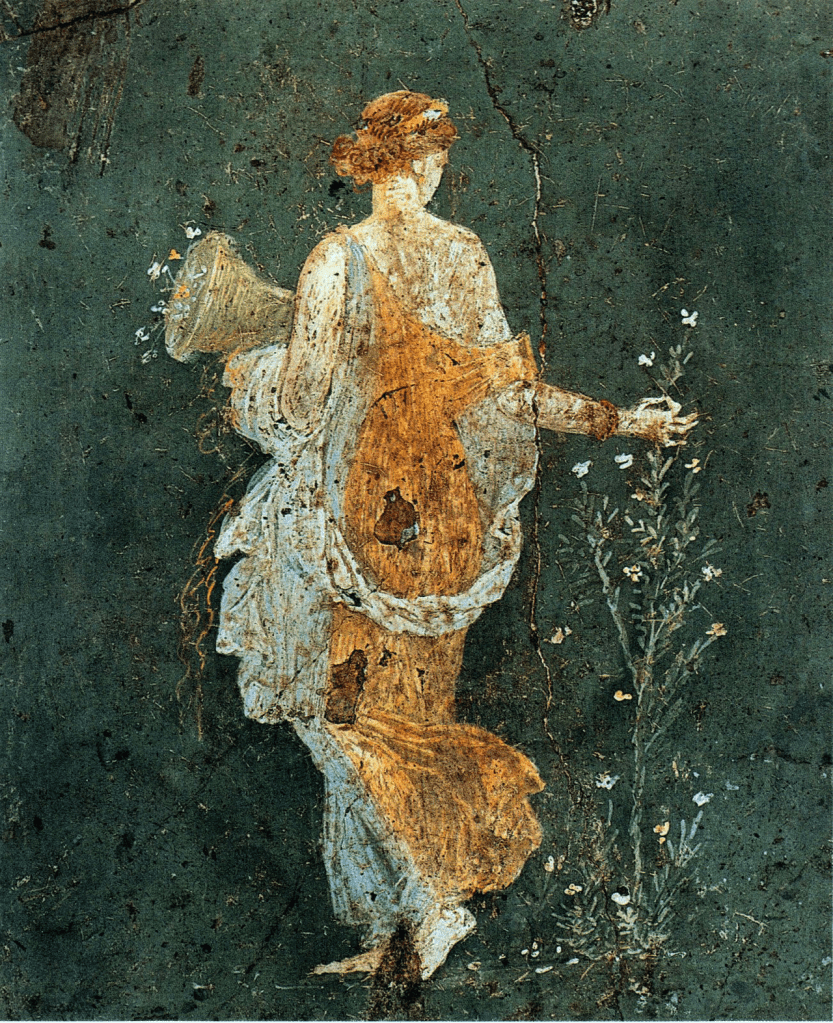
This is what happens to us too: relegated to some cavity of the Earth, we believe we live high up, on its summit, and we call it Heaven, the air, convinced as we are that it is the space where the stars turn.
(Plato, Phaedo)
And these are the affections of the world (kosmou), rotate and disappear. And rotation is upheaval, and disappearance is renovation. So, the intelligible world depends on God, that one sensible from the intelligible, and the Sun, through the intelligible and sensible world, dispenses the flow of Good from God, that is, action creator
(Hermes Trismegistus , Corpus)
Thus, they (the Pythagoreans) believe that the ratio of the velocities of the stars, in relation to the distances, are the same as those of the musical chords, and, therefore, they say that the sound of the rotating stars is harmonic
(Aristotle, De Caelo)
“(…) When, on the other hand, a man has tended with all his zeal to true knowledge and thoughts, and, of all his faculties, exercised mainly those of the spirit, such a man, is of absolute necessity, when he arrives at the truth, he has in his heart and in his thoughts the immortal and the divine and, to the extent that human nature is permitted to participate in immortality, in no way escapes him. It does not cease to worship the Divinity; he always cultivates, cared for, and arranged as he should, the “demon” who dwells in him: therefore he necessarily rejoices in a singular eudaemonia (…)
(Plato, Timaeus)
We have seen how, on the political level, the apotheosis of the emperor and reviewed the sources on the subject.
Now is the time to understand what were the conceptions of the world and of Heaven on which the idea of the apotheosis of a human being was based, even if an emperor, as well as what was the cultural context – rectius, mystical – which determined its emergence.
Let us, therefore, begin by examining the ideas that the people of the time had about the cosmos and the planet in which they lived.
MAN AND ASTERS
Before going into the ancient cosmos, it is necessary to make a premise: the “World” is not the Earth, as we understand it today, visible on the globe.
The World was the whole made up of the Earth, the waters, and the eight Heavens above it.
The starry sky revolved around the stationary Earth and not the other way around.
There was no “cosmos” outside the World. The Cosmos was the World itself.
For today’s science, the cosmos is infinite, a frightening abyss of nothing around the Earth.
The Earth is no longer the center of the World. It carries the insignificant lives of men, in an incomprehensible and hopeless universe.
So hopeless that, by way of eschatological consolation, someone has hypothesized the grotesque pantomime of billions of saving Christ crucifixions in billions of alien worlds.
The pre-Copernican system, on the other hand, placed man at the center of the Universe.
For the thrice great Hermes man, the hypostasis of God was the true center of the World.
And that man, the center of the World, acquired wisdom and eternal life by contemplating the stars.
The meaning and purpose of the sage’s life was the return to the stars.
Let’s hear what the divine Plato says about it :
“As for this kind of soul that is sovereign in us, here is what we need to think about it. God has given it to each of us as a divine Genius, this kind of soul that we declare that it dwells in the upper part of our body and raises us, above the earth, towards those parents we have in heaven” since we are one plant not terrestrial, but celestial. And this language is perfectly true. Indeed, it is up there, from where the soul, for the first time, originated, that Divinity has suspended our head, which is like our root, and thereby gave the body an upright posture. Then when a man has long surrendered himself to the lusts of the flesh or the pursuit of honors, and it is for these things that he gives himself the greatest pain, all his preferences have necessarily inclined towards the earth and, as far as it is possible to make himself mortal, he lacks nothing because he recovers completely, since he has always applied himself to nourishing the mortal part. He tended with all his zeal to science and to true thoughts, and, all his faculties, he has exercised principally those of the spirit, such a man, of absolute necessity, when he comes to the truth, has in his heart and in his thoughts the immortal and the divine and, insofar as it is permitted to human nature to participate in immortality, nowhere escapes him. It does not cease to worship the Divinity; always cultivates, is cared for, and arranged as it should, the “demon” that dwells in him: he therefore necessarily rejoices in a singular “eudaemonia“. Now, there is only one way to take care of a thing, whatever it is: it is to provide it, each time, the nourishment and movements that are convenient. Now the movements that have an affinity with the divine principle in us are the thoughts of the Whole and its revolutions. Each of us, following these celestial movements, rectifies, with the knowledge of the harmonies and revolutions of the Whole, the revolutions (of the intellectual soul) in our head, which were tasted at the moment of birth; which makes the subject contemplating similar to the object contemplated, in conformity with the original nature of this subject; and thus, having completed this likeness, he reaches the supreme end of the better life, which the gods have proposed to men, for the present duration and for the time to come.”
CONFORMATION OF THE EARTH
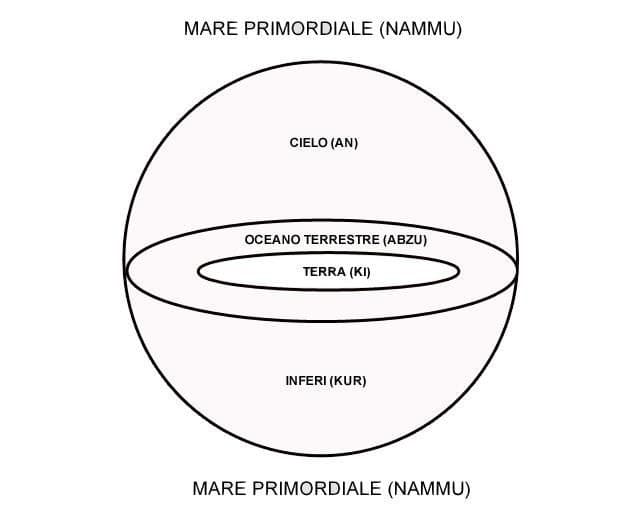
That the Earth was stationary was a concept accepted by everyone in the culture of the time.
Most philosophers conceived the World as spherical, but with a different conformation compared to modern representations.
By “World” was meant not our globe, but a sphere in the middle of which, along the equator, was the Earth motionless and closed above by the Firmament in incessant rotational movement, and surrounded by waters.
Let’s see specifically, what were the conceptions of the various philosophers/scientists of the time.
Contrary to what some contemporary scholars claim, “Pythagoras was also the first to call the universe cosmos (World) and to say that the earth is convex in shape” (each plane is often a convex geometric figure). According to Theophrastus it was Parmenides, and according to Zeno, Hesiod.
Hermes, giving the floor to Isis, tells us about it: “… And Isis replied: – The Earth lies supine in the center of the whole, like a man who looks up to Heaven and is divided into as many parts as human limbs.”
Aristotle recounts how Thales said that the Earth floated inertly on water and remained motionless like wood on it.
Anaximander said that the Earth is hovering in the air, it is not supported by anything, and it remains suspended because it has equal distance from everything that surrounds it. It has a spherical curved shape, similar to a stone column or drum; one of its surfaces is the one on which we move, and the other is on the opposite side.
From Plutarchus we learn that he thought that the Earth had a cylindrical shape and that the height corresponded to one-third of the width.
Parmenides was the first to say that the Earth occupies the center of the universe.
He thought the Earth was convex in shape. Because it is distant from all points, it remains in equilibrium. Therefore, it only stirs, but it does not move.
Anaxagoras said that the Earth had a flat shape and that it remained to hover motionless by virtue of its size, “so much because there is no emptiness and because the air, which is very strong, supports the Earth resting on it . (…) The Earth is hollow and contains water in its cavities ”.
Even the Pythagorean Archelaus argued that the Earth was hollow, still and in the middle of everything and, as proof, he alleged that the Sun does not rise or set at the same time for all men, what it should do if the Earth was flat.
Again according to Anaxagoras, the reason for the stability of the Earth is its flat shape because it does not cut the underlying air but seals it like a lid, as we can see that flat-shaped bodies do, which are hardly shaken by the winds due to their resistance they oppose. The Earth would do the same thing in front of the underlying air due to its flatness and the air, not having sufficient space to move, would remain stationary below, all collected, like the water in hourglasses: “If the Earth had no shape flat could not stand still.”
In contrast, Diogenes of Apollonia said the Earth was spherical, firmly placed in the center, having achieved its constitution by virtue of circular motion due to heat and freezing due to cold.
Like Anaximander, Leucippus also maintained that the Earth had the shape of a drum.
Eratosthenes argued, according to Macrobius, that “the size of the Sun is 27 times larger than that of the Earth, while Posidonius said it would be many times larger than the Earth.
Let us now turn to Plato. We note that, due to the completeness and systemic coherence of his thought, we will be forced to quote various passages several times in reference to the various topics.
(…) I believe that the Earth is very large. (…) . This is what happens to us too: we reside in some cavity of the Earth, we believe we live high up, on its summit, and we call Heaven, the air, convinced as we are that it is the space where the stars turn; Here, my friend, what is said, that first of all this real Earth, to those who look at it from above, appears as one of those multicolored leather spheres, divided into twelve segments, of different colors, similar these, just, to those that painters usually use down here. And that Earth up there, all of these colors is painted, but much brighter and purer than ours: now, in fact, it is purple, of marvelous beauty, now it is gold or all white, whiter than chalk and snow, and the other colors, then, of which it is composed, much more numerous and more beautiful than we have ever seen. And the very cavities of the Earth, filled with lanes of water and air, take on a particular color in the variegated range of the other colors so that the Earth appears in its own iridescent and uniform hue.
A peculiar feature of the Platonic system of thought is that our Earth lies on a small cavity of a “real Earth”, very large, placed motionless in the center of the universe.
From Strabo, we learn that “Posidonius reports that the one who first divided the Earth into five zones was Parmenides, but that he declared the torrid zone almost double in extension (compared to that which is in the tropics), extending beyond the two tropics towards the outside and towards the temperate zones.”
Aetius tells us that for Parmenides the air is a “secretion of the Earth, which evaporates due to the pressure stronger than this”.
Xenophanes declared that the Earth was infinite and that it was not enveloped in every part of the air. He also said that all things came from Earth.
Lucretius expressed the same concept when he said that the Earth “remains stationary in the middle of the world”, that is, stationary in the middle of the world.
Democritus argued that the Earth was oblong, having a length equal to one and a half times the width and that, moreover, being mixed with water, where it was strongly compressed, “because of this, it became hollow and deep, while where it was little or no water allowed the mountains to appear.”
The astronomer of Rhodes, Geminus , criticized the theory of Crathes of Mallo which – about Odyssey 1, 23-24 – claimed that, according to Homer, the Earth was round. Rather, for Homer, as for all ancient poets, the Earth is a flat disk surrounded by the ocean. Geminus argued thus:
What Homer presents (about the Ethiopians) agrees entirely with the conception of the world we have reported (scil. The flat disc Earth), on the other hand, this no longer agrees with the real shape of the universe, which is that of a sphere. In fact, the Earth is located in the middle of the whole world, and with respect to this world, it appears only as a point.
Then Geminus keep on
The Earth in its totality has the value of a central point with respect to the sphere of the fixed stars, and it is impossible for any emanation or effluvium to penetrate from the fixed stars to the Earth.
About the size of the Earth, the astronomer Cleomedes believed that it was only a point in relation to Heaven and “Well it has been shown, with the arguments (…) that the Earth is immense in size, many reasons show that it is only a point, not only with respect to the total size of the universe but also in relation to the elevation of the Sun and which in any case is much smaller than the sphere that embraces the fixed stars (…)”
Metrodorus of Chios affirmed that “nobody that is in its proper place moves if there is no one who pushes it out (…) For that reason not even the Earth moves “.
An overall geographical definition of the Earth will be given by the astronomer Iginus:
The Earth, placed in the middle point of the world, equidistant from all its points, occupies the center of the sphere. The axis divides it into two parts along its entire length. The ocean, diffused in the peripheral part of the sphere, bathes the borders of the almost entire globe; “it is therefore believed that the constellations fall into it when they set.
The Earth was, in ancient thought, at the center of everything, as Plotinus also confirms: “therefore it will be better to listen to Plato, who says that there must be a solid in the universe that is thus resistant so that the Earth is placed in the center like a bridge, a solid base for those who walk on it ”.
Finally, also for the neoplatonic Macrobius, the Earth is stationary, immobile at the center of the Universe and, as explained, placed flat at the equatorial center of the world and not curved and following the circumference of the sphere, as accepted today.
THE IMPORTANCE OF PITAGORISM FOR UNDERSTANDING THE ANCIENT “WORLD”
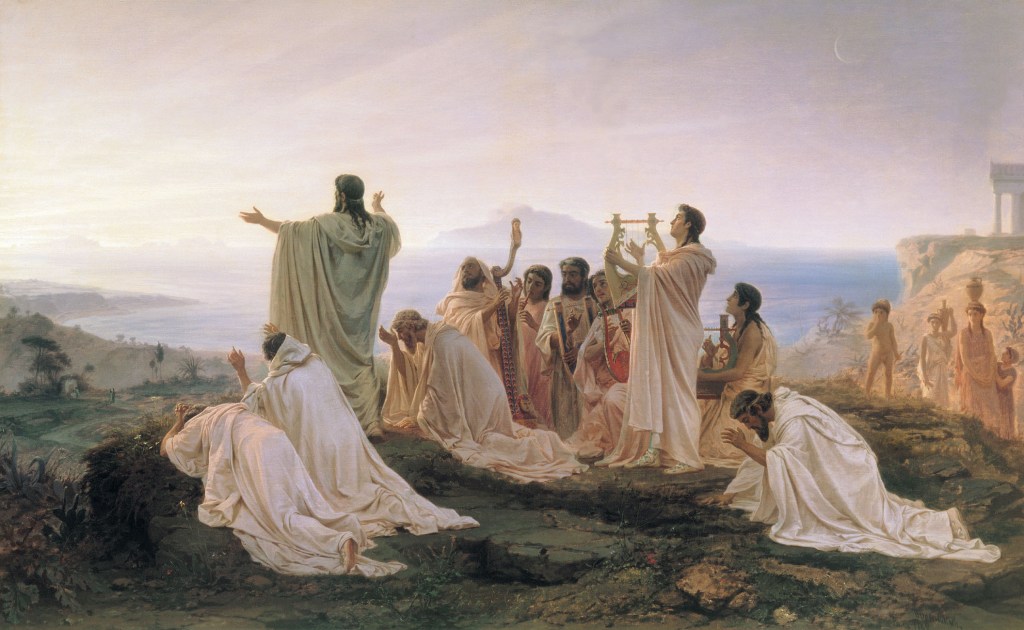
4 T Today, Plato is rightly considered the main author on the subject of sidereal religion. However, the very strong influence exerted by Pythagoreanism on Plato and on all future doctrinal evolution on the subject emerges from the analysis of contemporary texts.
We will not go into the ancient and vexata quaestio on the quantity and quality of the arguments stolen by the divine Plato from the Archaegete Pythagoras. Nor will we concern ourselves with the famous book given by the Pythagorean Archytas to Plato.
Later we will talk about theories of Neopythagoreans (or Neoplatonists) such as Plotinus, Porphyry, Iamblichus, Proclus. We will analyze Pythagorean constructions on universal harmony as a way of purification from earthly impurities. We will enter a coherent world of thought expressed over the centuries by philosophers, astronomers, musicians, etc., all faithful to the same school, the Pythagorean one.
It was not done on purpose or for calculation of any kind.
All classical thought on the subject of the World and Heaven relentlessly always returns to the same Pythagorean foundations.
Let us leave one of the few contemporary scholars to illustrate the importance assumed by Pythagoreanism on all ancient astronomy.
Rougier correctly attributes to the great Pythagoras the great merit of having subverted the theories of the so-called “meteorologists”. They had expelled the divine from the cosmic nature, reduced to stones, pumice, fires, etc. The philosopher of Samos with the consideration of the intelligence of the motion of the Stars and of the planets themselves (by no means wandering in the way in which the “meteorologists” intended) had assimilated to their movement and to their etheric essence that of human souls. Hence, the Pythagorean astral religion and the return of transcendence in the study of nature and the cosmos, impregnated, as Hermes said, with soul. This conception was subsequently irremediably altered, first by the Copernican revolution, then by current scientism.
We hear from Rougier’s words:
As soon as the science of nature was born on the shores of Ionia, it entered into violent conflict with popular religion, as evidenced by the trial for atheism brought against Anaxagoras of Clazomenes, the prop.ator in Athens of the physics of the Milesians, in the century of Pericles. Astrophysicists, then called meteorologists, argued that the erratic movements of the planets were the result of Fortune and chance and, equating the genesis of stars with the formation of meteors, professed the “terrestrial nature” of stars and the material unity of the world. These atheistic consequences drove many minds away from the study of this science, most notably Socrates and the young Plato in his wake. Socrates professed the need to limit the study of astronomy to the needs of the calendar and navigation, taking care not to penetrate mysteries that the gods had reserved for themselves. It was then that Pythagorean astronomy was revealed to Plato, during his travels in Magna Graecia. He taught him that the movement of the planets “is the exact opposite of a wandering march”, but that all stars “imitate the circular and uniform movements of intelligence” and, therefore, are gods. He came to discover that true astronomy, that which lifts the veil of appearances to grasp real and simple movements, far from leading to atheism, leads to God so that no one can claim to be pious, wise, and learned if he is not first of all astronomer. By putting an end to the threatening conflict between science and religion, the Pythagoreans seemed to base on strictly scientific arguments, contrary to the Monist doctrine of the Milesians, the faith in the duality of the Cosmos and of this microcosm that is man, making Astronomy, at the same time, the true theology of the Philosophers, the immediate grasp of the laws of world harmony, the beatific vision of the splendor of the visible gods and the mystical love of intelligible beauty.”
But let us now return to our analysis.
___
We admit it. In order to deal with the functions of the Pantheon, we found ourselves exploring the spiritual world of the Classical Age. Such was the dimension of the research that, in the end, the book became a text on sidereal religion where (also) it deals with the Pantheon.
In order to be able to understand the meaning of the Pantheon, we were forced to undertake a journey into the vision that the ancients had of Heaven, of Urania, as the Greeks called it.
Today, that understanding has been totally destroyed. Heaven is not the seat of the Gods. Even less is the return to it the goal of the sage’s life.
The relationship between Man and Urania has been cut.
The same link has been severed between man and the underworld, with Chthonia.
In an excellent essay, Giorgio Agamben states that the drama of modern man is to have lost the relationship with Chthonia:
Gaia, the earth with no more depth, which has lost all memory of the subterranean abode of the dead, is now entirely at the mercy of fear and death. From this fear only those who will find the memory of their double abode will be able to heal, who will remember that human is only that life in which Gaia and Chthonia remain inseparable and united.
Gaia, Chthonia, and Urania, together with Ocean, constitute the World, and we now want to talk about it.
THE TREATY OF THE WORLD OF THE PSEUDO-ARISTOTLE
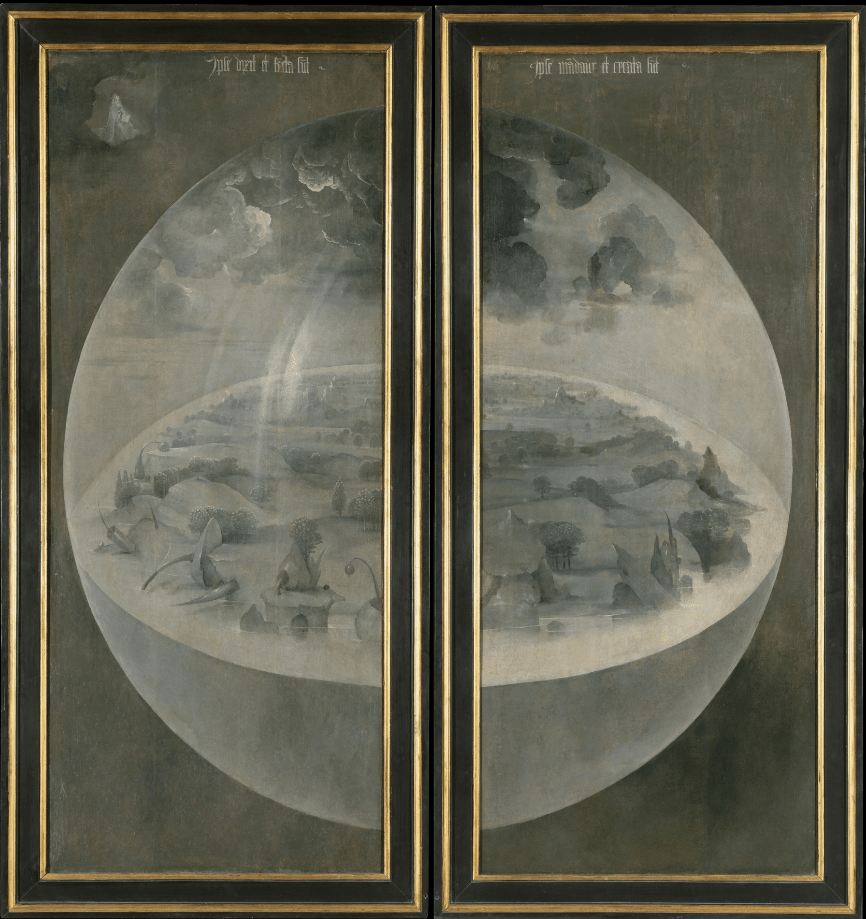
A Buddhist map found, it seems, in a monastery at the end of the 19th century, portrays geographical forms that resemble those of our Earth, at least those, in azimuthal perspective, portrayed in the UN flag.
Around it, beyond the Antarctic lands, numerous other lands never seen before appear. Would there be others worlds around the world that we know?
The Pythagorean Petrone thought that the worlds were 183 and arranged according to the figure of a triangle and that, on each side of the triangle, there were 60 worlds; the other three touched each other in the three corners.
We know none of this and, therefore, like Wittgenstein, we prefer to say no more. Let’s deal with the world that we know instead.
Aristotle’s Trattato on the World is useful to make a synthesis of the ancient vision:
(…) Thus, the world is the assembly that forms Heaven and Earth with all the species of beings [10] they contain. “World” is also said, in another sense, of the order and arrangement of universal Nature, which at the same time is under the care of God and preserved by God from all evil. Of this order, the center because it is immobile and fixed, has been assigned to the nurturing Earth, which is the abode and mother of living beings of all kinds. [15] The region above the Earth , which is bounded in its entirety and on all sides by the highest area, the abode of the gods, is called Heaven. Full of divine bodies, which it is customary to call stars, moved by an eternal movement, the Sky, with all the stars, rotates only in cadence in a single circular revolution, without ever ceasing, forever. All of this Heaven and the world being [20] spherical and, as I have already said, in a continuous movement, there are necessarily two immobile points, in opposite positions with respect to each other, as in the case of a ball that is spinning, two points that remain fixed and that hold the sphere, around which all the mass of the universe moves circularly in circles.
They are called [25] poles. If we conceive a straight line drawn from one of these points to the other, [26] – some call it an axis -, we will have the diameter of the World, which has as its center the earth and the two poles as ends. Of these two immobile poles, one is always visible, being located at the top of the axis at the northern cardinal point – it is called the arctic pole -, the other always remains hidden under the earth, at the southern cardinal point: it is called the [5] Antarctic pole.
Pseudo – Aristotle now begins to deal with the ether, which we will see to be fundamental for understanding the destiny of the soul in the context of the ancient world.
To the substance of the sky and the stars we give the name of ether, not, as some want because being fiery it burns (these people deceive themselves about its nature, infinitely distant from that of fire), but because it “always runs” “, turning in a circle: it is an element different from the other four, indestructible and divine.
We will come back to talking about ether. Let us now anticipate, for the coherence of exposure about the World, the theme of the Stars as a constitutive part of the World:
As for the stars that contain [10] the sky, some, without moving themselves, are transported in the same circular motion of the whole sky, and always occupy the same place: between them, like a belt, the so-called zodiacal circle passes obliquely through the tropics, which in turn is divided into the twelve regions of the zodiac signs. The other stars, which are wandering, do not move, by their nature, with the same speed as the previous ones, [15] nor with the same one with respect to the other, but each according to a different orbit, so that one or is closer or to the earth, or higher. Now, as regards the number of fixed stars, no one can discover it, although they all move on the same surface, which is that of the entire sky; instead, that of the planets is summarized in seven units and as many [20] concentric circles positioned in such a way that the upper is always larger than the lower one and that the seven, incorporated into each other, are in any case all wrapped in the sphere of fixed stars. Here is what is, in a continuous line, the position that the planets maintain immutably. “First comes the circle of the Luminous (Phenon), called at the same time circle of Saturn, then the circle of the Resplendent (Phaeton) [25], called the circle of Jupiter, then the Rutilating (Pyro), called the circle of Hercules or Mars, later the Sparkling (Stilbone) which some say consecrated to Mercury, others to Apollo, after it, the circle of the Light Bearer (Phosphorus), which some call the circle of Venus, others the circle of Juno, then the circle of the Sun, and finally the circle of the Moon, whose edge ends on the earth. [30] The ether encompasses all divine bodies and the area in which each of them moves according to its rank.
After the ethereal and divine nature, which obeys, as we show, a fixed order and which is, moreover, immutable, unalterable, and impassive, comes, contiguous to it, the nature which in all its parts is passable, changeable, and, in short, corruptible and perishable.
The ether closes all the divine bodies and produces with its movement the area of the fire, now known as the thermosphere and which is located between 80 km and 700 km in height. It records temperatures of 1,500°C. Above is the Exosphere at 2000°C. This area of the sublunar atmosphere produces meteorites. We hear directly from the voice of the Pseudo – Aristotle:
In this same nature [35], there is first the subtle and inflammable element, which ignites in contact with the ethereal substance, due to its vast dimensions and the rapidity of its movement. And in this igneous and disordered element, as it is called, shooting stars (meteorites) burst through space, rushing like a line of flame and what are called “beams”, “vortices” and comets often make a stationary appearance, [5] then they die out.
Having mentioned the origin of the meteorites, the author provides us, after the one on the fire area, another anachronistic piece of information, that is not justified on the basis of the supposed scientific ideas of the time: before the hot area, there would be a cold area of the atmosphere.
This area actually exists: today it is called the “mesosphere”, it is located between 50 and 80 km high and records temperatures of minus 85°C.
Then move on to talk about the inhabited areas of the world:
For as far as the “inhabited” world is concerned, the usual method is to divide it into the suns and on continents, without seeing that it is in its entirety a single island, surrounded by the sea called the Atlantic. There are also, probably, many other “inhabited worlds”, very far from ours, on the opposite shore of the seas, separate us from them, some larger, others smaller than ours, 25] but all invisible to our eyes. In fact, what our islands are compared to the seas around here, our “inhabited world” is compared to the Atlantic Sea and many other continents compared to the whole sea. Indeed, these continents are only large as the islands, so to speak, bathed all around by great seas. It is, therefore, the whole [30] of the humid nature diffused on the surface of the soil, with the so-called inhabited worlds that it has allowed arising as a sort of emergence from the earth, which would have come precisely as a result of the element of air. After the humid element, deep down, at the most central point of the universe, is the compressed and compact mass of the whole earth, immobile and unshakable.
We cannot help but notice that the description of continents as large islands bathed all around by large seas corresponds to today’s geographic knowledge and world map, subsequent to the great explorations of the eighteenth and nineteenth centuries.
This is all, [35] in the World, we call the low end. These five elements, therefore, are included in five regions of spherical shape, the smaller of which is each time contained in the larger ones, namely earth in water, water in air, air in fire. Fire in the ether constitutes the whole World, of which the entire upper portion represents the abode [5] of the gods, the lower that of ephemeral beings. Of this last portion, one part is moist – what we usually call rivers, springs, and seas – the other dry, what we usually call earth, continents, and islands.
After describing the geography of the Earth and its meteorological characteristics, the Pseudo Aristotle returns to talk about the World and the Stars:
(…) So it is with the world. It is, in fact, for a single rotation of the entire sky within the limits of a day and a night that the trajectories of all celestial bodies are produced, trajectories that all differ, although these bodies are contained in a single and same sphere in which some move a little faster, others slower depending on the length of their distances and their own disposition of each of them. In fact, the Moon goes through its cycle of growth, decrease and decline in a month, the Sun as well as the stars of the same speed, the Light Bearer and the star called Mercury, complete theirs in a year, and the Bright in the double of this [10] period (i.e. in two years), the star of Jupiter in a time six times of this (i.e. in 12 years), finally the aster called Saturn in a time two and a half times of this ‘star immediately below (i.e. in 30 years). However, the only harmony resulting from all these bodies singing and dancing in concert in the sky comes from the same cause and leads to the same end, and it is in the very meaning that he has called the universe an “Order” and not chaos without order. Like [15] in a choir, when the coryphaeus first sang the song, the whole chorus of men – or women, when it is so composed – follows the intonation and, with the mixture of different voices, these high ones, the low ones, form a single concertante harmony, so it happens with the God who governs the universe. In fact, at the signal given from above by the one who could rightly be called coryphaeus, the stars and everything in the sky inaugurates their eternal movement, the Sun that shines on all things begins its double run, that is, with one, with its rising and setting, it divides day and night, i.e. with the other, sliding through the zodiac signs forward to the north and back to the south brings the seasons of the year.
With the metaphor of the choir and the coryphaeus, Pseudo Aristotle thus begins to outline the fundamental argument, for the purposes of this study, the one of the harmony of the stars. We will return to the subject shortly.
THE WORLD OF ARIO DIDYMUS
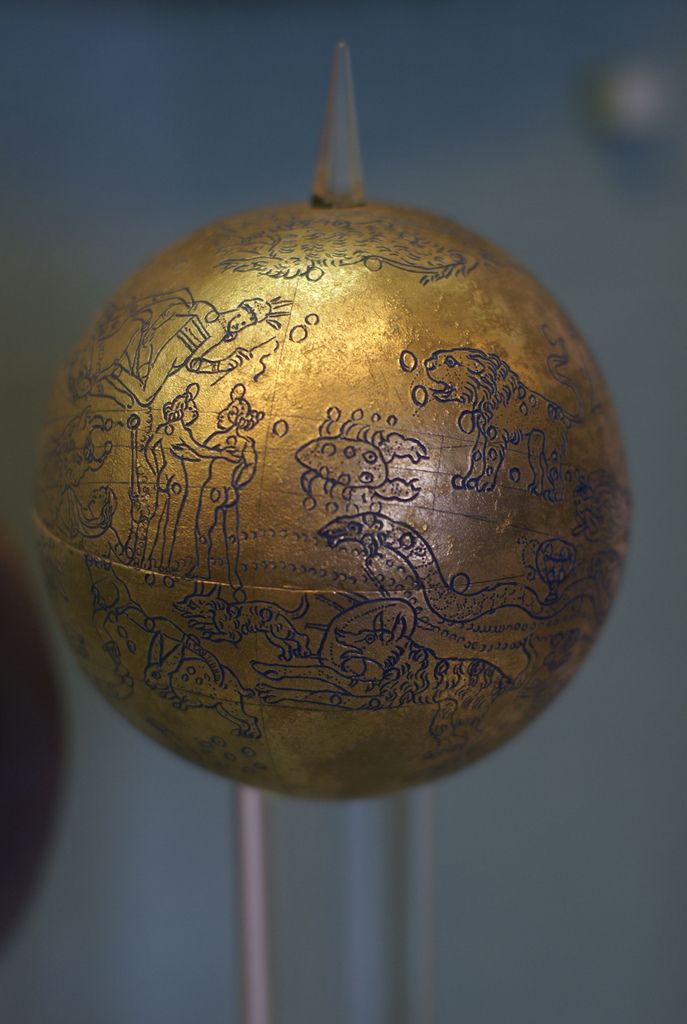
An epitome of Ario Didymus presents particular interest in the theme of the conformation of the World. For Didymus, the World is the union of gods and men, and of all things produced for them.
According to Chrysippus, the world is the union that heaven and earth form with the species of beings they contain or the union which gods and men form and all that has been produced for the good of these two classes of beings. In another sense, it is God who is called the world, God by virtue of whom the beautiful order of the world is formed and fulfilled.
Then he continues:
Considered according to this beautiful order, the world comprises a part that moves in a circle around the center and an immobile part; the part that moves in a circle is the ether, the immobile part is the earth, the masses of water that cover it, and the air. The most compact element of matter is naturally the foundation of the whole, in the same way, that, in a living being, bones: this element is called the earth. The water spreads circularly all around the earth; its characteristic is to keep itself everywhere at a very equal level.
It then describes the earth and the other elements that make up the lower part of the World, its foundation:
Instead, the earth has prominences which, in some places, protrude through the water in the direction of height: they are called islands, and those which extend more widely are called continents, because of the ignorance in which one is of what they are, they are also bathed by vast seas. In immediate contiguity with the water, there is the air which is like an evaporation of it and which is circulated circularly all around it, then, in contiguity with the air, the ether, the thinnest element and the purest.
Finally, here he is sketching his image of the sky:
These are therefore the elements into which the World, considered a beautiful order, is divided, while the part that moves in a circle around it is the ether, where the stars are placed – both the fixed stars and the planets – which, by nature, they are divine, soulful and ruled by Providence. The multitude of fixed stars is innumerable: as for the planets, they are seven in number, all less elevated than the fixed stars. The fixed stars are all located on the same plane, as it is easy to see, while each of the planets is assigned a different sphere: all these planetary spheres are surrounded by fixed stars. The highest of them after the sphere of the fixed stars is that of Saturn, after this comes that of Jupiter, then that of Mars, then that of Mercury, after that of Venus, then that of Sun, and finally, to the end of the series, that of the Moon bordering the air: it also appears of a more aeriform nature and exerts greater influence on earthly things. Under the moon comes the sphere of air which is moved by the ether, then that of water, and finally that of the earth located in the central point of the world, which represents the bottom of the universe, while the upper part is made up of what, from this point, it extends in all directions in a circle.
THE WORLD OF CICERO
Cicero’s Sleep of Scipio, is an essential text for our study.
Then the African said: “I see that you still contemplate the seat and the abode of men; but if it really seems so small to you, which it actually is, never stop keeping your gaze fixed on celestial things and despise human ones. In fact, what celebrity can you ever achieve in people’s speeches, what glory is worth seeking out? You see that on earth people live in scattered and restricted areas and that this sort of patches in which they live are interspersed with enormous deserts; moreover, the inhabitants of the earth are not only separated to the point that, between them, nothing can spread from one to the other, but some are arranged, with respect to you, in an oblique direction, others transversely, still others are actually at the antipodes. You certainly cannot expect glory from them.”
Below, Cicero presents a representation of the earth divided into two bands (not two hemispheres), under the dome of the sky constituting part of the globe of the world.
He also notes that the earth is in a certain sense crowned and wrapped in bands: two of them, diametrically opposite and resting, on their respective sides, at the very vertices of the sky, stiffen due to the frost, while the central band, over there, the largest, is burned by the blaze of the sun. Inside, there are two habitable areas: the southern region, there, where the inhabitants leave footprints opposite to yours, has nothing to do with your race; as for this other one, instead, that you live in, exposed to a kite, look at how it touches you only to a minimal extent. As a whole, in fact, the land that is inhabited by you, narrow at the top, wider at the sides, is, as it were, a small island surrounded by that sea that on earth you call the Atlantic, the Great Sea, the Ocean, but which, in spite of the high-sounding name, you can see how tiny it is.
The world that Scipio sees in a dream is a sphere, which at its center has a temple called Terra: “Men were, in fact, generated with the following commitment, to keep that sphere there, which you see at the center of this celestial temple called Terra“. Elsewhere, in the Tusculane, Cicero describes the terrestrial globe “As fixed in the middle of the world, rising from the sea”.
The image of the World as a (celestial) Temple finally lets the ancient Orphic doctrines resound in the Sleep of Scipio:
“No” he replied. “If that god to whom all the celestial temples you see belongs has not freed you from the prison of the body, it cannot happen that access to this place is practicable for you.”
THE WORLD TEMPLE OF GOD
In the Introduction of Manilio’s Astronomica there are these beautiful verses:
bina mihi positis lucent altaria flammis, ad duo templa precor duplici circumdatus aestu carminis et rerum: certo cum lege canentem mundus et immaculate vatem circumstrepit orbe vixque soluta suis inmittit verba figuris,
or “two altars shine with flames lit by me; before two temples I pray, agitated by a double ardor: for poetry and for the theme. And around the Poet who sings following his rigorous laws, the World also resounds in its immense circle, with difficulty letting the words adapt to its forms”.
Festugiere comments on the passage as follows: “At the moment of singing the sky and its divine inhabitants, – a difficult task twice, both for the difficulties of the verse and for those of the subject, the poet does not go alone, according to the ancient custom of the time, to the sanctuary of the Muses of the Helicon (primusque novis Helicona movere | cantibus, I 4), but he goes to pray in the temple of the World. In fact, the World is also a sanctuary, and Manilius is its priest (vates). He feels all penetrated by a sacred fear. Around him, the immense sphere of the Universe whirls around. How to celebrate such a great being without a special favor from Heaven itself. Science and prayer are closely linked here, and it is the constant influence of a truly religious breath in the entire course of the Astronomica that makes the greatness of the poem.”
But not only is the World a Temple, the World, Kosmos, as we will see shortly in Hermes, is itself a God. See this passage from Philo:
It is in a very pious and very holy way, it seems to me, that Aristotle , fighting this opinion, “declared that the Kosmos is unbegotten and indestructible. As for those who hold the contrary opinion, he accused them of a monstrous atheism,” for having dared to compare to the works made by human hand such an immense visible god, who truly embraces in himself the Sun, the Moon and this “pantheon” of the other stars, planets and fixed stars.
Speaking of this, with a blatant mockery of these ungodly, Aristotle adds: “In the past, I was concerned only for my home, I feared that, due to the violence of the winds or storms, or the wear and tear of time, or because we would have neglected to take appropriate care of it, it would come to collapse: but now there is a much greater danger that threatens us because of those who, with their theories, demolish the whole Kosmos factory.
In the Platonic Epinomides as well as in Aristotle and, a fortiori, in subsequent writings, the religion of the World manifests a common trait: the doctrine of intelligible is neglected.
This entails an implication: the visible World is no longer considered as the image of another World, the final object of contemplation, but itself becomes its object, it is to it that the worship of the sage is addressed.
In essence, this is the religion of the World.
The World is in motion, but it is ordered, and from this order comes the proof of the existence of a Soul of the World, of an Intellect that governs it, of a cosmic God.
The sensitive universe and the intelligible whole will also be different things for Plato, but the visible Heaven and the divine Soul that moves the Whole are not so different.
Although many of these ideas have been attributed to the Stoics, Plato provided most of the elements with his Epinomides. Aristotle then drew the first features of the religion of the world.
To the question “What is Wisdom and which science leads to it?”, Plato, in Epinomides, gives this answer: “Wisdom, which is piety, consists in the science of the stars or astronomy”.
Adoration is no longer addressed to the intelligible, but to the visible World as an organic expression of a divine Intellect (nous).
In the religion of the World, in other words, the living World is worshiped, as endowed with a Soul, the Soul Mundi?
The thrice great Hermes wrote against the religion of the world :
“Who then is this material god?” « It is the World, but it is not good, as it is material and is easily subject to affections, and indeed it is the first of all passable beings, the second of beings in general, and incomplete in itself; he began to live at a certain moment, but he is destined to exist forever; it subsists in becoming and is always becoming, source of becoming of qualities and quantities. Indeed, it is in motion, and every material movement is becoming.
Plato seems to respond to this almost Gnostic conception of the World as negativity subject to affection. The visible world is not the image of another world, the final object of contemplation, but the worship of the sage must be addressed to it, since, as immortal, it cannot be evil.
___
Finally, it is worth mentioning, in relation to the Mundus, Cicero’s controversy against Aristotle :
Aristotle in his third book On Philosophy confuses together many concepts in controversy with his teacher Plato. Now he attributes divine nature to the intellect alone, now he identifies divinity with the World, now he presents to the World a being distinct from it and assigns it the functions of regulator and conservator of universal motion through a sort of reverse rotation, now he divinizes the celestial fire, without realizing that the sky is only a part of that World that in other passages he has defined as a god. On the other hand, in the midst of such a rapid movement, how can this alleged divine consciousness remain equal to itself, with which heaven would like to be endowed? Where will such a large number of gods find a place if we include the sky among the gods? It should be added that this same thinker makes divinity an incorporeal being and therefore excludes that it can perceive reality and, consequently, regulate its action with prudent wisdom. Furthermore, how could an incorporeal World move or, always moving, be serene and happy?
THE FORMATION OF THE WORLD ACCORDING TO PLATO
On the composition of the World, Plato in the Timaeus argued that a living being that contained all living beings within itself was suitable a form that was to contain all forms. Therefore, he rounded it into the shape of a sphere, equally distant in every point from the center to its extremities, in a circular orbit, which is the most perfect and the most similar to itself of all forms, having thought that the like was of great long more beautiful than unlike.
(…) Such was the reasoning that the god who always is formulated regarding the god he would one day be, and so made a smooth and uniform body, in every point equally distant from the center, and whole and perfect and composed of bodies perfect: and placed the soul in the midst of it, he tried to spread it in every direction, and even covered the body with it from the outside, and created a circular Heaven that moves all around, unique and deserted, by its virtue is able to take care of himself and not needing anyone else, good connoisseur and friend of himself” (…) In the crater […] in which he had tempered and mixed the soul of the universe, he poured the things that were left over from those used before.[…].
In the Phaedo, Plato has Socrates say that “the Earth is at the center of the universe and is round and that, in order not to fall, it needs neither air nor any other support of the kind; but what suffices to support it is the constant homogeneity of the universe and the perfect balance of the Earth itself. In fact, a balanced thing, placed in the center of a homogeneous substance, will never be able to lean anywhere, either a little or a lot, but, being itself homogeneous, it will remain motionless…”
AURELIO BRUNO
(themes drawn from Aurelio Bruno, “The Pantheon of the Sky, 2022, ISBN: 979-8370654237)
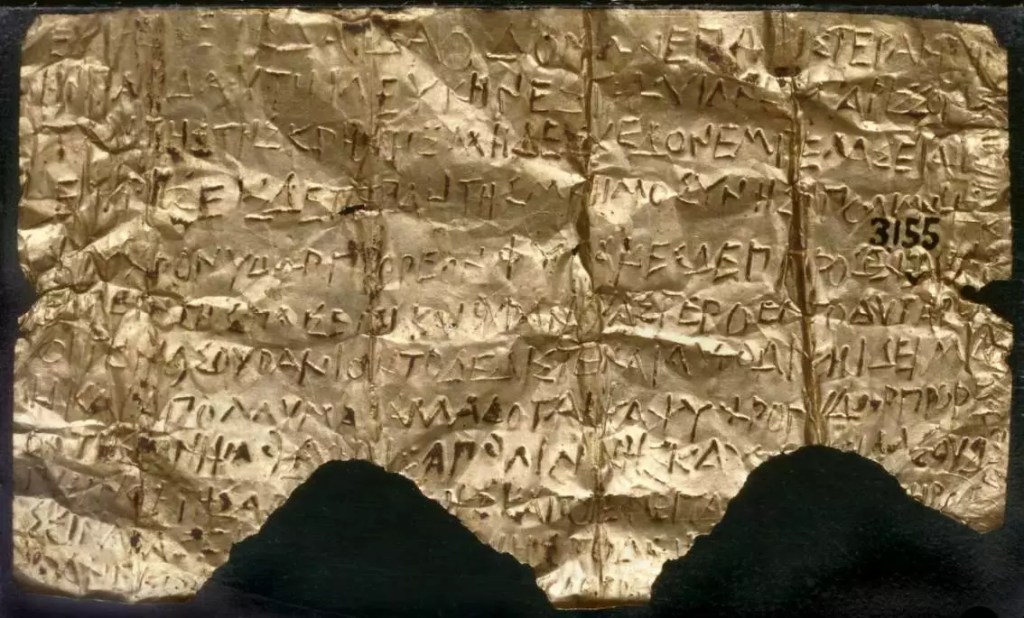
I am a child of the Earth and of the starry sky,
I’m of celestial race, know that…
(Orphic gold plate of Petelia, British Musem)
Disclaimer
Last updated: February 26, 2023
Interpretation and Definitions
Interpretation
The words of which the initial letter is capitalized have meanings defined under the following conditions. The following definitions shall have the same meaning regardless of whether they appear in singular or in plural.
Definitions
For the purposes of this Disclaimer:
- Company (referred to as either “the Company”, “We”, “Us” or “Our” in this Disclaimer) refers to Il Pantheon del Cielo.
- Service refers to the Website.
- You means the individual accessing the Service, or the company, or other legal entity on behalf of which such individual is accessing or using the Service, as applicable.
- Website refers to Il Pantheon del Cielo, accessible from www.pantheondecoded.org
Disclaimer
The information contained on the Service is for general information purposes only.
The Company assumes no responsibility for errors or omissions in the contents of the Service.
In no event shall the Company be liable for any special, direct, indirect, consequential, or incidental damages or any damages whatsoever, whether in an action of contract, negligence or other tort, arising out of or in connection with the use of the Service or the contents of the Service. The Company reserves the right to make additions, deletions, or modifications to the contents on the Service at any time without prior notice. This Disclaimer has been created with the help of the TermsFeed Disclaimer Generator.
The Company does not warrant that the Service is free of viruses or other harmful components.
External Links Disclaimer
The Service may contain links to external websites that are not provided or maintained by or in any way affiliated with the Company.
Please note that the Company does not guarantee the accuracy, relevance, timeliness, or completeness of any information on these external websites.
Errors and Omissions Disclaimer
The information given by the Service is for general guidance on matters of interest only. Even if the Company takes every precaution to insure that the content of the Service is both current and accurate, errors can occur. Plus, given the changing nature of laws, rules and regulations, there may be delays, omissions or inaccuracies in the information contained on the Service.
The Company is not responsible for any errors or omissions, or for the results obtained from the use of this information.
Fair Use Disclaimer
The Company may use copyrighted material which has not always been specifically authorized by the copyright owner. The Company is making such material available for criticism, comment, news reporting, teaching, scholarship, or research.
The Company believes this constitutes a “fair use” of any such copyrighted material as provided for in section 107 of the United States Copyright law.
If You wish to use copyrighted material from the Service for your own purposes that go beyond fair use, You must obtain permission from the copyright owner.
Views Expressed Disclaimer
The Service may contain views and opinions which are those of the authors and do not necessarily reflect the official policy or position of any other author, agency, organization, employer or company, including the Company.
Comments published by users are their sole responsibility and the users will take full responsibility, liability and blame for any libel or litigation that results from something written in or as a direct result of something written in a comment. The Company is not liable for any comment published by users and reserves the right to delete any comment for any reason whatsoever.
No Responsibility Disclaimer
The information on the Service is provided with the understanding that the Company is not herein engaged in rendering legal, accounting, tax, or other professional advice and services. As such, it should not be used as a substitute for consultation with professional accounting, tax, legal or other competent advisers.
In no event shall the Company or its suppliers be liable for any special, incidental, indirect, or consequential damages whatsoever arising out of or in connection with your access or use or inability to access or use the Service.
“Use at Your Own Risk” Disclaimer
All information in the Service is provided “as is”, with no guarantee of completeness, accuracy, timeliness or of the results obtained from the use of this information, and without warranty of any kind, express or implied, including, but not limited to warranties of performance, merchantability and fitness for a particular purpose.
The Company will not be liable to You or anyone else for any decision made or action taken in reliance on the information given by the Service or for any consequential, special or similar damages, even if advised of the possibility of such damages.
Contact Us
If you have any questions about this Disclaimer, You can contact Us:
- By email: pantheondecoded@gmail.com
-
L’UNIVERSO DEGLI “ANTICHI”
È quello che capita anche a noi: relegati in qualche cavità della Terra, crediamo di abitare in alto, sulla sua sommità e chiamiamo Cielo, l’aria, convinti come siamo che esso sia lo spazio dove si volgono gli astri.
(Platone, Fedone)
E queste sono le affezioni del mondo (κόσμος), ruotare e scomparire. E la rotazione è rivolgimento, scomparsa è rinnovamento. Dunque, il mondo intelligibile dipende da Dio, quello sensibile dall’intelligibile, e il Sole, attraverso il mondo intelligibile e quello sensibile, dispensa il flusso del Bene proveniente da Dio, ossia l’azione creatrice
(Ermete Trismegisto, Corpus)
Così essi (i pitagorici) credono che il rapporto delle velocità degli astri, in relazione alle distanze siano i medesimi degli accordi musicali e perciò dicono che è armonico il suono degli astri rotanti
(Aristotele, De Caelo)
“(…) Quando, invece, un uomo ha teso con tutto il suo zelo alla scienza e ai pensieri veri, e, di tutte le sue facoltà, ha esercitato principalmente quelle dello spirito, un tale uomo, di assoluta necessità, quando perviene alla verità, ha nel suo cuore e nei suoi pensieri l’immortale e il divino e, nella \ misura in cui è consentito alla natura umana partecipare all’immortalità, in nessuna parte gli sfugge. Non cessa di rendere culto alla Divinità; coltiva sempre, curato e sistemato come si deve, il “demone” che abita in lui: gioisce quindi necessariamente di una singolare eudemonia (…)
(Platone,Timeo)
UOMO E ASTRI
Prima di addentrarci nel cosmo antico è necessario fare una premessa:
il “Mondo” non è la Terra, come la intendiamo oggi, visibile nel
mappamondo.
Il Mondo era l’insieme costituito dalla Terra, dalle acque e dagli otto
Cieli al di sopra di essa.
Il cielo stellato ruotava attorno alla Terra stazionaria e non il
contrario.
Non esisteva un “cosmo” al di fuori del Mondo. Il Cosmo era il
Mondo stesso85.
Per la scienza di oggi il cosmo è infinito, uno spaventoso abisso di
nulla intorno alla Terra.
La Terra non è più il centro del Mondo. Essa reca le insignificanti
vite degli uomini, in un universo incomprensibile e privo di speranza.
Talmente privo di speranza che, a mo’ di consolazione escatologica,
qualcuno ha ipotizzato la grottesca pantomima di miliardi di
salvifiche crocifissioni cristiche in miliardi di mondi alieni.86
Il sistema pre-copernicano metteva, invece, l’uomo al centro
dell’Universo.
Per il tre volte grande Ermete l’uomo, ipostasi di Dio, era il vero
centro del Mondo.
59E quell’uomo centro del Mondo acquisiva saggezza e vita eterna
contemplando le stelle.
Il senso e il fine della vita del saggio era il ritorno tra le stelle.
Sentiamo cosa dice in proposito il divino Platone:
“Quanto a questa specie di anima che in noi è sovrana, ecco ciò che bisogna
pensarne. Dio l’ha data a ciascuno di noi come un Genio divino, questa
specie di anima che noi dichiariamo che abita nella parte superiore del
nostro corpo e ci solleva, sopra la terra, verso quei genitori che abbiamo in
cielo”, poiché noi siamo una pianta non terrestre, ma celeste. E questo
linguaggio è perfettamente vero. In effetti, è lassù, da dove l’anima, per la
prima volta, ha avuto origine, che la Divinità ha sospeso la nostra testa, che
è come la nostra radice, e, in tal modo, ha dato al corpo la stazione eretta.
Quindi quando un uomo si è da tempo consegnato alle brame della carne o
all’inseguimento degli onori, ed è per queste cose che si dà la maggior parte
di pena, tutte le sue preferenze, necessariamente, si sono inclinate verso la
terra e, per quanto è possibile rendersi mortali, non gli manca niente perché
vi riesca completamente, poiché si è sempre applicato a nutrire la parte
mortale. Quando, invece, un uomo ha teso con tutto il suo zelo alla scienza
e ai pensieri veri, e, di tutte le sue facoltà, ha esercitato principalmente
quelle dello spirito, un tale uomo, di assoluta necessità, quando per viene
alla verità, ha nel suo cuore e nei suoi pensieri l’immortale e il divino e,
nella misura in cui è consentito alla natura umana partecipare
all’immortalità, in nessuna parte gli sfugge. Non cessa di rendere culto alla
Divinità; coltiva sempre, curato e sistemato come si deve, il “demone” che
abita in lui: gioisce quindi necessariamente di una singolare “eudemonia“,
Ora, c’è solo un modo per prendersi cura di una cosa, qualunque essa sia: è
fornirle, ogni volta, il nutrimento e i movimenti che convengono. Ora i
movimenti che hanno affinità con il principio divino in noi sono i pensieri
del Tutto e le sue rivoluzioni. Ognuno di noi, seguendo questi movimenti
celesti, rettifica, con la conoscenza delle armonie e delle rivoluzioni del
Tutto, le rivoluzioni (dell’anima intellettuale) nella nostra testa, che sono
state gustate al momento della nascita; che rende il soggetto che contempla
simile all’oggetto contemplato, in conformità alla natura originaria di questo
60soggetto; e cosi, avendo completato questa somiglianza, raggiunge il fine
supremo della vita migliore, che gli dei hanno proposto agli uomini, per la
durata presente e per il tempo a venire.87”
CONFORMAZIONE DELLA TERRA
Che la Terra fosse stazionaria era un concetto accettato da tutti nella
cultura dell’epoca.88
Come detto, la maggior parte dei filosofi concepiva il Mondo come
sferico, ma con una conformazione diversa rispetto alle
rappresentazioni moderne.
Per “Mondo” si intendeva non il nostro globo, ma una sfera alla cui
metà, ovvero lungo l’equatore, insisteva la Terra, immobile chiusa al
di sopra dal Firmamento in incessante movimento rotatorio, e
circondata dalle acque.89
Vediamo nello specifico quali erano le concezioni dei vari
filosofi/scienziati dell’epoca.
A differenza di quanto sostengono alcuni studiosi contemporanei,
“Pitagora fu anche il primo a chiamare cosmo (Mondo) l’universo e a
dire che la terra è di forma convessa” (ogni piano è sempre una
figura geometrica convessa). Secondo Teofrasto invece fu Parmenide
e secondo Zenone, Esiodo90.
Ermete, dando la parola a Iside, ci dice a riguardo: “… E Iside
rispose: – La Terra giace supina al centro del tutto, come un uomo
che guarda al Cielo ed è divisa in tante parti quante le membra
umane.”91
Aristotele racconta di come Talete dicesse che la Terra galleggiasse
inerte sull’acqua e come rimanesse ferma come un legno su di essa.92
Anassimandro diceva che la Terra è librata nell’aria, non è sostenuta
da niente e rimane sospesa perché ha uguale distanza da ogni cosa
che la circonda. Ha la forma ricurva sferica, simile a una colonna di
pietra o tamburo; delle sue superfici l’una è quella sulla quale ci
muoviamo, l’altra sta dalla parte opposta.93
61Da Plutarco apprendiamo che egli pensava che la Terra avesse forma
cilindrica e che l’altezza corrispondesse a un terzo della larghezza94.
Parmenide fu il primo a dire che la Terra occupa il centro
dell’universo.95
Egli pensava che la Terra fosse di forma convessa. Per il fatto che è
distante da tutti i punti, essa rimane in equilibrio. Perciò essa si agita
soltanto, ma non si muove.96
Anassagora diceva che la Terra avesse forma piatta e che rimanesse
librata immobile in forza della sua grandezza, “tanto perché non c’è
vuoto e perché l’aria, che è molto gagliarda, sorregge la Terra
appoggiata sopra. (…) La Terra è cava e contiene acqua nelle
cavità”.97
Anche il pitagorico Archelao sosteneva che la Terra fosse cava e, a
riprova, adduceva il fatto che il Sole non si leva né tramonta
contemporaneamente per tutti gli uomini, ciò che dovrebbe fare se la
Terra fosse piatta.98
Sempre secondo Anassagora, il motivo della stabilità della Terra è la
forma piatta perché essa non taglia l’aria sottostante ma la suggella a
guisa di coperchio, come si vede che fanno i corpi di forma piatta, i
quali sono difficilmente scossi dai venti per la resistenza che
oppongono. La stessa cosa farebbe la Terra di fronte all’aria
sottostante per la sua piattezza e l’aria, non avendo spazio sufficiente
per spostarsi, rimarrebbe ferma di sotto, tutta raccolta, come l’acqua
nelle clessidre: “Se la Terra non avesse forma piatta non potrebbe
stare ferma.”99
Al contrario, Diogene di Apollonia diceva che la Terra fosse sferica,
saldamente collocata al centro, avendo raggiunto la sua costituzione
in forza del movimento circolare dovuto al caldo e del congelamento
dovuto al freddo.100
Come Anassimandro, anche Leucippo sosteneva che la Terra avesse
la forma di tamburo.101
62Eratostene sosteneva, secondo Macrobio, che “la dimensione del
Sole è 27 volte più grande di quella della Terra, mentre Posidonio
diceva che esso sarebbe molte volte più grande della Terra.102
Passiamo ora a Platone. Avvertiamo che, per la completezza e
coerenza sistemica del suo pensiero, saremo costretti a citare più
volte vari passaggi in riferimento ai diversi argomenti.
(…) ritengo che la Terra sia grandissima.(…)103. È quello che capita anche a
noi: relegati in qualche cavità della Terra, crediamo di abitare in alto, sulla
sua sommità e chiamiamo Cielo, l’aria, convinti come siamo che esso sia lo
spazio dove si volgono gli astri; Ecco, amico mio, quel che si dice, che per
prima cosa questa vera Terra, a chi la guardi dall’alto, appare come una di
quelle variopinte sfere di cuoio,divise in dodici spicchi, dai colori diversi,
simili questi, appena, a quelli che di solito usano quaggiù i pittori. E quella
Terra lassù, tutta di questi colori è dipinta, ma molto più luminosi e più puri
dei nostri: ora, infatti, è purpurea, di una meravigliosa bellezza, ora è color
dell’oro o tutta bianca, più bianca del gesso e della neve, e gli altri colori,
poi, di cui è composta, assai più numerosi e più belli di quanti noi mai ne
abbiamo visti. E le stesse cavità della Terra, colme corsie son d’acqua e
d’aria, assumono una colorazione particolare nella gamma variopinta degli
altri colori, così che la Terra appare in una sua tonalità cangiante e uniforme
insieme104.
Un tratto peculiare del sistema di pensiero platonico è che la nostra
Terra insista in una piccola cavità di una “vera Terra”, grandissima,
posta immobile al centro dell’universo.105
Da una testimonianza di Strabone, apprendiamo che “Posidonio
riferisce che colui che per primo divise la Terra in cinque zone fu
Parmenide, ma che egli dichiarava pressoché doppia in estensione la
zona torrida (rispetto a quella che è fra i tropici), estendendosi oltre i
due tropici verso l’esterno e verso le zone temperate”.106
Ezio ci dice che per Parmenide l’aria è una “secrezione della Terra,
che evapora a causa della pressione più forte di questa”.107
63Senofane dichiarava che la Terra fosse infinita e che non fosse
avvolta in ogni parte di aria. Diceva inoltre che tutte le cose
venissero dalla Terra.108
Stesso concetto esprimeva Lucrezio quando diceva che la Terra
“resta ferma nel mezzo del mondo”109, cioè stazionaria a metà del
mondo.
Democrito, sosteneva che la Terra fosse oblunga, avendo la
lunghezza pari a una volta e mezza la larghezza110 e che inoltre,
essendo mescolata con l’acqua, lì dove era fortemente compressa, “a
causa di questa divenne cava111 e profonda, mentre ove era poco o
nulla di acqua lasciò apparire le montagne”.112
L’astronomo di Rodi, Gemino, criticava la teoria di Cratete di Mallo
che – a proposito di Odissea 1, 23-24 – sosteneva che, secondo
Omero, la Terra era rotonda. Per Omero, piuttosto, come per tutti gli
antichi poeti, la Terra è un disco piatto circondato dall’Oceano.
Gemino così argomentava:
Ciò che Omero presenta (sugli Etiopi) concorda interamente con la
concezione del mondo che abbiamo segnalato (scil. la Terra disco piatto),
per contro ciò non concorda più con la forma reale dell’universo, che è
quella di una sfera. Infatti la Terra è situata nel mezzo dell’insieme del
mondo, e rispetto a questo mondo, appare solo come un punto113.
E ancora:
La Terra nella sua totalità ha il valore di un punto centrale rispetto alla sfera
degli astri fissi ed è impossibile che nessuna emanazione o effluvio penetri
dagli astri fissi fino alla Terra114.
Circa le dimensioni della Terra, l’astronomo Cleomede riteneva che
essa fosse solo un punto in relazione al Cielo e “Sebbene sia stato
dimostrato, con gli argomenti (…) che la Terra è di dimensioni
6465
immense, molte ragioni dimostrano che è solo un punto, non solo
rispetto alla grandezza totale dell’universo, ma anche in rapporto
all’elevazione del Sole e che comunque è molto più piccola della
sfera che abbraccia gli astri fissi (…)”115
Metrodoro di Chio affermava che “nessun corpo che si trovi nel
luogo suo proprio si muove, se non c’è nessuno che lo spinga fuori
(…) Per la qual cosa neppure la Terra si muove”.116
Una definizione geografica complessiva della Terra la darà
l’astronomo Igino:
La Terra, posta nel punto di mezzo del mondo, equidistante da tutti i suoi
punti, occupa il centro della sfera. L’asse la divide in due parti lungo l’intera
sua lunghezza. L’Oceano, diffuso nella parte periferica della sfera, bagna i
confini del globo pressoché intero;” si ritiene perciò che le costellazioni vi
cadano dentro al loro tramontare.117
La Terra era, nel pensiero antico, al centro di tutto, come conferma
anche Plotino: “perciò sarà meglio ascoltare Platone, il quale dice
che è necessario ci sia nell’universo un solido che sia in tal modo
resistente, sicché la Terra è posta al centro come un ponte, solida
base per coloro che vi camminano sopra”.
Infine, anche per il neoplatonico Macrobio, la Terra è stazionaria,
immobile al centro dell’Universo e, come spiegato, posta piatta al
centro equatoriale del mondo e non curva e seguente la circonferenza
della sfera, per come accettato oggi.118
4 T L’IMPORTANZA DEL PITAGORISMO PER LA COMPRENSIONE DEL “MONDO” ANTICO
Oggi Platone viene ritenuto, giustamente, il principale autore in tema
di religione siderale. Dall’analisi dei testi coevi emerge però lafortissima influenza esercitata dal pitagorismo su Platone e su tutta la
futura evoluzione dottrinale in materia.
Non entreremo nell’antica e vexata quaestio sulla quantità e qualità
degli argomenti rubati dal divino Platone all’Archegete Pitagora119.
Nè ci occuperemo del famoso libro dato dal pitagorico Archita a
Platone.
Nel prosieguo parleremo di teorie di Neopitagorici (o Neoplatonici)
come Plotino, Porfirio, Giamblico, Proclo. Analizzeremo costruzioni
pitagoriche sull’armonia universale quale via di purificazione dalle
impurità terrestri. Entreremo in un mondo coerente di pensiero
espresso nei secoli da filosofi, astronomi, musicisti, etc., tutti fedeli
alla stessa scuola, quella pitagorica120.
Non lo si è fatto apposta o per calcolo di alcun tipo.
Tutto il pensiero classico in materia di Mondo e Cielo
implacabilmente ritorna sempre sui medesimi fondamenti pitagorici.
Ma lasciamo che sia uno dei pochi studiosi contemporanei ad
illustrare il rilievo assunto dal Pitagorismo su tutta l’astronomia
antica.
Il Rougier121, attribuisce correttamente al sommo Pitagora il grande
merito di avere sovvertito le teorie dei cosiddetti “metereologi”. Essi
avevano espulso il divino dalla natura cosmica, ridotta a pietre,
pomici, fuochi, etc. Il filosofo di Samo con la considerazione
sull’intelligenza del moto degli Astri e degli stessi pianeti (niente
affatto vaganti al modo in cui intendevano i “metereorologi”) aveva
assimilato al loro movimento e alla loro essenza eterica quella delle
anime umane. Da qui la religione astrale pitagorica e il ritorno della
trascendenza nello studio della natura e del cosmo, impregnato, come
diceva Ermete, di anima. Tale concezione è stata in seguito
irrimediabilmente alterata, prima dalla rivoluzione copernicana, poi
dallo scientismo attuale122.
Sentiamo dalle parole di Rougier:
66Non appena la scienza della natura nacque sulle rive della Ionia, entrò in
violento conflitto con la religione popolare, come dimostra il processo per
ateismo intentato contro Anassagora di Clazomene, il propagatore ad Atene
della fisica dei Milesiani, nel secolo di Pericle. Gli astrofisici, che allora si
chiamavano meteorologi, sostenevano che i movimenti erratici dei pianeti
erano il risultato della Fortuna e del caso e, equiparando la genesi delle
stelle alla formazione delle meteore, professavano la “natura terrestre” delle
stelle e l’unità materiale del mondo. Queste conseguenze atee allontanarono
molte menti dallo studio di questa scienza, in particolare Socrate e il
giovane Platone sulla sua scia. Socrate professava la necessità di limitare lo
studio dell’astronomia alle necessità del calendario e della navigazione,
guardandosi bene dal voler penetrare misteri che gli dèi avevano riservato a
se stessi. Fu allora che l’astronomia pitagorica fu rivelata a Platone, nel
corso dei suoi viaggi in Magna Grecia. Gli insegnò che il movimento dei
pianeti “è l’esatto contrario di una marcia errante”, ma che tutte le stelle
“imitano i movimenti circolari e uniformi dell’intelligenza” e, quindi, sono
dei. Arrivò a scoprire che la vera astronomia, quella che solleva il velo delle
apparenze per cogliere i movimenti reali e semplici, ben lungi dal condurre
all’ateismo, conduce a Dio, così che nessuno può affermare di essere pio,
saggio e dotto se non è prima di tutto astronomo. Ponendo fine al
minaccioso conflitto tra scienza e religione, i Pitagorici sembravano fondare
su argomenti rigorosamente scientifici, contrariamente alla dottrina monista
dei milesiani, la fede nella dualità del Cosmo e di questo microcosmo che è
l’uomo, facendo dell’Astronomia, allo stesso tempo, la vera teologia dei
Filosofi, il coglimento immediato delle leggi dell’armonia del mondo, la
visione beatifica dello splendore degli dèi visibili e l’amore mistico della
bellezza intelligibile”.
Ma torniamo ora alla nostra analisi.
___
Lo ammettiamo. Per potere trattare delle funzioni del Pantheon ci
siamo ritrovati a esplorare il mondo spirituale dell’Età Classica. Tale
6768
la dimensione della ricerca che, alla fine, il libro è diventato un testo
di religione siderale ove si tratta (anche) del Pantheon.
Per potere ovvero capire il senso del Pantheon siamo stati costretti ad
intraprendere un viaggio nella visione che gli antichi avevano del
Cielo, di Urania, come lo chiamavano i Greci.
Oggi quella comprensione è stata totalmente annientata. Il cielo non
è la sede degli Dei. Tanto meno il ritorno ad esso è lo scopo della
vita del saggio.
Il rapporto tra Uomo e Urania è stato tagliato.
Altrettanto legame è stato reciso tra uomo e le parti infere del Mondo,
con Ctonia.
In un eccellente saggio Giorgio Agamben afferma che il dramma
dell’uomo moderno è quello di avere perso il rapporto con Ctonia:
Gaia, la terra senza più profondità, che ha perso ogni memoria della dimora
sotterranea dei morti, è ora integralmente in balia della paura e della morte.
Da questa paura potranno guarire solo coloro che ritroveranno la memoria
della loro duplice dimora, che ricorderanno che umana è solo quella vita in
cui Gaia e Ctonia restano inseparabili e unite.123
Gaia, Ctonia ed Urania, insieme ad Oceano124, costituiscono il
Mondo e di esso vogliamo ora parlare.
IL TRATTATO DEL MONDO DELLO PSEUDO-ARISTOTELE
Una mappa buddista, ritrovata, sembra, in un monastero alla fine del
XIX secolo, ritrae forme geografiche che assomigliano a quelle della
nostra Terra, almeno quelle, in prospettiva azimutale, ritratte nella
bandiera dell’ONU.
Attorno ad essa, oltre le terre Antartiche, appaiono numerose altre
terre mai viste prima. Attorno al Mondo che noi conosciamo ve ne
sarebbero altri?Il pitagorico Petrone pensava che i mondi fossero 183 e disposti
secondo la figura di un triangolo e che, su ogni lato del triangolo, ci
fossero 60 mondi; gli altri tre si toccavano nei tre angoli.125
Non sappiamo nulla di tutto ciò e, pertanto, come Wittgenstein126,
preferiamo non dire altro. Trattiamo del Mondo che invece
conosciamo.
Il Trattato “Del Mondo” dello Pseudo-Aristotele127 c’è utile a fare
una sintesi della visione antica:
(…) Ordunque, il mondo è l’assemblaggio che formano il Cielo e la Terra
con tutte le specie di esseri [10] che questi contengono. “Mondo” si dice
anche, in un altro senso, dell’ordine e della sistemazione della Natura
universale, che allo stesso tempo è sotto la cura di Dio e preservata da Dio
da ogni male. Di questo ordine il centro, per il fatto che è immobile e fisso,
è stato assegnato alla Terra nutrice, che è la dimora e la madre di esseri
viventi di ogni genere128. [15] La regione superiore alla Terra, che è
delimitata in tutto il suo insieme e da ogni parte del lato dalla zona più alta,
dimora degli dei, è denominata Cielo. Pieno di corpi divini, che si è soliti
chiamare astri, mosso da un movimento eterno, il Cielo, con tutti gli astri,
ruota solennemente in cadenza in un’unica rivoluzione circolare, senza mai
cessare, per sempre. Tutto questo Cielo e il mondo essendo [20] sferici e,
come ho già detto, in un movimento continuo, ci sono necessariamente due
punti immobili, in posizione opposta uno rispetto all’altro, come nel caso di
una palla che si fa girare, due punti che rimangono fissi e che trattengono la
sfera, attorno alla quale tutta la massa dell’universo si muove circolarmente
in tondo.129
Sono chiamati [25] poli. Se si concepisce una linea retta tracciata da uno di
questi punti all’altro, [26] – alcuni la chiamano asse -, si avrà il diametro del
Mondo, che ha come centro la terra e come estremità i due poli. Di questi
due poli immobili, uno è sempre visibile, essendo situato nella sommità
dell’asse nel punto cardinale settentrionale – lo si chiama polo artico -, l’altro
rimane sempre nascosto sotto la terra, nel punto cardinale meridionale: lo si
chiama polo [5] antartico.130
69Lo pseudo Aristotele comincia ora a trattare dell’etere, che vedremo
essere fondamentale per la comprensione delle sorti dell’anima nel
contesto del Mondo antico.
Alla sostanza del cielo e degli astri diamo il nome di etere, non, come alcuni
vogliono, perché essendo ignea essa arde (queste persone si ingannano sulla
sua natura, infinitamente lontana da quella del fuoco), ma perché “corre
sempre””, girando in cerchio: è un elemento differente dagli altri quattro,
indistruttibile e divino.
Torneremo a parlare di etere. Anticipiamo ora, per coerenza di
esposizione sul Mondo, il tema degli Astri131 in quanto parte
costitutiva del Mondo:
Quanto agli astri che contiene [10] il cielo, alcuni, senza muovere se stessi,
sono trasportati nello stesso movimento circolare di tutto il cielo, e
occupano sempre lo stesso posto: in mezzo a essi, come una cintura, passa
obliquamente attraverso i tropici il cosiddetto cerchio zodiacale, che si
divide a sua volta nelle dodici regioni dei segni zodiacali. Gli altri astri, che
sono erranti, non si muovono, per loro natura, con la stessa velocità dei
precedenti, [15] né con la stessa gli uni rispetto agli altri, ma ciascuno
secondo un’orbita differente, in modo che uno è più vicino alla terra, l’altro
più in alto. Ora, per quanto riguarda il numero degli astri fissi, nessuno può
scoprirlo, sebbene si muovano tutti sulla stessa superficie, che è quella
dell’intero cielo; invece quello dei pianeti si riassume in sette unità e in
altrettanti [20] cerchi concentrici posizionati in modo tale che il superiore
sia sempre più grande di quello inferiore e che i sette, inglobati l’uno
nell’altro, siano comunque tutti avvolti nella sfera degli astri fissi. Ecco qual
è, in linea continua, la posizione che i pianeti conservano immutabilmente”.
Prima viene il cerchio del Luminoso (Fenone), detto allo stesso tempo
cerchio di Saturno, quindi il cerchio del Risplendente (Fetonte) [25],
chiamato cerchio di Giove, quindi il Rutilante (Piro), chiamato cerchio di
Ercole132 o di Marte, in seguito lo Scintillante (Stilbone), che alcuni
affermano consacrato a Mercurio, altri ad Apollo133, dopo di esso, il cerchio
70del Portatore di Luce (Fosforo), che alcuni chiamano cerchio di Venere, altri
cerchio di Giunone, poi il cerchio del Sole, e in ultimo il cerchio della Luna,
il cui bordo termina sulla terra134. [30] L’etere racchiude tutti i corpi divini e
l’area in cui ognuno di essi si muove secondo il suo rango.
Dopo la natura eterea e divina, che obbedisce, come mostriamo, a un ordine
fisso e che è peraltro immutabile, inalterabile e impassibile, viene, contigua
a essa, la natura che in tutte le parti è passibile, mutabile e, in breve,
corruttibile e deperibile.
L’etere chiude tutti i corpi divini e produce con il suo movimento
l’area del fuoco, oggi conosciuta come termosfera e che si trova tra
80 km e 700 km di altezza. Essa registra temperature di 1.500 °C.
Sopra ancora sta la Esosfera a 2000 °C. Tale area dell’atmosfera
sublunare produce le meteoriti. Sentiamo direttamente dalla voce
dello Pseudo-Aristotele:
In questa stessa natura [35], c’è dapprima l’elemento sottile e infiammabile,
che si infiamma a contatto con la sostanza eterea, a causa delle vaste
dimensioni di questa e della rapidità del suo movimento. E in questo
elemento igneo e disordinato. come viene chiamato, che prorompono
attraverso lo spazio le stelle filanti (meteoriti), che si slanciano come una
linea di fiamma e che ciò che è detto “travi”, “vortici” e comete spesso
fanno un’apparizione [5] stazionaria, poi si estinguono.
Fatto cenno dell’origine delle meteoriti, l’autore ci fornisce, dopo
quella sull’area del fuoco, un’altra notizia anacronistica, ovvero non
giustificata sulla base delle supposte idee scientifiche dell’epoca:
prima dell’area calda esisterebbe un’area fredda dell’atmosfera.
Effettivamente tale area esiste: oggi e’ chiamata “mesosfera”, si
trova tra i 50 e gli 80 km di altezza e registra temperature di meno
85 °C.
Passa poi a parlare delle aree abitate del Mondo:
71Per quanto riguarda il Mondo “abitato”, il metodo usuale è dividerlo in isole
e in continenti, senza vedere che è nella sua interezza un’unica isola,
circondata dal mare detto Atlantico. Esistono inoltre, probabilmente, molti
altri “mondi abitati”, molto lontani dai nostri, sulla sponda opposta dei mari
ce ne separano, alcuni più grandi, altri più piccoli del nostro, 25] ma tutti
invisibili ai nostri occhi all’infuori del nostro. Infatti, ciò che sono le nostre
isole rispetto ai mari qui intorno, il nostro “Mondo abitato” lo è rispetto al
Mare Atlantico e molti altri continenti rispetto a tutto quanto il mare. In
effetti, questi continenti sono solo grandi isole, per così dire, bagnate
tutt’intorno da grandi mari135. É quindi tutto quanto l’insieme [30] della
natura umida diffusa sulla superficie del suolo, con i mondi cosiddetti
abitati che ha lasciato sorgere come una sorta di emergenza dalla terra, che
sarebbe precisamente venuto a seguito dell’elemento dell’aria. Dopo
l’elemento umido, nel più profondo, nel punto più centrale dell’universo, c’è
la massa compressa e compatta di tutta quanta la terra, immobile e
incrollabile.
Non possiamo fare a meno di notare che la descrizione dei continenti
quali grandi isole bagnate tutt’intorno da grandi mari corrisponde alle
conoscenze geografiche e al mappamondo odierno, successive alle
grandi esplorazioni del XVIII e XIX secolo.
Questo è tutto ciò che [35], nel Mondo, chiamiamo la parte bassa. Questi
cinque elementi pertanto, inclusi in cinque regioni di forma sferica, le più
piccole delle quali sono ogni volta contenute nelle più grandi, ovvero la
terra nell’acqua, l’acqua nell’aria, l’aria nel fuoco. Il fuoco nell’etere,
costituisce tutto il Mondo, di cui l’intera porzione superiore rappresenta la
dimora [5] degli dei, l’inferiore quella degli esseri effimeri. Di quest’ultima
porzione, una parte è umida – ciò che si è soliti chiamare fiumi, sorgenti e
mari -, l’altra secca, quella che sogliamo chiamare terra, continenti e isole.
Dopo aver descritto la geografia della Terra e le sue caratteristiche
metereologiche, lo Pseudo Aristotele ritorna a parlare del Mondo e
degli Astri:
72(…) Così è con il Mondo. È in effetti per un’unica rotazione del cielo intero
entro i limiti di un giorno e di una notte che vengono prodotte le traiettorie
di tutti i corpi celesti, traiettorie che differiscono tutte, sebbene questi corpi
siano contenuti in una singola e stessa sfera136 in cui si muovono alcuni un
po’ più velocemente, altri più lentamente) a seconda della lunghezza delle
loro distanze e della propria disposizione di ciascuno di essi. Di fatto, la
Luna percorre in un mese il suo ciclo di crescita, di decrescita e di declino,
il Sole nonché gli astri dalla medesima velocità, il Portatore di Luce e l’astro
detto di Mercurio, compiono il loro in un anno, il Rutilante nel doppio di
questo [10] periodo (ovvero in due anni), l’astro di Giove in un tempo sei
volte di questo (ovvero in 12 anni), infine l’astro detto di Saturno in un
tempo due volte e mezzo dell’astro immediatamente sotto (ovvero in 30
anni). Tuttavia, l’unica armonia risultante da tutti questi corpi che cantano e
danzano di concerto nel cielo proviene da una stessa causa e conduce a uno
stesso fine, ed è nel significato autentico che ha fatto chiamare l’universo un
“Ordine” e non un caos senza ordine. Come [15] in un coro, quando il
corifeo ha per primo intonato il canto, tutto quanto il coro di uomini – o
donne, quando è così composto – fa seguito all’intonazione e, con la miscela
di voci diverse, queste acute, quelle gravi, formano una sola armonia
concertante, così avviene con il Dio che governa l’universo. Infatti al
segnale dato dall’alto da colui che giustamente si potrebbe chiamare corifeo,
gli astri e tutto quanto il cielo inaugurano il loro movimento eterno, il Sole
che splende su tutte le cose inizia la sua doppia corsa, ossia, con l’una, con
il suo sorgere e tramontare, divide il giorno e la notte, ossia con l’altra,
scivolando attraverso i segni zodiacali in avanti verso il nord e indietro
verso il sud porta le stagioni dell’anno137.
Con la metafora del coro e del corifeo lo Pseudo Aristotele comincia
così a tratteggiare l’argomento fondamentale, ai fini di questo studio,
dell’armonia degli astri. Torneremo sul tema tra poco.
Il MONDO DI ARIO DIDIMO
Un’epitome di Ario Didimo presenta particolare interesse sul tema
della conformazione del Mondo. Per Didimo, il Mondo è l’unione
degli dei e gli uomini, e di tutte le cose prodotte per essi.
Secondo Crisippo, il mondo è l’unione che formano il cielo e la terra con le
specie di esseri che contengono, o l’unione che formano gli dei e gli uomini
e tutto ciò che è stato prodotto per il bene di queste due classi di esseri. In
un altro senso, è Dio che è detto il mondo, Dio in virtù del quale si forma e
si compie il bell’ordine del mondo.138
Poi prosegue:
Considerato secondo questo bell’ordine, il mondo comporta una parte che si
muove in circolo attorno al centro e una parte immobile; la parte che si
muove in circolo è l’etere, la parte immobile è la terra, le masse d’acqua che
la ricoprono e l’aria. L’elemento più compatto della materia è naturalmente
il fondamento di tutto l’insieme, allo stesso modo che, in un essere vivente,
le ossa: questo elemento si chiama la terra. L’acqua si spande circolarmente
tutto intorno alla terra; la sua caratteristica è di mantenersi dappertutto a un
livello molto uguale.
Descrive quindi la terra e gli altri elementi che compongono la parte
bassa del Mondo, il suo fondamento:
Invece, la terra comporta delle prominenze che, in alcuni punti, sporgono
attraverso l’acqua in direzione dell’altezza: sono chiamate isole, e quelle che
si estendono più ampiamente sono dette continenti per l’ignoranza in cui si è
di quello che esse sono, anch’esse bagnate da vasti mari. In contiguità
immediata con l’acqua si trova l’aria che di essa è come un’evaporazione e
che è diffusa circolarmente tutto attorno a essa, poi, in contiguità con l’aria,
l’etere, l’elemento più sottile e il più puro.
Infine, eccolo tratteggiare la sua immagine del cielo:
74Tali sono dunque gli elementi nei quali si divide il Mondo considerato come
un bell’ordine, mentre la parte che si muove in circolo attorno a esso è
l’etere, dove sono posti gli astri – sia gli astri fissi che i pianeti – che, per
natura, sono divini, dotati di un’anima e governati dalla Provvidenza.
Innumerevole è la moltitudine degli astri fissi: quanto ai pianeti, sono in
numero di sette, tutti meno elevati degli astri fissi. Gli astri fissi sono tutti
situati sullo stesso piano, come è peraltro facile vedere, mentre a ciascuno
dei pianeti è assegnata una sfera differente: tutte queste sfere planetarie
sono avvolte da quella degli astri fissi. La più elevata di esse dopo la sfera
degli astri fissi è quella di Saturno, dopo questa viene quella di Giove, poi
quella di Marte, poi quella di Mercurio, dopo quella di Venere, quindi
quella del Sole,139 infine, alla fine della serie, quella della Luna che confina
con l’aria: appare anche di natura più aeriforme ed esercita maggiore
influenza sulle cose terrene. Sotto la luna viene la sfera dell’aria che è mossa
dall’etere, poi quella dell’acqua, infine quella della terra situata nel punto
centrale del mondo, che rappresenta il fondo dell’universo, mentre la parte
superiore è costituita da ciò che, da questo punto, si estende su tutte le
direzioni in circolo.
IL MONDO DI CICERONE
Sul tema della conformazione della terra, “fondo del Mondo”,
secondo Ario Didimo, anticipiamo alcuni passaggi del Sonno di
Scipione di Cicerone, testo essenziale per il nostro studio.
Allora l’Africano disse: «M’avvedo che contempli ancora la sede e la
dimora degli uomini; ma se davvero ti sembra così piccola, quale in effetti è,
non smettere mai di tenere il tuo sguardo fisso sulle cose celesti e disprezza
quelle umane. Tu infatti quale celebrità puoi mai raggiungere nei discorsi
della gente, quale gloria che valga la pena di essere ricercata? Vedi che
sulla terra si abita in zone sparse e ristrette e che questa sorta di macchie in
cui si risiede è inframmezzata da enormi deserti; inoltre, gli abitanti della
terra non solo sono separati al punto che, tra di loro, nulla può diffondersi
dagli uni agli altri, ma alcuni sono disposti, rispetto a voi, in senso obliquo,
75altri trasversalmente, altri ancora si trovano addirittura agli antipodi. Da essi,
gloria non potete di certo attendervene.»140
Di seguito, Cicerone presenta una raffigurazione della terra divisa in
due fasce (non due emisferi), sotto la cupola del cielo costituente
parte del globo del Mondo.
Nota, inoltre, che la terra è in un certo senso incoronata e avvolta da fasce:
due di esse, diametralmente opposte e appoggiate, sui rispettivi lati, ai
vertici stessi del cielo, s’irrigidiscono per la brina, mentre la fascia centrale,
laggiù, la più estesa, è arsa dalla vampa del sole. Al suo interno, due sono le
zone abitabili: la regione australe, là, nella quale gli abitanti lasciano
impronte opposte alle vostre141, non ha nulla a che fare con la vostra razza;
quanto a quest’altra, invece, che abitate voi, esposta ad aquilone, guarda
come vi tocchi solo in misura minima. Nel suo complesso infatti la terra che
è da voi abitata, stretta ai vertici, più larga ai lati, è, come dire, una piccola
isola circondata da quel mare che sulla terra chiamate Atlantico, Mare
Magno, Oceano, ma che, a dispetto del nome altisonante, vedi bene quanto
sia minuscolo.142
Il Mondo che Scipione vede in sogno è una sfera, che al suo centro
ha un tempio chiamato Terra: “gli uomini sono stati infatti generati
col seguente impegno, di custodire quella sfera là143, che tu scorgi al
centro di questo tempio celeste chiamato Terra”.144 Altrove, nelle
Tusculane, Cicerone descrive il globo terrestre “fisso nel mezzo del
Mondo, nascente dal mare”.145
L’immagine del Mondo quale Tempio (celeste) lascia risuonare
infine, nel Sonno di Scipione, le antiche dottrine orfiche:
«No», rispose. «Se non ti avrà liberato dal carcere del corpo quel dio cui
appartiene tutto il tempio celeste che vedi, non può accadere che per te sia
praticabile l’accesso a questo luogo».146
IL MONDO TEMPIO DI DIO
Nell’introduzione degli Astronomica di Manilio vi sono questi
bellissimi versi (1 20-24):
bina mihi positis lucent altaria flammis, ad duo templa precor duplici
circumdatus aestu carminis et rerum: certa cum lege canentem mundus et
immenso vatem circumstrepit orbe vixque soluta suis inmittit verba
figuris,147
ovvero “due altari risplendono di fiamme da me accese; dinanzi a
due templi io prego, agitato da un duplice ardore: per la poesia e per
il tema. Ed attorno al Vate che canta seguendo le rigorose sue leggi,
anche il Mondo risuona nel suo immenso giro, a stento lasciando
adeguare le parole alle sue forme.”
Festugiere così commenta il passo: “Al momento di cantare il cielo e
i suoi divini abitanti, – compito due volte arduo, sia per le difficoltà
del verso sia per quelle del soggetto, il poeta non si reca solamente,
secondo l’antico uso dell’epoca, al santuario delle Muse dell’Elicona
(primusque novis Helicona movere | cantibus, I 4), ma va a pregare
nel tempio del Mondo. Infatti il Mondo è, anch’esso, un santuario, e
Manilio ne è il sacerdote (vates). Si sente tutto penetrato da un
timore sacro. Intorno a lui, l’immensa sfera dell’Universo gira
ronzante. Come celebrare un essere così grande senza un favore
speciale del Cielo stesso. Scienza e preghiera sono qui strettamente
unite; ed è la costante influenza di soffio veramente religioso
nell’intero corso degli Astronomica che fa la grandezza del
poema.”148
Ma non solo il Mondo è un Tempio, il Mondo, Kosmos, per come
vedremo tra poco in Ermete, è esso stesso un Dio. Si veda questo
brano di Filone:
77È in un modo molto pio e molto santo, mi sembra, che Aristotele,
combattendo questa opinione”, ha dichiarato che il Kosmos è ingenerato e
indistruttibile. Quanto a coloro che sostengono l’opinione contraria, li ha
accusati di un mostruoso ateismo”, per aver osato paragonare alle opere
fatte da mano umana un così immenso dio visibile, che abbraccia davvero in
se stesso il Sole, la Luna e questo “pantheon” degli altri astri, pianeti e astri
fissi.
A proposito di ciò, con un palese scherno nei confronti di questi empi,
Aristotele aggiunge: “In passato, ero preoccupato solo per la mia casa,
temevo che, a causa della violenza dei venti o delle tempeste, o per l’usura
del tempo, o perché si sarebbe trascurato di prendersi di essa le opportune
cure, giungesse a crollare: ma adesso c’è un pericolo molto più grande che
ci minaccia a causa di coloro che, con le loro teorie, demoliscono tutta la
fabbrica del Kosmos.149
Nell’Epinomide platonico così come in Aristotele e, a fortiori, negli
scritti successivi, la religione del Mondo manifesta un tratto comune:
la dottrina degli intelligibili è trascurata.
Ciò comporta un’implicazione: il Mondo visibile non è più
considerato come l’immagine di un altro Mondo, oggetto finale della
contemplazione, ma esso stesso ne diviene l’oggetto, è a esso che si
indirizza l’adorazione del saggio.
È questa, nella sua sostanza, la religione del Mondo.
Il Mondo è in movimento, ma è ordinato e da quest’ordine discende
la prova dell’esistenza di un’Anima del Mondo, di un Intelletto che lo
regge, di un Dio cosmico.
L’universo sensibile e il tutto intellegibile saranno pure cose diverse
per Platone, ma il Cielo visibile e l’Anima divina che muove il Tutto
non sono poi così diversi.
Sebbene molte di queste idee siano state attribuite agli Stoici, Platone
ha fornito la maggior parte degli elementi col suo Epinomide.
Aristotele ha disegnato poi i primi tratti della religione del Mondo.
78Alla domanda “Cos’è la Saggezza e quale scienza conduce a essa?”,
Platone, nell’Epinomide, da questa risposta: “la Saggezza, che è la
pietà, consiste nella scienza degli astri o astronomia”.150
Adorazione rivolta non più all’intellegibile, ma al Mondo visibile
quale espressione organica di un divino Intelletto (nous).
Nella religione del Mondo si adora, in altri termini, il Mondo vivente,
in quanto dotato di un Anima, l’Anima Mundi?151
Avverso la religione del Mondo il tre volte grande Ermete scriveva:
«Chi è dunque questo dio materiale?». «E’ il Mondo ma non è buono, in
quanto è materiale ed è facilmente soggetto ad affezioni, ed è anzi il primo
di tutti gli esseri passibili, il secondo degli esseri in generale, e incompleto
in se stesso; ha incominciato a vivere in un certo momento, ma è destinato a
esistere in eterno; sussiste nel divenire ed è sempre diveniente, fonte del
divenire delle qualità e delle quantità. Infatti, è in movimento, e ogni
movimento materiale è un divenire.
A questa concezione quasi gnostica del Mondo come negatività
soggetta alle affezioni, sembra rispondere Platone. Il Mondo visibile
non è l’immagine di un altro Mondo, oggetto finale della
contemplazione, ma a esso si deve indirizzare l’adorazione del saggio,
poiché, in quanto immortale, non può essere cattivo.
___
Vale, infine, la pena ricordare in ultimo, a proposito del Mundus, la
polemica di Cicerone contro Aristotele:
Aristotele nel terzo libro Sulla filosofia confonde insieme molti concetti in
polemica col suo maestro Platone. Ora attribuisce natura divina al solo
intelletto, ora identifica la divinità col Mondo, ora prepone al Mondo un
essere da esso distinto e gli assegna le funzioni di regolatore e conservatore
del moto universale mediante una sorta di rotazione in senso inverso, ora
divinizza il fuoco celeste, senza accorgersi che il cielo è solo una parte di
79quel Mondo che in altri passi egli ha definito come dio. D’altronde in mezzo
a un così rapido movimento come potrà conservarsi uguale a sé stessa
codesta pretesa coscienza divina di cui si vorrebbe dotato il cielo? Dove
troverà posto un così elevato numero di dèi se annoveriamo fra gli dei anche
il cielo? Si aggiunga che questo stesso pensatore fa della divinità un essere
incorporeo ed esclude quindi che esso possa percepire la realtà e,
conseguentemente, regolare con oculata saggezza la sua azione. Come
potrebbe, inoltre, muoversi un Mondo incorporeo o, muovendosi sempre,
essere sereno e felice?152
LA FORMAZIONE DEL MONDO SECONDO PLATONE
Sulla composizione del Mondo, Platone nel Timeo scrisse che
all’essere vivente che doveva contenere in sé tutti i viventi conveniva
una forma che contenesse in sé tutte quante le forme. Perciò lo
arrotondò a forma di sfera, ugualmente distante in ogni punto dal
centro alle sue estremità, in un’orbita circolare, che è fra tutte le
forme la più perfetta e la più simile a se stessa, avendo pensato che il
simile fosse di gran lunga più bello del dissimile.
(…)Tale fu il ragionamento che il dio che sempre è formulò riguardo al dio
che un giorno sarebbe stato, e così fece un corpo liscio e uniforme, in ogni
punto ugualmente distante dal centro, e intero e perfetto e composto di corpi
perfetti: e posta l’anima in mezzo a esso, cercò di stenderla in ogni
direzione, e addirittura dal di fuori ricoprì con essa il corpo, e realizzò un
Cielo circolare che si muove tutt’intorno, unico e deserto, per sua virtù in
grado di accompagnarsi da sé e di non aver bisogno di nessun altro, buon
conoscitore e amico di se stesso” (…) Nel cratere […] nel quale aveva
temperato e mescolato l’anima dell’universo, versò le cose che erano
avanzate da quelle usate prima […].153.
Nel Fedone, Platone fa dire a Socrate che “la Terra è al centro
dell’universo ed è rotonda e che essa, per non cadere, non ha bisogno
né dell’aria, né di alcun altro sostegno del genere; ma ciò che basta a
80reggerla è l’omogeneità costante dell’universo e il perfetto equilibrio
della Terra stessa. Infatti, una cosa equilibrata, posta al centro di una
sostanza omogenea, non potrà mai inclinarsi da nessuna parte, né
poco né tanto ma, risultando essa stessa omogenea, resterà
immobile …” 154
NOTE
85 kosmos « cosmo viene da diakosmēsis « ordinamento». Il conio della
parola kosmos viene attribuito all’Archegete Pitagora, che con essa per
primo designò l’universo (Giamblico, De vita pyth., 162A e Diogene
Laerzio, VIII). Cosmo è il mondo come totalità ordinata e armonica
rispetto al chaos originario. Pitagora fu anche il primo a dire che la terra
è di forma convessa (ogni piano è sempre una figura geometrica
convessa), cfr., Diogene Laerzio, VIII 48. Anche Ezio ci dice che
Pitagora fu il primo a chiamare cosmo la sfera delle cose tutte, per
l’ordine che esiste in essa (A 21. Aët. II 1, 1 [Dox. 327]).
86 Si veda S.Lem in “Fiasco”, Fischer, 1987, “..l’immagine degli
innumerevoli pianeti con una moltitudine di mele laddove non ci sono
alberi da mela o fichi che il Signore non può maledire perché non ci
sono fichi. Un’armata di Pilati che si lavano le mani, una foresta di
crocifissioni, folle di Giuda e innumerevoli immacolate concezioni di
esseri riprodotti senza copula. In breve la moltiplicazione del Vangelo
trasforma la nostra fede in una caricatura, una parodia della religione…”
87 Platone, Timeo, (90 a-2-d 7)
88 Come si vede oggi nella bandiera e nel logo delle Nazioni Unite
ritraenti una mappa azimutale della Terra
89 Unica eccezione era una teoria, confusa e contraddittoria in assenza
della teoria della gravità newtoniana, quella dei primi pitagorici: “La
maggior parte di quanti pensano che la totalità del cielo sia finita
pongono la terra al centro della sfera. Ma gli italici chiamati pitagorici
pensano il contrario. Secondo loro, al centro si trova il fuoco, mentre la
terra, che è un astro tra gli altri, si muove intorno al centro secondo
un’orbita circolare, producendo così la notte e il giorno”, Aristotele,
Trattato sul cielo, II XIII, 293, a 18
90 Diogene Laerzio, VIII 48 e Teofrasto [phys. opin. fr. 17]. Anche
Ezio ci dice che Pitagora fu il primo a chiamare cosmo la sfera delle
cose tutte, per l’ordine che esiste in essa (A 21. Aët. II 1, 1 [Dox. 327])
13391 E. Trismegisto, “Frammenti estratti da Stobeo”, XXIV.11, pag. 1125,
“Corpus Hermeticum”, a cura di I. Ramelli; 2000, Bompiani.
92 Aristotele, “De Caelo”, B 13. 294 su “I presocratici, testimonianze e
frammenti”, Laterza, 1981, pag.91
93 Hippolito, “Refutatio contra omnes haereses”, I 6, 1-7, p.10, su “I
presocratici, testimonianze e frammenti”, Laterza, 1981, pag.99
94 Plutarco, “Stromata”, 2, su “I presocratici, testimonianze e
frammenti”, Laterza, 1981, pag. 99s. opin. fr. 17]94 E. Trismegisto,
“Frammenti estratti da Stobeo”, XXIV.11, pag. 1125, “Corpus
Hermeticum”, a cura di I. Ramelli; 2000, Bompiani.
95 Diogene Laerzio, IX 21-23, su “I presocratici, testimonianze e
frammenti”, Laterza, 1981, pag.248 e Parmenide “Sulla natura”, a cura
di G.Reale, Bompiani, 2017, pag.111. test.44
96 Diogene Laerzio, VIII, 48 (Pitagora) su “I presocratici, testimonianze
e frammenti”, Laterza, 1981, pag.248. In una testimonianza di Ezio si
legge che “Parmenide e Democrito dicono che la terra, per il motivo che
ha uguale distanza da tutte le parti, resta in equilibrio, non avendo
alcuna causa per la quale debba inclinare da una parte piuttosto che
dall’altra. Per questo motivo essa subisce scosse, ma non si muove”, cfr.
Aezio, Raccolta di Opinioni filosofiche III, 15, 7, test. 44 Parmenide
“Sulla Natura”, a cura di G: Reale Bompiani 2017, pag. 111
97 Hippolito, “Refutatio contra omnes haereses”, I 8,1 sgg, p.13 sg, su
“I presocratici, testimonianze e frammenti”, Laterza, 1981, pag.570
98 Hippolito, “Refutatio contra …, ivi, pag.61
99 Aristotele, “De Caelo” B 13. 294 b 13 su “I presocratici,
testimonianze e frammenti”, Laterza, 1981, pag.590
100 Diogene Laerzio, IX,57, su “I presocratici, testimonianze e
frammenti”, Laterza, 1981, pag.248
101 Diogene Laerzio, IX 30 dd, su “I presocratici, testimonianze e
frammenti”, Laterza, 1981, pag.644
102 Macrobius, tradotto da W.H. Stahl “Commentary on the Dream of
Scipio by Macrobius”, 1952, Columbia Univeristy Press, Cap. X
134103 Come Platone, il Frammento 107 degli Oracoli Caldaici dice “Non
porre mente ai confini infiniti della Terra” (PP.64-65 Kroll=ID., ibidem,
1128 B 8-C 7) in Oracoli Caldaici (Giuliano il Teurgo) a cura di A.
Tonelli, Bompiani, 2016, pag.261. Nel Papiro di Derveni si legge anche:
“Esso che mostra per molti mortali nella Terra sconfinata”, cfr. DP
COL. XXIV, , in “Eleusis e Orfismo, I misteri e la tradizione iniziatica
greca”, a cura di A.Tonelli, Feltrinelli, pag. 541.
104 Platone “Fedone”, 108A, 109 C
105 Riportiamo per intero il passaggio, “Io, prima di tutto, son convinto
di una cosa,” riprese Socrate, “che se la terra è al centro dell’universo ed
è rotonda, essa, per non cadere, non ha bisogno né dell’aria, né di alcun
altro sostegno del genere; ma ciò che basta a reggerla è l’omogeneità
costante dell’universo e il perfetto equilibrio della terra stessa. Infatti,
una cosa equilibrata, posta al centro di una sostanza omogenea, non
potrà mai inclinarsi da nessuna parte, né poco né tanto ma, risultando
essa stessa omogenea, resterà immobile. Prima di tutto io di questo sono
convinto.” (…) “Poi,” riprese, “ritengo che la terra sia grandissima e che
noi, dal Fasi alle colonne d’Ercole, non ne abitiamo che una ben piccola
parte, solo quella in prossimità del mare, come formiche o rane intorno a
uno stagno; e molti altri popoli vivono anch’essi in regioni un po’ simili
alle nostre. Infatti, sparse su tutta la superficie terrestre vi sono cavità di
ogni specie, per forma e per grandezza, nelle quali si raccolgono l’acqua,
la nebbia e l’aria. Ma la terra vera e propria, la terra pura si libra nel
Cielo limpido, dove son gli astri, in quella parte chiamata etere da
coloro che sogliono discutere di queste questioni; ciò che confluisce
continuamente nelle cavità terrestri non è che un suo sedimento. (…) . È
quello che capita anche a noi: relegati in qualche cavità della terra,
crediamo di abitare in alto, sulla sua sommità e chiamiamo Cielo, l’aria,
convinti come siamo che esso sia lo spazio dove si volgono gli astri;
“Ecco, amico mio, quel che si dice, che per prima cosa questa vera terra,
a chi la guardi dall’alto, appare come una di quelle variopinte sfere di
cuoio, divise in dodici spicchi, dai colori diversi, simili questi, appena, a
135quelli che di solito usano quaggiù i pittori. E quella terra lassù, tutta di
questi colori è dipinta, ma molto più luminosi e più puri dei nostri: ora,
infatti, è purpurea, di una meravigliosa bellezza, ora è color dell’oro o
tutta bianca, più bianca del gesso e della neve, e gli altri colori, poi, di
cui è composta, assai più numerosi e più belli di quanti noi mai ne
abbiamo visti. E le stesse cavità della terra, colme corsie son d’acqua e
d’aria, assumono una colorazione particolare nella gamma variopinta
degli altri colori, così che la terra appare in una sua tonalità cangiante e
uniforme insieme. (…) E quella terra non è soltanto ornata di tutte
queste bellezze ma anche d’oro e d’argento e d’altri metalli del genere.
Essi si trovano alla superficie, in gran quantità, dovunque, ed è una
visione meravigliosa concessa a spettatori beati. E vi sono anche molti
animali diversi da quelli di qui e uomini, poi, che abitano all’interno,
altri sulle rive dell’aria, come noi, qui, su quelle del mare e altri ancora
in isole avvolte d’aria, non lungi dal continente. In una parola, quello
che per noi, per i nostri bisogni, è l’acqua e il mare, per loro è, l’aria e
ciò che è l’aria per noi, per loro è l’etere. E le stagioni son così temperate
che quella gente non conosce malattie e vive una vita assai più lunga
della nostra. Ed è così superiore a noi per la vista, per l’udito, per
l’intelligenza, per ogni altra facoltà, come l’aria lo è per purezza rispetto
all’acqua e l’etere all’aria. Lì vi sono anche boschi sacri e templi, dove
realmente abitano gli dei e si avverano oracoli e profezie, per cui,
veramente, quegli uomini hanno contatti visibili e rapporti concreti con
le divinità. E il Sole, la Luna e le stelle essi li vedono come sono in
realtà e v’è ogni altra beatitudine che s’accompagna a queste cose. (…)
Quelli, invece, che si son distinti per santità di vita, e che son poi coloro
che si son liberati da questa terra e se ne sono allontanati come da un
carcere, giungono in alto, in una pura dimora e abitano la vera terra. E
specialmente quelli che si son purificati attraverso la filosofia, vivono
sciolti da ogni legame corporeo, per l’eternità, anzi giungono in sedi
ancor più belle di queste che non è facile descrivere e del resto ne
mancherebbe, ora, anche il tempo. (…) Platone “Fedone”, ibidem, LXII,
136pag.33, 34
106 Strabone “Geografia” I, 94, in Parmenide “Sulla Natura”, a cura di
G: Reale Bompiani 2017, test. 44 a, pag. 113
107 Aezio, “Raccolta di opinioni filosofiche” in Parmenide “Sulla
Natura”, a cura di G: Reale Bompiani 2017, test. 44 a, pag. 113
108 Plutarco, “Stromata”, 4 su ibidem pag. 99 e Hippolito, “Refutatio
contra omnes haereses”, I 6, 1-14, p.10, su “I presocratici, testimonianze
e frammenti”, Laterza, 1981, pag.160
109 Lucrezio “De rerum natura”, Libro V, 535 e ss. Trad.E. Cetrangolo,
1978, RCS Sansoni, pag. 317
110 Diogene Laerzio, IX 41, su “I presocratici, testimonianze e
frammenti”, Laterza, 1981, pag.743
111 Sembra anticipare Platone (vedi tra poco)
112 Hermippus “De astrologia”, II, 1 ,4 e ssp.33,15, su “I presocratici,
testimonianze e frammenti”, Laterza, 1981, pag.745
113 Geminu Eisagoge eis ta phainomena = Gemini elementa
astronomiae / ad codicum fidem rec., Germanica interpretatione et
commentariis instruxit Carolus Manitius. Ed. stereotypa ed. anni 1898.
Stutgardiae [Stuttgart], Teubner, 1974, XVI, 29, p. 176.7 ss. Manitius,
(on μείου τάξιν ἐπέχρυσα) in A.J. Festugière ne “La rivelazione di
Ermete Trismegisto, il Dio Cosmico”, a cura di M.Neri, Mimesis, 2019,
pag. 1064
114 Gemino, XVIII, 16, p. 186.11 Manitius, (ἡ γὰρ σύμπασα γῆ
κέντρου λόγον ἔχει πρὸς τὴν τῶν ἀπλανῶν <ἀστέρων> σφαῖραν, καὶ
οὐδεμία ἀποφορὰ οὐδὲ ἀπόρροια διικνεῖται ἀπὸ τῶν ἀπλανῶν ἀστέρων
ἐπὶ τὴν γῆν), (poiché la terra simpatica del centro ha una relazione con
la sfera delle <stelle> erranti, e né la resa né il deflusso sono causati
dalle stelle erranti sulla terra), cfr. A.J. Festugière, ivi, pag. 1064
115 Cleomede, I 11, 56-57, p. 102. 21 ss. Z196, in cfr. A.J. Festugière,
ivi, pag. 1064- 1065
116 Aetius, III,15,16 “(Doxographi graeci)” su “I presocratici,
testimonianze e frammenti”, Laterza, 1981, pag.835
137117 Igino “Mitologia Astrale”, 8. 1, libro 1, Adelphi, 2009, pag.11
118 Macrobius, tradotto da W.H. Stahl “Commentary on the Dream of
Scipio by Macrobius”, 1952 Columbia University Press, Cap. XIX, 11,
pag. 165 e cap. IV, 7, pag. 198.
119 Proclo ricorda come Platone insegnasse molte mirabili dottrine
riguardo agli Dei mediante figure matematiche, e la filosofia dei
pitagorici sotto questi velarii nasconde l’iniziazione ai dogmi divini.
Tale infatti è tutto il Sacro discorso, e Filolao nelle Baccanti, e tutto il
modo dell’insegnamento di Pitagora intorno agli Dei.
120 Per un’importante analisi delle varie teorie dottrinarie sul
pitagorismo e le pratiche di ascesa astrale, causa motivi di brevità,
rimandiamo al saggio di J.P.Culianu “Psychanodia A survey of the
evidence concerning the ascension of the soul and its relevance”, Leiden
E.J.Brill, 1983, pag.27 e ss. Ancora si veda F.Ingrillì,“Mangiare e bere
Dioniso Studi sulla religione misterica greca”, Chora Nebròdes, 2011
pag. 302 e ss.
121 Cfr., L.Rougier “La Religione astrale dei Pitagorici”, Victrix
collana Sapientia, 2021
122 L.Rougier “La Religione astrale dei Pitagorici”, Victrix collana
Sapientia, 2021, pagg.19, 20.
123 Riportiamo qualche parte del saggio di Agamben: “Un passo
dell’Antro delle ninfe di Porfirio ci informa che Ferecide caratterizzava
la dimensione ctonia come profondità, «parlando di recessi (mychous),
di fossi (bothrous), di antri (antra)», concepiti come le porte
(thyras, pylas) che le anime varcano nella nascita e nella morte. La terra
è una realtà doppia: Ctonìa è il fondo informe e nascosto che Gaia copre
col suo variegato ricamo di colline, campagne fiorite, villaggi, boschi e
greggi.(…) Il termine latino corrispondente a chthon non è tellus, che
designa un’estensione orizzontale, ma humus, che implica una direzione
verso il basso (cfr. humare, seppellire), ed è significativo che da esso sia
stato tratto il nome per l’uomo (hominem appellari quia sit humo natus).
Che l’uomo sia “umano”, cioè terrestre, nel mondo classico non implica
un legame con Gaia, con la superficie della terra che guarda il cielo, ma
innanzitutto un’intima connessione con la sfera ctonia della
profondità.(…) Vendryes ha mostrato che il significato originale del
nostro termine “mondo” non è, come si era sempre sostenuto, una
traduzione del greco kosmos, ma deriva appunto dalla soglia circolare
che dischiudeva il “mondo” dei morti. La città antica si fonda sul
“mondo” perché gli uomini dimorano nell’apertura che unisce la terra
celeste e quella sotterranea, il mondo dei vivi e quello dei morti, il
presente e il passato ed è attraverso la relazione fra questi due mondi che
diventa possibile per essi orientare le loro azioni e trovare ispirazione
per il futuro.
Non soltanto l’uomo è legato nel suo stesso nome alla sfera ctonia, ma
anche il suo mondo e lo stesso orizzonte della sua esistenza confinano
con i recessi di Ctonia. L’uomo è, nel senso letterale del termine, un
essere del profondo”, “Gaia e Ctonia”, di G.Agamben, 28 dicembre
2020 su quidlibet.it
124 Ὠκεανός,(Ōkeanós) è un titano, figlio di Urano (il cielo) e di Gea
(la terra)
125 Plutarco, “De defectu oraculorum”, or 22, p. 422 B
126 La frase “Di ciò di cui non si può parlare si deve tacere” è una delle
sette proposizioni contenute nel Tractatus logico-philosophicus di Wittgenstein
127 A-J. Festugière, ne “La rivelazione di Ermete Trismegisto, Il Dio
Cosmico”, a cura di M.Neri, Vol.2, Mimesis, 2019, pag. 1077 e ss.,
riporta il testo del Trattato “Del mondo” (perì kosmou) per come
tradotto da W.L. Lorimer, Parigi 1933.
128 Sia ora consentito, per inciso, di aggiungere l’auspicio che
quanto sopra non venga inserito tra i tanti “deliri” dei c.d.
“terrapiattisti”. Trattasi di culture di un epoca lontanissima da quella
nostra molto più progredita.
129 In un frammento di Ario Didimo si riporta questo passaggio molto
somigliante al Trattato del Mondo: “Secondo Crisippo, il mondo èl’unione che formano il Cielo e la terra con le specie di esseri che
contengono, o l’unione che formano gli dei e gli uomini e tutto ciò che è
stato prodotto per il bene di queste due classi di esseri. In un altro senso,
è Dio che è detto il mondo, Dio in virtù del quale si forma e si compie il
bell’ordine del mondo (ouakóounois). Considerato secondo questo
bell’ordine, il mondo comporta una parte che si muove in circolo attorno
al centro e una parte immobile; la parte che si muove in circolo è l’etere,
la parte immobile è la terra, le masse d’acqua che la ricoprono e l’aria.
L’elemento più compatto della materia è naturalmente il fondamento di
tutto l’insieme, allo stesso modo che, in un essere vivente, le ossa:
questo elemento si chiama la terra. L’acqua si spande circolarmente tutto
intorno alla terra; la sua caratteristica è di mantenersi dappertutto ad un
livello molto uguale”. Invece, la terra comporta delle prominenze che, in
alcuni punti, sporgono attraverso l’acqua in direzione dell’altezza: sono
chiamate isole, e quelle che si estendono più ampiamente sono dette
continenti per l’ignoranza in cui si è di quello che esse sono, anch’esse
bagnate da vasti mari. In contiguità immediata con l’acqua si trova l’aria
che di essa è come un’evaporazione e che è diffusa circolarmente tutto
attorno ad essa, poi, in contiguità con l’aria, l’etere, l’elemento più sottile
e il più puro (…) Cfr..Diels, Dox.p.465 su A-J. Festugière, ne “La
rivelazione di Ermete Trismegisto, Il Dio Cosmico”, a cura di M.Neri,
Vol.2, Mimesis, 2019, pag. 1115
130 I due poli di cui parla lo pseudo Aristotele non sono i poli della
terra che conosciamo noi, bensì i poli del Mondo e sono il centro del
movimento di esso.
131 Secondo Robert Graves, The Greek Myths, Penguin 1992, cap.I
pag.27, nel mito pelasgico, e dunque preellenico, della creazione, di cui
l’Orfismo conserverebbe tracce, i primordiali titani sarebbero i sette
pianeti. Inoltre, nella raccolta dei frammenti orfici di Kern, al fr.158 si
legge che Zeus, distribuisce le sfere mondane ai Titani, in questo
assistito da Dike. Dobbiamo questo spunto ad una segnalazione di
Renata Rossi.
132 Cfr. Teone di Smirne, p. 130 Hi., Plinio, N.H., II 8, Macrobio, Sat.,
III 12,6 (l’impiego di questo nome sarebbe “Caldeo”, mentre reliqui
omnes Martis appellant, gli altri lo chiamano tutti martedì).
133 Cfr. Macrobio, Sat., 1, 19, 7 apud multas gentes stella Mercurii ad
Apollinis nomen refertu (presso molte nazioni la stella di Mercurio è
associata al nome di Apollo).
134 Il cerchio della Luna fa da frontiera e limita il dominio dell’etere.
Tocca immediatamente la regione dell’aria, esercita un’influenza diretta
sulla terra (cfr. Ario Didimo, su A.J. Festugiere, nel La Rivelazione di
Ermete Trismegisto, il Dio Cosmico, a cura di M.Neri, Mimesis, Vol.2,
2020, p. 1119, 1. 8 ss.)
135 Come facevano a saperlo? I primi viaggi attorno al Mondo e
nell’Oceano Pacifico, in particolare, sono avvenuti tra il XVIII secolo e
il XIX secolo.
136 In un noto frammento di Empedocle, il numero 14, si legge: Ma da
ogni parte è uguale a se stesso, e ovunque senza confini, lo Sfero
rotondo che gioisce di avvolgente solitudine (ἀλλ᾽ ὅ γε πάντοθεν ἶσος
«ἑοῦ· καὶ πάμπαν ἀπείρων Σφαῖρος κυκλοτερὴς μονίηι περιηγέι
γαίων.(28 DK) Sros. Ecl. I 15, 2ab [I 144,20 W.]. Sempre in un
frammento su Empedocle di Ezio si legge: Empedocle dice che vi è un
solo mondo, ma che tuttavia questo mondo non costituisce il tutto, bensì
solo una piccola parte del tutto, mentre il resto è materia inerte (31 A 47.
Aët. I 5, 2 [Dox. 291]. Altrettanto, per come riportato da Diogene
Laerzio, deve dirsi per Parmenide, citato da Favorino: Esiste un solo
mondo e il vuoto non esiste (Diog. Laert. IX 25-29). Dunque due dei
filosofi presocratici più importanti sostengono che il Mondo, ovvero
l’Universo antico, sia uno solo.
137 Pseudo Aristotele, 399 A, nella versione di A.J. Festugiere, nel La
Rivelazione di Ermete Trismegisto, il Dio Cosmico, a cura di M.Neri,
Mimesis, Vol.2, 2020, pag.1091
138 Vedi A.J.Festugiere, nel La Rivelazione di Ermete Trismegisto, il
Dio Cosmico, a cura di M.Neri, Mimesis, Vol.2, 2020, pag. 1115 e
Diels, Dox., p. 76, a proposito dell’Epitome di Ario Didimo
139 Vedremo più avanti delle due concezioni sul sistema degli astri: una
più antica seguita da Platone e di origine egiziana che vede il Sole dopo
la Luna ed un altra più moderna seguita dall’Ermete alessandrino che
vede il Sole nel mezzo dei 7 astri.
140 Cicerone, il Sonno di Scipione, VI 20. Garzanti, 2000, pag.13: Tum
Africanus: ‘Sentio,’ inquit, ‘te sedem etiam nunc hominum ac domum
contemplari; quae si tibi parva, ut est, ita videtur, haec caelestia semper
spectato, illa humana contemnito! Tu enim quam celebritatem sermonis
hominum aut quam expetendam consequi gloriam potes? Vides habitari
in terra raris et angustis in locis et in ipsis quasi maculis, ubi habitatur,
vastas solitudines interiectas eosque, qui incolunt terram, non modo
interruptos ita esse, ut nihil inter ipsos ab aliis ad alios manare possit,
sed partim obliquos, partim transversos, partim etiam adversos stare
vobis; a quibus exspectare gloriam certe nullam potestis” (Allora
l’africano: «Sento», disse, «che già ora si contempla la sede degli uomini
e la casa; il che se piccolo a te, com’è, così pare, guardando sempre
queste cose celesti, e disprezzando quelle umane! Per te, quale celebrità
puoi raggiungere nei discorsi degli uomini, o quale gloria desideri? Vedi
che dimorano nella terra in luoghi rari e angusti, e nei luoghi stessi in
cui dimorano, vasti deserti intervallati, e coloro che abitano la terra non
solo sono così interrotti che nulla può fluire tra loro dall’uno all’altro, ma
in parte obliquamente, in parte trasversalmente, in parte anche per stare
contro di te; dal quale non puoi certo aspettarti alcuna gloria).
141 “Impronte opposte alle vostre”, non perché la zona australe sarebbe
dall’altra parte del globo, in un altro emisfero, ma poiché il sole centrale
rispetto al disco piatto della terra rilascia luce che dall’altra parte del
piano terrestre crea ombre contrarie delle stesse impronte.
142 Cicerone, ibidem, (21) Cernis autem eandem terram quasi
quibusdam redimitam et circumdatam cingulis, e quibus duos maxime
inter se diversos et caeli verticibus ipsis ex utraque parte subnixos
obriguisse pruina vides, medium autem illum et maximum solis ardore
torreri. Duo sunt habitabiles, quorum australis ille, in quo, qui insistunt,
adversa vobis urgent vestigia, nihil ad vestrum genus; hic autem alter
subiectus aquiloni, quem incolitis, cerne quam tenui vos parte contingat!
Omnis enim terra, quae colitur a vobis, angustata verticibus, lateribus
latior, parva quaedam insula est circumfusa illo mari, quod ‘Atlanticum’,
quod ‘magnum’, quem ‘Oceanum’ appellatis in terris; qui tamen tanto
nomine quam sit parvus. (Ma tu vedi la stessa terra, per così dire,
riscattata e circondata da certe cinture, delle quali le due più diverse tra
loro, e sostenute dai vertici del cielo da ogni parte, sono state coperte di
brina, ma la media e la i più grandi sono bruciati dal calore del sole. Vi
sono due luoghi abitabili, de’ quali quello a meridione, ove quelli che
insistono, vi mettono i passi addosso, non ha nulla a che vedere con la
vostra stirpe; ma quest’altro suddito del settentrione, che tu abiti, vedi
quanto poco ti tocca! Perché ogni terra da te adorata, stretta ai vertici,
più ampia ai lati, è una specie di piccola isola circondata da quel mare,
che è l’”Atlantico”, che è il “grande”, che tu chiami “l’Oceano”. ‘ sulla
terra; che però è così piccolo di nome).
143 Ricorda un passaggio dell’Asclepio di Ermete Trismegisto “Ma
nella sua parte materiale, che consiste di fuoco e di terra, di acqua e di
aria, l’uomo rimane fisso sulla terra, per non lasciare abbandonate e
deserte tutte quelle cose che sono state affidate alla sua cura” (E.
Trismegisto, Asclepio, 1)
144 Cicerone, ibidem, “15 (…) Homines enim sunt hac lege generati, qui
tuerentur illum globum, quem in hoc templo medium vides, quae terra
dicitur,(…)” (Poiché ci sono uomini nati da questa legge, che dovevano
proteggere quel globo, che vedi nel mezzo di questo tempio, che è
chiamato la terra.)
145 Cicerone, Tusculanæ disputationes, I, 68 “(…) tum globum terrae
eminentem e mari, fixum in medio mundi universi loco (…)” (poi il
globo della terra che sorge dal mare, fissato nel centro del mondo intero)
per come riportato da A.J.Festugiere, nel La Rivelazione di Ermete
Trismegisto, il Dio Cosmico, a cura di M.Neri, Mimesis, Vol.2, 2020,
pag.642.
146 Cicerone, “Il sonno, ibidem, “(15) Non est ita,’ inquit ille. ‘Nisi
enim deus is, cuius hoc templum est omne, quod conspicis, istis te
corporis custodiis liberaverit, huc tibi aditus patere non potest. Homines
enim sunt hac lege generati, qui tuerentur illum globum, quem in hoc
templo medium vides (Non è così, disse. Perché a meno che quel dio, il
cui tempio è tutto ciò che vedi, non ti abbia liberato da queste guardie
fisiche, l’accesso qui non può esserti aperto. Perché ci sono uomini nati
da questa legge che proteggerebbero quel gruppo che vedi nel mezzo di
questo tempio).
147 Manilio, Astronomica, 1 20-24
148 Festugiere, in “La Rivelazione di Ermete Trismegisto, il Dio
Cosmico”, a cura di M.Neri, Mimesis, Vol.2, 2020, pag. 810
149 Filone, Aet. [De Aeternitate Mundi] 3, p. 4.14
150 Festugiere, nel La Rivelazione di Ermete Trismegisto, il Dio
Cosmico, a cura di M.Neri, Mimesis, Vol.2, 2020, ci indica a pag. 773
n. 19 che la frase deriva dalla congiunzione di due passaggi
dell’Epinomide: 989 e 1 πειρώμεθα δή… διεξελθεῖν… θεοσεβείας ᾧτινι
τρόπῳ τις τίνα μαθήσεται (proviamo… lasciali stare… timorati di Dio,
come si imparano) e 990 4 4 ἀγνοεῖ τε ὅτι σοφώτατον ἀνάγκη τὸν
ἀληθῶς ἀστρονόμον εἶναι.(ignora che il bisogno più saggio è il vero
astronomo (proviamo… lasciali stare… timorati di Dio, come si
imparano ignora che il bisogno più saggio è il vero astronomo.)
151 Sembra di sentire le teorie di J.Lovelock, Gaia a new look at life on
earth, Oxford Landmark Science 1979
152 Cicerone, “Sulla natura degli Dei”, I 13, 33, U.Pizzani (a cura di)
Mondadori, 1967
153 Platone, “Timeo”, 33 B, C
154 Platone “Fedone”, 108A, 109 C
Sono figlio della Terra e del Cielo stellato,
sono di razza celeste, sappiatelo…
(Lamina d’oro orfica di Petelia, British Musem
-
INTRODUCTION TO THE “PLATONIC” PANTHEON
aureliobruno©2023
The Pantheon is one of the main and most famous ancient monuments in the world. Every year, millions of people queue up, getting longer and longer, to be able to enter quickly to see the circular temple.
In the pediment it still bears the attribution of it to its builder Marcus Vipsanius Agrippa, a friend of the emperor Octavian Augustus: it has been studied for centuries, but still no one has been able to understand what it was for and why it had this strange circular shape. Nor has the meaning of the dome with its hole in the center been understood.
In this article we will try to give an explanation.
To do this, we will take off our modern glasses and try to see the world as the ancients did.
We first see a Star symbol inside the temple.
Contemporary sources such as Dio Cassius and Ammianus Marcellinus spoke of resemblance to the sky.
We assume, therefore, that it may have served purposes related in some way to the Stars.
On the other hand, as known, the emperor Octavian was officially declared ascended to the Stars with a resolution of the Senate of 17 September of the year 767 Ab Urbe Còndita (14 after Christ).
Here the photo of an Augustan coin that portrays the constellation of Capricorn, as a symbol of Saturn’s aurea aetas, scholars say. In our opinion it represented instead the door of the gods for the stellar ascent, located in the sign of Capricorn and first narrated by Omèro in the Odyssey, and then by Porfirio in the Cave of the Nymphs.
Was the emperor’s accession, therefore, only political propaganda? We’ll find out shortly. Let’s Start by asking ourselves, what was the World for the ancients?
Here we see the ancient vision of the Sumerians. The world consists of a sphere, composed of the dome of the Sky (Sn), the Earth (Ki), and the terrestrial Ocean (Abzu) in the center along the sphere’s equator. Under the Underworld (Kur). The sphere was in turn surrounded by the primordial sea (Nammu).
The firmament that surrounded the sphere was adorned along its entire circumference by constellations, as visible in the Roman era globe kept in Mainz in Germany).
Even the famous statue of Atlas holding up the world sphere shows that the constellations are visible on its circumference.
Similarly, in the painting by Annibale Carracci, Atlas supports the world with the constellations portrayed above it, in the firmament.
We note, therefore, a fundamental difference: the earth did not follow the circumference of the sphere becoming spherical in turn, but was stationary flat on the equator of the sphere. the painting The Garden of Terrestrial Delights by Bosch helps to better understand the concept.
The sky, consisting of a hemispherical dome above and below was divided into 12 constellations that revolved around the earth together with the seven Stars, or Saturn, Jupiter, Mars, Mercury, Venus, Sun and Moon as visible in this lunar astrological calendar Roman or in this Roman mosaic of the zodiac.
We were saying that in the Sumerian conception the sphere was in turn surrounded by the primordial sea called Nammu. We see the waters of the ocean above the firmament and the clouds in the depiction ASketch of Cosmas A model of the universe .
The earth was flat at the equator of the world, we said, as visible in this Arab map of the Earth created by the geographer Idrisi in the eleventh century.
It was divided into various southern climatic divisions, as visible in the Ymago mundi et tractatus alii and in the Sacrobosco’s map.
To better understand the difference between the world and the earth and the division between the areas of the sky, it will be useful to refer to the vast medieval Christian iconography before the so-called Copernican revolution, which for the most part created those glasses that prevent us from understanding the ancient world.
In the church of the Dormition of the Theotokos in Askilipio, Rhodes, Greece we find wall frescoes from the ninth century which can lead us well.
The first concerns the creation of the world with the seven heavens by Christ, the second deals with the creation of the Earth, where the creation of the Earth is distinct from that of the world.
Finally, the creation of the sun and the moon and then of the animals, after the creation of the world and the Earth.
In the mosaic on creation in the cathedral of Monreale in Palermo, a twelfth-century church, you can see the Stars, the Sun and the Moon inside the sphere of the world.
other creation of the world in mosaic, from the thirteenth century in Venice, Basilica of San Marco, you can see the sphere of the world with Stars, sun and moon inside.
Even more useful is the painting by Giovanni di Paolo, Creation of the World and Expulsion from Paradise, where you can see, around the earth placed in the center, the seven heavens following the sphere of fire and, lastly, the eighth Starry sphere (with the symbols of the constellations) closed by the firmament with the darkest circle.
Another theme of the great conceptual difference between the geographical conception of the ancient world and the modern one is that of the axis mundi, axis of the world, or the axis around which the firmament revolved. This axis has been called Yggdrasil by the populations of Northern Europe and Scandinavia, in particular. Here we see Yggdrasill in a copy of a rune in Sweden
In another artistic reproduction of the Yggdrasill world tree, the roots are noted, both in Heaven and on Earth. The stellar root system is called the Behenian Stars, or the root Stars of the tree of life, from the Arabic bahman, root, since each of them was considered a source of astrological energy for one or more planets.
The race of the Stars around the axis of the world, i.e. around the pole Star , here in a photo by Ken Christison , was compared in the Roman world to horse racing. Here we see in the circus mosaic of Villa Silin in Libya, in the center the monument of the Sun, on the sides the monuments for the other 6 Stars.
Below is an artist’s rendering of the ancient view of the movement of the Sun and Moon around the axis mundi. And yet another representation of the ancient vision of the movement of the celestial dome around the Pole Star, placed in the center.
We still deal with the axis mundi and the fates that Plato dealt with in the tenth book of the Republic regarding the myth of Er.
In the drawing we see Ananke holding the board and the fates which move spheres (or spindle whorls as Plato redefined them) around the column of light .
Below Ananke, the fates, Lachesis, Clotho and Atropos around the column. One spins the spindle whorl of the present Clotho, Atropos of the future and Lachesis of the past.
In a bas-relief we can see the fate Lachesis who, on a globe supported by a column, holds a sheet (destiny) in her hand, while Clotho spins and Atropos cuts the thread.
We see once again the fates portrayed in a mosaic.
Said of the axis mundi and the fates, let’s talk about the eight heavens and about the here hypothesized similarity with the Pantheon.
Here we see a vase reproducing the seven planetary skies (white spaces), with a cross-shaped earth in the center. The vase dates back to the ninth century BC.
Below is a similar medieval reproduction of the skies of the world. After the atmosphere and area of focus, the seven planetary heavens are followed by the eighth stellar sphere.
To have a vision of the conception of the world seen from the side, the reproduction of Fazio degli Uberti, in the Dittamondo, is useful : above the earth, we see water, air, fire, the eight spheres and the empyrean. The lateral vision therefore presents an inverted pyramid or dome.
A similar representation of the eight heavens and the eight Platonic spindle whorls was offered by a mathematician who tried to represent the harmonic and mathematical relationships between the Stars, exposed by Plato in the myth of Er and in the Timaeus. This scholar, Newsome, mathematically reinterprets Plato’s Stars and also indicates the 3 fates that turn their respective whorls or the spheres of the Stars
As visible after the whorl of the moon, in which the axis mundi was fixed around which the sky revolved, was that of the sun: this abstract disposition was the ancient one, typical of the Egyptians and Plato. Subsequently, in a later period the Chaldean conception prevailed, which instead placed the sun in a central position with respect to the Stars.
If the figure of Newsome is turned upside down, with amazement, we can see that this figure is perfectly and incredibly specular to the upper dome of the Pantheon.
Obviously, for obvious static reasons, the builders chose to turn the whorls upside down, since an upside-down dome or pyramid would hardly have resisted time and earthquakes.
Below is an artistic representation of the spindle whorls inserted in the column of light (axis mundi) of the myth of Platonic Er.
In this photo you can appreciate the eight spindle whorls seen from outside the Pantheon and the axis mundi at the top. The last whorl, or the first band before the steps, is that of the eighth sphere or of the fixed Stars, the first whorl, after that of Saturn, then Jupiter, Mars, Mercury, Venus The whorl around the oculus (axis mundi) is that of the Moon.
Now let’s see how the spindle whorls are rendered architecturally inside.
The eighth spindle whorl, fixed Stars, was on the ground floor and was limited below by the floor and above by the ledge of the shutter. Saturn’s second spindle whorl was at tax. With Jupiter’s spindle began the bands of 28 chests of drawers per band (28 are the lunar houses), followed by Mars, Mercury, Venus, the Sun and the Moon, the latter, for obvious reasons, without lunar houses, inside which, as said, stood the axis of the world.
In the view from the top of the dome of the Pantheon it is noticeable the eighth whorl (Stars) on the circumference and the first whorl around the oculus (axis mundi) that of the Moon.
We now deal with the religion of the world and the Pantheon.
Plato’s cosmic religion (from the Greek cosmos ornament or Mundus in Latin) we assume was reproduced in the Pantheon.
What determines this intuition? The fact that, as mentioned, the Pantheon was, due to the aforementioned news of Ammianus Marcellinus and Dio Cassius, depicting the sky, the aforementioned architectural reproduction of the Platonic conception of celestial spindle whorls and, finally, information that we report from an eighteenth-century author, Vasi : This marvelous temple, according to common sentiment, […] was called Pantheon because it was dedicated to all the Gods imagined by the Gentiles. In the upper part […] were placed the statues of the celestial Gods, and in the lower part the terrestrial ones, standing in the middle that of Cybele; and in the lower part, which is now covered by the floor, the statues of the Penates were distributed.
So there were statues under the floor to represent Chtonia.
In the photo, the niches for the planetary gods of Urania in the impost and the ground floor with the niches for the earthly gods of Gaia.
On the impost were instead placed statues of the seven planetary deities of Urania. Gaia (the Earth) was instead represented by the statues of the terrestrial Gods on the ground floor of the Pantheon, with Cybele in the middle.
Here we see the floor of the Pantheon. For each geometric figure, the seven circular bands of the seven chthonic planes are inscribed, portrayed here in a seventeenth – century Indian painting depicting the seven levels of Jain hell.
In correspondence, above the floor, was the internal dome divided into seven circular bands.
After Urania, Gaia and Chtonia, what was missing to complete the celebration of Plato’s world? The ocean. Where is it? Behind the Pantheon, and was the temple of Neptune also made by Agrippa.
We see here a reconstruction of the Basilica of Neptune (Ocean), behind the pantheon. In the image on the left you can see the Stagnum (which represented the fresh water of lakes and rivers ) and on the right the portico of the Argonauts .
In the photo we see friezes of the Basilica of the god Neptune /Ocean .
In the image we see a summary of the urban plan of Agrippa dedicated to the cult of the world: pantheon, Basilica of Neptune, Argonauts Portico and Stagnum. The Pantheon included the uranic , terrestrial and chthonic deities. The basilica of Neptune the oceanic ones.
Below is a reconstruction of the Basilica of the god Neptune with statues: behind you can see the Pantheon. One can note the correspondence of the statues on the ground floor of the temple of Neptune with those of the Pantheon.
Let’s talk about the atmosphere.
In the image the layers of the earth’s atmosphere according to modern science. How did the ancients know about the existence of the mesosphere and thermosphere?
In the following photo, the thin atmospheric band photographed from a height of 35 km by a weather balloon (credits:www.institut-montalembert.fr ethique et politique).
Let’s briefly mention Nero’s coenatio rotunda in which the Stars revolved continuously around him, as Suetonius wrote.
The similarity with the temporally previous Pantheon similar to the sky is evident, testifying to the Augustan and non-Hadrian origin of the conception of the structure.
In the photo remains of the alleged coenatio rotunda of Nero .
Below is a coin that should portray the coenatio on which it is written: mac (machina) aug (augusta). Some argue that the floor rotated , but in the view of the time the earth was stationary.
Now let’s deal with the fundamental point of our research: was the music for the ascent to the Stars studied by the Pythagoreans also used in the Pantheon?
In the Pythagorean doctrine, the rites for the astral ascent of the soul were performed with vocalizations, tones and semitones corresponding to Stars and muses.
The Gnostic Marco thus reproduced in this scheme the correspondence of vowels, Stars, intonations, musical notes and muses.
About the ascent through music: see the pipes of the Pan syringe representing the Stars
In another photo a statue of Syringe (with astral pipes) and Pan .
We then see the hypogeum of Santa Maria in Stelle, near Verona. No one has yet figured out that those strange tubes, they are actually the cosmic pipes of Pan’s syrinx as a representation of the musical harmony of the spheres.
Another image shows Pythagoras studying harmony and ratio with various musical instruments .
From Zeugma (in Turkey) comes this beautiful mosaic of the Muses.
Here we have a Pythagorean askos in the shape of a mermaid. The seven-barrel syringe represents the harmony of the seven Stars, the pomegranate the cycle of life and death. The handle depicts the soul of the deceased managed by the Siren of the myth of ER holding the syringe.
In the following image we see the Tetraktys , siren harmony , which depicts the Pythagorean musical universe: the octave (1 in relation to 2), the fifth (2 in relation to 3) and the fourth (3 in relation to 4).
In the Pythagorean tuning fork system and Plato’s Timaeus , the moon’s tuning fork resonates double to the sun, triple to Venus, and quadruple to Mercury, etc.
From the Museum of Capua we see a mosaic with a sacred choir from the third century after Christ, while from the Villa of the Cicerone in Pompeii the mosaic of a musician with a tympanum.
In the Great Magic Papyrus of Paris also called apathanatismos (recipe of immortality) and in other similar papyri there are intonations with vowels, made during the logoi (words of passage) corresponding to each Star, during the rite which aimed to clean, polish, soul for the ascent to the Stars, or for immortality.
Here a photo of the Magic Papyrus of Paris and next to it a photo of the honeycomb structure (gold?) of the Sun taken by the Ynouie observatory in the Hawaiian Islands.
Considering that, in the rite, the logos of the Sun come immediately after that of the Moon, there are, in our opinion, no doubts about the attribution of the papyrus to the Hellenistic-Alexandrian era and not to the Mithraic culture, much later.
It follows that the Magic Papyrus for Immortality could probably have been used by the emperor in the rites for his immortality through ascent to the Stars.
We now deal with the shape of the sky and its similarities to the Pantheon.
In this Egyptian stele we see the Goddess Nut, with a blue body arched into a cylinder, which symbolizes the firmament. Any coincidence with the original cylindrical structure of the Pantheon? Or are there Egyptian references, not only in the hermetic rites, but also in the structure?
This papyrus depicts another image of the goddess Nut arching over the Earth, the reclining God Geb (Gaia). Halfway through stands the God Shu who represents the air.
Here we see a biblical representation of the firmament (raqia in Hebrew) also arched like a cylinder.
It follows that the strange shape of the temple of the Pantheon, equal to the cylinder of the sky mentioned by Hermes Trismegistus, would have been influenced by Egyptian cosmological conceptions.
In addition to the reference to Egyptian cosmology, one of the reasons for the cylindrical shape was, in our opinion, the ritual use of the structure to be used for circumambulatory lustrations (or round purification rites).
We think that the circumambulatory lustral rites, which we believe were held internally for the purification of the emperor’s soul, were performed in the same direction as the stellar motion, i.e. clockwise (verse)
Suppose, then, that in the funeral mausoleum of Augustus circumambulatory rites were held in the opposite direction to the stellar motion, i.e. in an anti-clockwise direction (antistrophe).
In the photo the tabulae iguvinae: they are seven bronze tablets found in the ancient ikuvium (Gubbio). In them the lustratio ceremonies are described.
Here we admire an imperial procession portrayed in the ara pacis in Rome.
An anti-clockwise circumambulation is the one that takes place today around the kaba, in Mecca, in Saudi Arabia : that is, the rite of ṭawaf.
In the photo today’s circumambulatory dances celebrated in Sweden around the midsommarstong, clockwise circumambulation around the pole, here added with modern symbols.
With regard to the concepts of strophe and antistrophe, let us now deal with the dances of the planets and the lustral labyrinths.
Below is a Ptolemaic representation of the Pythagorean discovery of retrograde motion. It would have been caused by the combination of two circular orbits (epicycle and deferent).
In the image the retrograde motions of Mars (in red), Mercury (in purple) and Venus (in green) seen from the Earth (travel time seven years). It should be noted that a retrograde motion corresponds to each node.
We believe that in the labyrinth (in the photo Theseus and Minotaur in Paphos, Cyprus), by imitating the motion of the planets, lustral ceremonies were practiced in strophe (forward) and antistrophe (backward). Here is the labyrinth of Chartres cathedral: note the internal rose.
In the picture the dance of the planets Mercury and Venus over the years. The Mercury dance takes the form of an annulus. The planet Venus takes the form of a cosmic rose (penthalpha) with its retrograde motions in 8 years.
In the photo, the backward dance of the planet Mars and the retrograde motion of the same planet described by Kepler.
The stellar ascent’ conceptions were also Egyptian.
In the photo the Liber de quindecim stellis of Hermes Abhaidimon, a source used for the combination of Stars, plants and stones for the rites of ascent to the Stars.
In the following photo, the Great Magic Papyrus of Paris, also called a manual for immortality, which we believe was used by Octavian due to its Egyptian Alexandrian origins shortly before the Augustan age.
In the images we see a combination of Stars, plants, and stones of the Liber de quindecim stellis.
Here is an Egyptian papyrus from the third century after Christ: the vocalizations at the end sound like this : ae e io oo uoi e ea – e e io oo uoi e e – e iou oo uoi e – iou oo uoi- ou oo uou oo u uuuuu- oo . Note the presence of the Star and the Moon on the sides of the papyrus.
In the photo an Egyptian green jasper amulet: on the forehead, Osiris with two falcons in a boat. On the back , engraving of aeêiouô vocals. Jasper is a stone consecrated to Mars and Jupiter.
In the photo, another Egyptian green jasper amulet. On the forehead: a magical figure with four wings and a tail. On the back, another vocalization: iaô eulamô ieuêêu a ee êêê iiii ooooo uuuuuu ôôôôôôô .
In the photo, a plantain (plantago lanceolata): it is a plant species associated with jasper and the planets Mars and Jupiter.
With reference to the same ritual technique for the ascent to the Stars we see in the photo mithraic symbols for the ascent to the Stars represented in the Mithraeum of Felicissimus in ancient Ostia dating back to the second half of the third century after Christ . In the first segment those of the Moon, in the second those of the Sun, in the third those of Venus, in the fourth those of Mercury.
Other mithraic symbols for the ascent to the Stars in the Mithraeum of Felicissimus are those of Mars in the first segment, those of Jupiter in the second, those of Saturn in the third.
Ritual ascent techniques were, therefore, knowledge codified in detail in ritual procedures expressed in words, sounds, symbols and signs.
Everything was based on the Pythagorean and then Platonic thesis of the consubstantiality between soul and Stars, made up of the same substance, the ether, rotating in the same clockwise direction as the Stars.
In the pictures, we see scenes of souls in the Elysian fields. Below are portraits affixed to mummies from the Roman era.
And finally, the image of a sarcophagus with a young man portrayed above the Moon and among the Stars.
If one wanted to achieve the peculiar quality of the Stars, i.e. perennial immortality, it was necessary to follow the same motion by circumambulating in the same direction, in harmony between body and soul, because the incorporeals are reflected in the bodies and the bodies in the incorporeals, that is to say the sensible world in the intelligible world and the intelligible in the sensible, as Hermes Trismegistus taught.
An emperor who had wanted to consecrate, with his ascensio ad astra, the beginning of the empire founded on a new pact between Rome and the Gods, could not have failed to respect these techniques in detail, to avoid harmful impiety.
So let’s imagine, for a moment, Octavian during the celebration of the rite of immortality. Here he is, dressed in white, following the circumambulatory procession, led by the Vestals, inside the Pantheon. We hear him shouting imperiously to the Stars: Silence! Silence! I am a Star that proceeds with you and that shines from the abyss, as written in the Magic Papyrus of Paris.
At the end we see him holding in his hand the Orphic gold plate on which it is written: I am a child of the earth and of the Starry sky, I am of celestial race, know it.
AURELIO BRUNO
(themes drawn from Aurelio Bruno, “The Pantheon of the Sky, 2022, ISBN: 979-8370654237)
https://amzn.eu/d/88jufi0 Disclaimer
Last updated: February 26, 2023
Interpretation and Definitions
Interpretation
The words of which the initial letter is capitalized have meanings defined under the following conditions. The following definitions shall have the same meaning regardless of whether they appear in singular or in plural.
Definitions
For the purposes of this Disclaimer:
- Company (referred to as either “the Company”, “We”, “Us” or “Our” in this Disclaimer) refers to Il Pantheon del Cielo.
- Service refers to the Website.
- You means the individual accessing the Service, or the company, or other legal entity on behalf of which such individual is accessing or using the Service, as applicable.
- Website refers to Il Pantheon del Cielo, accessible from www.pantheondecoded.org
Disclaimer
The information contained on the Service is for general information purposes only.
The Company assumes no responsibility for errors or omissions in the contents of the Service.
In no event shall the Company be liable for any special, direct, indirect, consequential, or incidental damages or any damages whatsoever, whether in an action of contract, negligence or other tort, arising out of or in connection with the use of the Service or the contents of the Service. The Company reserves the right to make additions, deletions, or modifications to the contents on the Service at any time without prior notice. This Disclaimer has been created with the help of the TermsFeed Disclaimer Generator.
The Company does not warrant that the Service is free of viruses or other harmful components.
External Links Disclaimer
The Service may contain links to external websites that are not provided or maintained by or in any way affiliated with the Company.
Please note that the Company does not guarantee the accuracy, relevance, timeliness, or completeness of any information on these external websites.
Errors and Omissions Disclaimer
The information given by the Service is for general guidance on matters of interest only. Even if the Company takes every precaution to insure that the content of the Service is both current and accurate, errors can occur. Plus, given the changing nature of laws, rules and regulations, there may be delays, omissions or inaccuracies in the information contained on the Service.
The Company is not responsible for any errors or omissions, or for the results obtained from the use of this information.
Fair Use Disclaimer
The Company may use copyrighted material which has not always been specifically authorized by the copyright owner. The Company is making such material available for criticism, comment, news reporting, teaching, scholarship, or research.
The Company believes this constitutes a “fair use” of any such copyrighted material as provided for in section 107 of the United States Copyright law.
If You wish to use copyrighted material from the Service for your own purposes that go beyond fair use, You must obtain permission from the copyright owner.
Views Expressed Disclaimer
The Service may contain views and opinions which are those of the authors and do not necessarily reflect the official policy or position of any other author, agency, organization, employer or company, including the Company.
Comments published by users are their sole responsibility and the users will take full responsibility, liability and blame for any libel or litigation that results from something written in or as a direct result of something written in a comment. The Company is not liable for any comment published by users and reserves the right to delete any comment for any reason whatsoever.
No Responsibility Disclaimer
The information on the Service is provided with the understanding that the Company is not herein engaged in rendering legal, accounting, tax, or other professional advice and services. As such, it should not be used as a substitute for consultation with professional accounting, tax, legal or other competent advisers.
In no event shall the Company or its suppliers be liable for any special, incidental, indirect, or consequential damages whatsoever arising out of or in connection with your access or use or inability to access or use the Service.
“Use at Your Own Risk” Disclaimer
All information in the Service is provided “as is”, with no guarantee of completeness, accuracy, timeliness or of the results obtained from the use of this information, and without warranty of any kind, express or implied, including, but not limited to warranties of performance, merchantability and fitness for a particular purpose.
The Company will not be liable to You or anyone else for any decision made or action taken in reliance on the information given by the Service or for any consequential, special or similar damages, even if advised of the possibility of such damages.
Contact Us
If you have any questions about this Disclaimer, You can contact Us:
- By email: pantheondecoded@gmail.com
-
Le Culture
IL PANTHEON DEL CIELO: CULTURE E RITI PER L’ASCESA STELLARE NEL PANTHEON “PLATONICO” DI ROMA https://amzn.eu/d/9c9Tzcx
 Il Pantheon del Cielo